
The 2026 MLS NEXT Pro postseason adds a new play-in round and retains its distinctive pick-your-opponent system. Eighteen clubs enter the postseason process, but only 16 reach the conference quarterfinals. Understanding that difference makes the qualification lists, bracket and match results much easier to follow.
This guide was checked on October 11, 2026, before that day's U.S. play-in kickoffs. The play-in fixtures below are scheduled events at this checkpoint, with winners still to be confirmed. Later-round opponents should never be filled in simply because one team is favored.
What changed in the 2026 MLS NEXT Pro playoffs?
The main change is an additional chance for the ninth-place team in each conference. Instead of ending its season outside the eight-team playoff field, it meets the eighth-place team for the final quarterfinal position. The two play-in winners then join the clubs already through to the next stage.
That creates two valid descriptions of the field. The broader postseason has 18 entrants, including the four clubs participating in the two play-in matches. The quarterfinal bracket has 16 clubs after those matches eliminate two entrants. Neither number should be presented without identifying the stage it counts.
The league also continues pick-your-opponent for a fourth consecutive year. Higher seeds can choose from specified lower-seeded opponents in the first two playoff rounds. The postseason is therefore not a permanently fixed numerical bracket from the moment the regular season ends. Selection decisions are part of the competition, and the permissible choices change after teams are eliminated.
Across the whole path, there are 17 matches: two play-ins, eight conference quarterfinals, four conference semifinals, two conference finals and one championship match. That count is useful when comparing the published schedule with a bracket graphic. A graphic showing only the quarterfinals onward leaves out the two games that establish the last seeds.
Keep the competition name precise. MLS NEXT Pro is the professional league with this postseason; MLS NEXT youth tournaments and first-team MLS Cup Playoffs have separate rules and calendars. A parent club's first-team league position does not decide its NEXT Pro affiliate's playoff seed. Our U.S. soccer league guide explains where the professional competition fits.
Which teams qualify, and how are seeds determined?
The qualification rules operate within the Eastern and Western Conferences. A seed is a team's position in its conference postseason order, not its position in one combined league table. That distinction matters later: a club can be the highest remaining seed in its conference without having the most regular-season points of the two eventual Cup finalists.
Automatic qualification and the play-in places
Under the 2026 qualification announcement, the two division champions and the next five clubs with the most points qualify automatically in each conference. Those seven clubs can prepare for the quarterfinals while the eighth- and ninth-place clubs contest the last berth.
Ninth place therefore means a postseason opportunity rather than a guaranteed place in the quarterfinal field. Eighth place also carries a condition: the team must win its play-in to continue. Once that game is decided, its winner enters the main bracket as seed eight. If the ninth-place club wins, it does not keep a separate ninth seed in a nine-team quarterfinal competition.
For a supporter, the practical distinction is whether a club has already qualified for the next round or still needs one more result. A list headed “postseason teams” can legitimately include the play-in participants; a list headed “quarterfinal teams” cannot treat all four as confirmed qualifiers.
The final regular-season seed lists
The following order comes from the league's final regular-season announcement. Positions eight and nine identify play-in participants; only their winner occupies position eight in the quarterfinals.
| Seed | Eastern Conference | Points | Western Conference | Points |
|---|---|---|---|---|
| 1 | Crown Legacy FC | 58 | Austin FC II | 65 |
| 2 | Chattanooga FC | 56 | Portland Timbers2 | 57 |
| 3 | Atlanta United 2 | 48 | Ventura County FC | 53 |
| 4 | Columbus Crew 2 | 48 | Houston Dynamo 2 | 52 |
| 5 | New England Revolution II | 48 | MNUFC2 | 45 |
| 6 | New York City FC II | 47 | LAFC 2 | 45 |
| 7 | CT United FC | 46 | St Louis CITY2 | 44 |
| 8 | Red Bull New York II | 46 | San Jose Earthquakes II | 42 |
| 9 | Huntsville City FC | 44 | Tacoma Defiance | 41 |
Equal points do not make the published order interchangeable. Atlanta, Columbus and New England all finished on 48, but occupy different positions with different selection rights. Minnesota and LAFC likewise share 45 points without sharing a seed. Use the official order when building a bracket; sorting tied clubs alphabetically would change real opponents and hosting rights.
Read a division title and a conference seed as separate pieces of information. The qualification announcement identifies how clubs enter the field, while the final list establishes their postseason positions. A bracket should preserve those positions through the selection process instead of assigning a new order based on assumptions about division winners.
How the new play-in round works
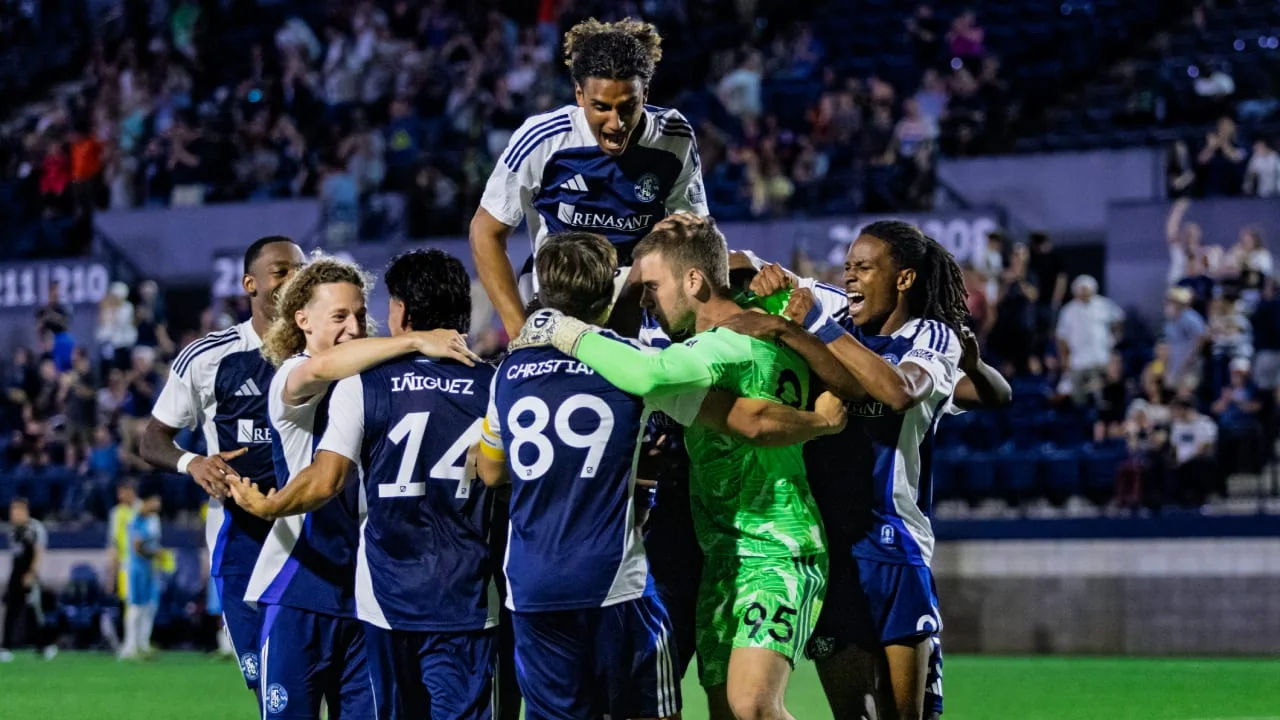
Each play-in is one elimination match hosted by the eighth-place team. On October 11, Red Bull New York II host Huntsville at MSU Soccer Park, with a 5 p.m. Eastern kickoff confirmed by the club announcement. San Jose host Tacoma at PayPal Park at 5 p.m. Pacific, which is 8 p.m. Eastern.
The Eastern game is a rematch of Decision Day, when Huntsville won 2-1 at the same venue. That previous result explains the appeal of the pairing, but supplies neither a head start nor an aggregate score. New York enter a fresh elimination match, and Huntsville must win again to advance.
Huntsville's late-season profile supplies a more useful reason to watch than its ninth seed alone: five wins in the last six regular-season games, with Zidane Yáñez scoring six times in his last four. Those are indicators of the side's recent form, not a promise that the run will continue.
Why a draw cannot leave both teams alive
There is only one available quarterfinal berth in each play-in. The match must produce an advancing winner; a tied score cannot send both clubs through, and there is no second leg to complete a series.
Read historical scores carefully when judging the Western pairing. San Jose's club preview records a 0-0 draw followed by a 4-1 Tacoma shootout win on March 14, then Tacoma's 1-0 and 2-1 victories on July 12 and September 5. The March shootout tally is separate from the match's goal score. Calling that game a 4-1 regulation victory would misrepresent the series.
The current play-in announcements establish single elimination without detailing their tied-match timing procedure. They should not be supplemented with first-team MLS Wild Card rules or an old NEXT Pro competition manual. When following the live event, check the official match coverage for the applicable procedure and record any shootout tally separately from the game score. Advancement, rather than regular-season points allocation, is the decisive information.
Pick your opponent: how the first two rounds are built
Pick-your-opponent gives eligible high seeds a choice within a defined pool. It does not let a club choose any team in the league, cross conferences or change the hosting rules. The bracket becomes clearer when selection rights and eligible opponents are tracked separately.
Conference quarterfinal selections
Seeds one, two and three choose from seeds five through eight. Seed four hosts the remaining lower-seeded club. A high seed's advantage therefore includes a choice as well as a home match, while the fourth seed receives a home match without choosing its opponent.
The September 23 selections took place before the play-ins. Clubs could select the eventual winner of the eighth-versus-ninth game, even though that winner's identity was not known. The choice was a bracket position with two possible occupants. Completing a bracket at that stage meant preserving the placeholder, rather than waiting to announce all eight quarterfinal pairings again.
One actual choice illustrates the consequence for a club without selection rights: Ventura County selected MNUFC2, leaving Houston to host LAFC 2. That pairing emerged from the choices already made. It was not a separate Houston selection.
There may be tactical reasons for preferring one eligible opponent, such as playing style, recent availability or familiarity. Those possible considerations should be treated as analysis unless a club representative explains its decision. A chosen opponent is not officially labeled the weakest side, and selecting it does not provide evidence that the match will be easy.
Conference semifinal selections
Once four clubs remain in a conference, the highest surviving seed chooses and hosts one of the two lowest surviving seeds. The other two clubs meet with the higher seed hosting. The U.S. Soccer format explainer confirms this second selection stage.
Consider a hypothetical field of seeds one, three, five and eight. Seed one may choose five or eight; it cannot choose three. If it chooses five, three hosts eight. If it chooses eight, three hosts five. Those examples explain the rule and do not predict which 2026 clubs will advance.
Now imagine seeds three, four, six and eight survive instead. Seed three becomes the highest remaining seed and may choose six or eight. Seed four hosts whichever lower seed remains. The selection right follows the best seed still alive; it does not disappear simply because the original first seed has been eliminated.
Keep each survivor's original postseason seed when applying this rule. Renumbering four surviving clubs as a fresh one-to-four table would obscure which club earned the right to select and host. The quarterfinal result determines who remains, then the selection announcement determines the semifinal pairings. A result page and a selection page answer different questions.
The confirmed 2026 matchups and results checkpoint
At the results checkpoint of October 11, 2026, 14:00 UTC, both play-ins were still scheduled. That cutoff is seven hours before the Eastern match's advertised kickoff. No play-in winner or 2026 postseason score is recorded here. A blank winner position means the deciding game has not been completed at this checkpoint.
The confirmed quarterfinal schedule below uses Eastern Time throughout. The home team is listed first. “Play-in winner” is an official selection placeholder, rather than a prediction.
| Date | Conference quarterfinal | Kickoff ET |
|---|---|---|
| October 16 | Atlanta United 2 vs CT United FC | 6 p.m. |
| October 16 | Portland Timbers2 vs St Louis CITY2 | 10 p.m. |
| October 16 | Ventura County FC vs MNUFC2 | 10 p.m. |
| October 17 | Columbus Crew 2 vs New England Revolution II | 3 p.m. |
| October 18 | Chattanooga FC vs New York City FC II | 5 p.m. |
| October 18 | Crown Legacy FC vs Eastern play-in winner | 7 p.m. |
| October 18 | Houston Dynamo 2 vs LAFC 2 | 7 p.m. |
| October 18 | Austin FC II vs Western play-in winner | 8:30 p.m. |
Atlanta's kickoff is 6 p.m. Eastern, as explicitly listed in the official club announcement of the Eastern quarterfinals. The older league-wide selection release still shows TBA for that row, so its placeholder should not override the confirmed time. Recheck the match listing before making arrangements. The two Friday Western fixtures share the same advertised start, so neither should be treated as following the other in a sequential television window.
For later results, separate three fields: the match score, any decisive shootout score and the advancing club. A team appearing in an upcoming quarterfinal row is not proof that its play-in has finished. Likewise, a live score remains provisional until the official match status confirms completion. This distinction is especially useful for international readers whose local date has already moved to October 12 while the American match is still underway.
The road to MLS NEXT Pro Cup: dates, hosts and coverage
After the quarterfinals, the published round windows are October 23-25 for the conference semifinals, October 30-November 1 for the conference finals, and November 6-8 for MLS NEXT Pro Cup. These are scheduling windows, not a confirmation that each surviving club will play on the first day listed.
Two conference winners reach the Cup. There is no separate national semifinal between four clubs: the conference finals already reduce the field from four to two. This makes the sequence easy to follow even when the opponent-selection stage has rearranged the earlier pairings.
Who hosts the later rounds and the final
The higher surviving conference seed hosts its conference final. The Cup uses a different comparison: the finalist with the higher regular-season points total hosts. Conference seeds cannot alone decide a match between Eastern and Western clubs because each seed belongs to a separate table.
For example, a hypothetical Crown Legacy-Portland final would compare 58 points with 57, giving Crown the hosting advantage. A hypothetical Chattanooga-Portland final would compare 56 with 57, giving Portland the advantage even though both clubs were second seeds. These scenarios illustrate the points comparison and are not forecasts of the finalists.
Keep that rule separate from a team's form during the playoffs. Winning an away quarterfinal or producing a large semifinal victory does not add regular-season points to its hosting claim. Supporters considering travel should wait for the actual finalists and confirmed event details. A favorable potential route is not a confirmed home Cup fixture.
Where to follow the games
Official 2026 announcements list OneFootball and MLSNEXTPro.com for live coverage of all playoff matches and the Cup. Begin with the specific event on the league's playoff hub, where the matchup and competition can be checked together. Our MLS NEXT Pro viewing guide covers the broader access and replay process.
During the first two rounds, follow both the match coverage and the subsequent selection announcement. A completed quarterfinal tells you which club advances; it may not yet tell you which opponent that club will face. The second question is settled by the semifinal choice process.
When checking results from outside North America, preserve the advertised time zone and check the local calendar date. The fixture table here uses Eastern Time consistently, while individual clubs may advertise in their local zone. Keeping the competition, match status, original seed and time zone together is enough to follow the postseason without confusing a scheduled placeholder with a completed result.
Comments
Comments are reviewed before publication.
Spam, abusive content, personal information and policy-violating links are not published.
Sign in with Google to comment or reply.
Loading comments…