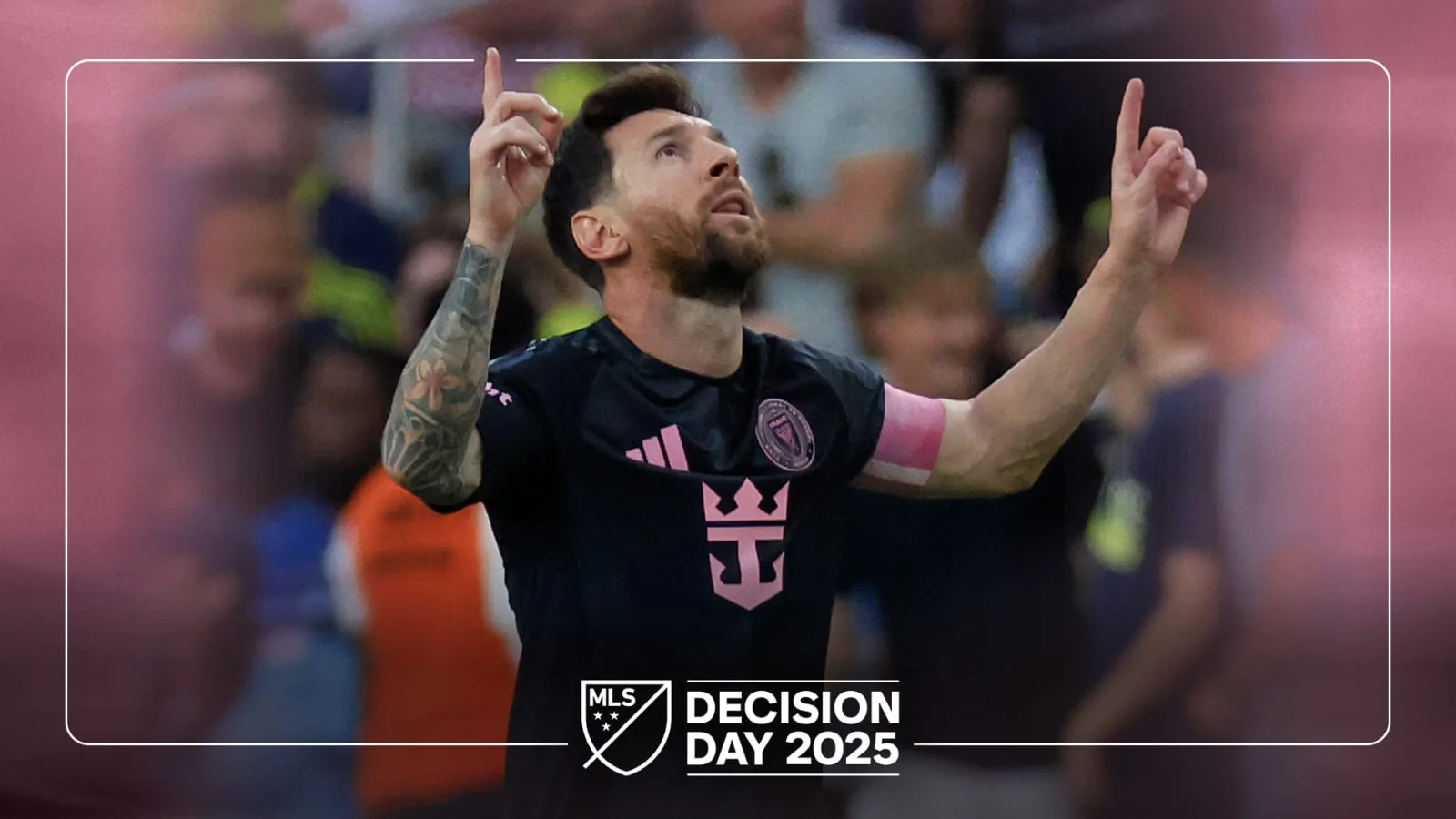
How many MLS goals did Messi score through 2025?
Lionel Messi scored 50 MLS regular-season goals for Inter Miami across the completed 2023, 2024 and 2025 seasons. Add his seven MLS Cup Playoffs goals, and the combined total is 57 through the MLS Cup final on December 6, 2025. These are completed-season figures, not a live total including 2026.
This completed-season archive explains why a search for Messi MLS goals can produce several different answers. A regular-season scoring list, a postseason profile and an Inter Miami all-competitions record measure different things. The numbers can all be correct while answering different questions.
| Season | Regular-season goals | Playoff goals | Combined MLS goals |
|---|---|---|---|
| 2023 | 1 | 0 | 1 |
| 2024 | 20 | 1 | 21 |
| 2025 | 29 | 6 | 35 |
| 2023–2025 total | 50 | 7 | 57 |
The combined column is an addition for this guide. It should not be inserted into a league table that counts only regular-season goals. Equally, the regular-season column should not be described as every competitive goal Messi scored in an Inter Miami shirt. His club also played in competitions outside MLS, including Leagues Cup and the Concacaf Champions Cup.
For a historical comparison with other league scorers, use the regular-season column alongside our MLS all-time top scorers guide. For an account of how he helped Miami win the championship, the playoff column deserves its own attention. Keeping the two visible is more informative than presenting an unexplained career number.
This archive uses a fixed finishing line so the underlying arithmetic remains reproducible. The 2026 season is outside its statistical scope; goals scored after December 6, 2025 do not silently enter the totals. When comparing this table with a newer player profile, first check the profile's season and competition filters. A higher figure on a later date is not, by itself, evidence that either table was wrong.
2023: why his first MLS season produced one league goal
His Inter Miami debut and MLS debut were different events
Messi joined Inter Miami in July 2023, but his first MLS regular-season appearance came on August 26 against the New York Red Bulls. By then, his arrival had already generated a tournament victory and a substantial collection of goals. Those earlier highlights belonged principally to Leagues Cup, which must be separated from the regular-season league record.
At Red Bull Arena, Messi entered as a substitute with Miami leading. His late combination with Benjamin Cremaschi produced the second goal in a 2-0 victory: Messi found Cremaschi, continued his movement and finished the return pass. That was his first MLS regular-season goal. It was not his first Inter Miami goal, and the distinction matters when searching for footage of his American debut.
By the end of his first Miami season, the club credited him with 11 goals across all competitions. Ten came in Leagues Cup. The remaining goal was the one at the Red Bulls, leaving a regular-season total of one. The spectacle of the summer tournament can make that league figure feel surprisingly small, but the explanation is competition classification rather than a missing set of league goals.
How to read the short first-season entry
The 2023 row should not be treated as a like-for-like test against a full league campaign. Messi arrived during the year, and the one-goal total belongs to his limited regular-season involvement after that arrival. A season table records what happened within a competition; it does not automatically describe how much of that competition the player was available to contest.
For supporters building a video playlist, the practical distinction is straightforward. Put the Red Bulls finish under MLS 2023. Place his Leagues Cup goals in a separate tournament group, even when the opponent was another MLS club. The identity of the opposing team does not decide which statistical column receives the goal.
This also explains why a headline about his first Miami trophy cannot be used as evidence of an MLS Cup win in 2023. Leagues Cup and MLS Cup have different tournaments, brackets and records. The one-goal regular-season entry is a narrow measurement of league scoring; the ten tournament goals describe a different and much more prolific part of the same opening chapter.
2024: 20 regular-season goals and a separate playoff goal
Scoring rate, the Supporters' Shield and the MVP award
Messi's first full MLS calendar year produced 20 regular-season goals in 19 appearances. He also recorded 16 assists, and Miami finished with 74 points to win the Supporters' Shield. His final league appearance of the campaign brought a hat trick in a 6-2 win over New England, giving the regular-season scoring row a memorable finish.
The appearance count is worth keeping beside the goals. Twenty divided by 19 gives roughly 1.05 goals per appearance. Using his 1,485 league minutes instead gives approximately 1.21 goals per 90 minutes. These are two different calculations: an appearance may be a substitute outing, while a per-90 rate adjusts the denominator for actual playing time. Neither means he scored in every match.
He won the 2024 MLS MVP award, but he did not win that season's Golden Boot. Christian Benteke finished with 23 regular-season goals to take the scoring award. That distinction helps separate an assessment of overall value from the simpler question of who accumulated the largest goal total.
The Atlanta playoff goal belongs in its own column
Miami's postseason ended against Atlanta United in Round One. Messi scored a header in the decisive third game, but Atlanta won 3-2 and advanced. His goal counts in his MLS Cup Playoffs record even though it came in a defeat and Miami did not progress to the next round.
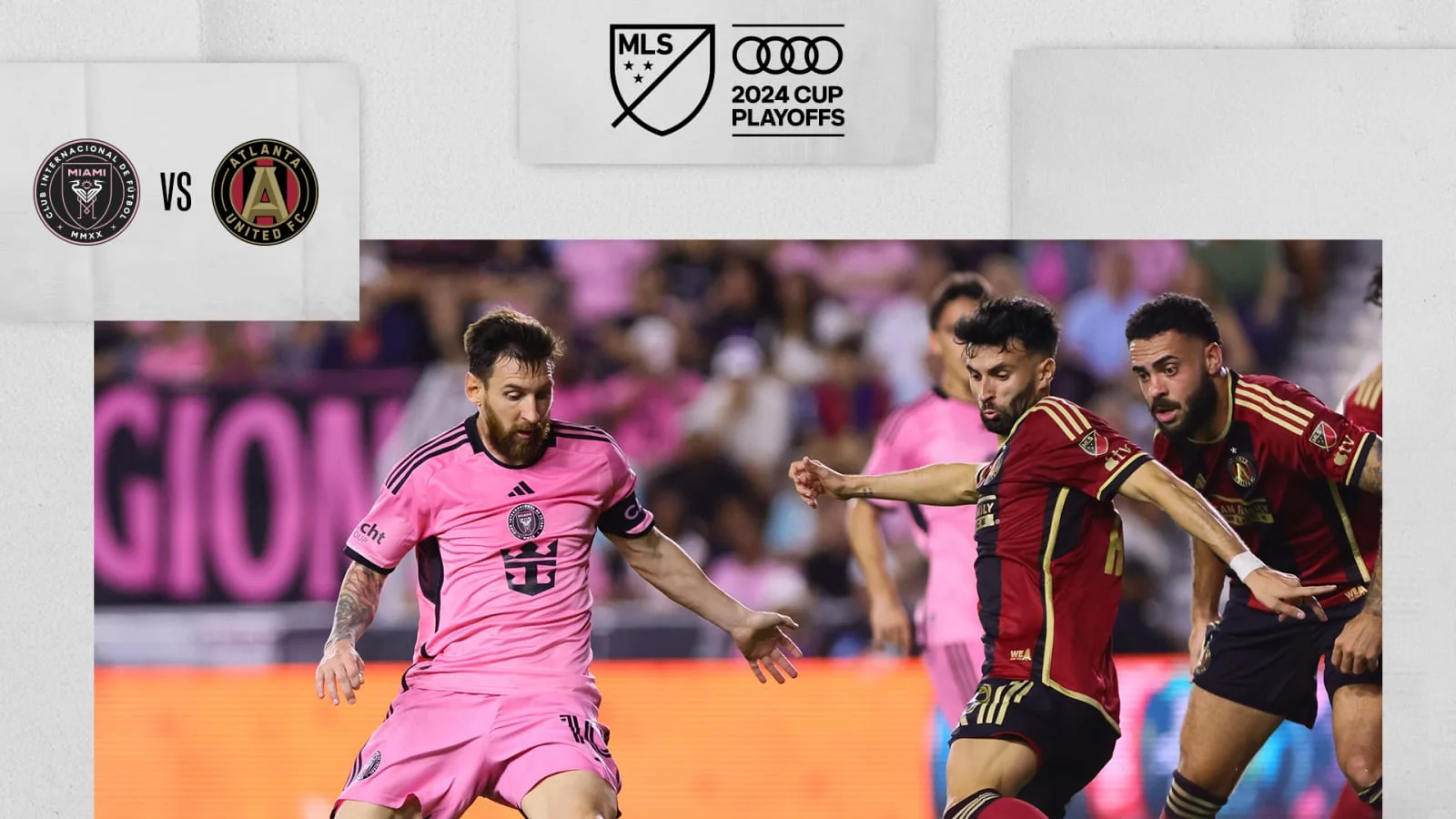
Inter Miami's season review records 21 goals for Messi across the regular season and playoffs combined. It also records 23 across all competitions. Those figures reconcile cleanly: 20 regular-season goals plus one playoff goal make 21 MLS goals; the club-wide total includes two further goals outside those MLS competitions.
For a comparison with the 2025 Golden Boot race, retain the figure of 20. For a comparison of his entire MLS involvement in each year, use 21 and clearly label the inclusion of playoffs. The disappointing ending against Atlanta changes the sporting story of 2024, but it does not erase his regular-season production or move the postseason header into the Golden Boot calculation.
2025: the 29-goal Golden Boot season
More appearances produced a larger season total
Messi finished the 2025 regular season with 29 goals in 28 appearances, winning his first MLS Golden Boot. Compared with 2024, he played in nine more league matches and scored nine more goals. The larger total reflected both sustained scoring and a larger body of league appearances.
His goals-per-appearance rate was approximately 1.04, close to the previous year's 1.05. Over 2,420 minutes, his rate was about 1.08 goals per 90 minutes. The distinction is useful when assessing improvement: his total increased substantially, while his scoring frequency remained at a similarly exceptional level rather than suddenly doubling.
These calculations also prevent a misleading comparison between a player's appearances and his club's schedule. Dividing his goals by every Miami match would describe scoring across team fixtures, including games in which he did not play. Dividing by his own appearances answers how productive he was when involved. A careful comparison identifies which question it is asking before choosing the denominator.
Decision Day settled the Golden Boot race
Messi closed the regular season with a hat trick in Miami's 5-2 win at Nashville. Sam Surridge and Denis Bouanga each finished with 24 goals, leaving Messi five ahead. The finale therefore settled the race with a clear goals advantage, rather than requiring an assists or minutes tiebreaker.
His regular-season total included one penalty goal, scored on Decision Day. The other 28 were non-penalty goals. That category should be read literally: removing penalty kicks does not automatically mean every remaining finish came from open play, because free kicks and other set-piece situations are separate descriptions of how a goal develops.
MLS also credited Messi with ten multi-goal regular-season games in 2025. That gives a different view of the campaign from the overall total: repeated braces and the closing hat trick explain how his scoring accumulated. A season average smooths those bursts into a single rate, while individual match records preserve the uneven pattern that supporters actually watched.
The year eventually brought a second consecutive MLS MVP award as well. That recognition belongs beside the Golden Boot as part of his season's achievements, but it is not an extra statistical competition. His regular-season goals remain 29 whether a profile is discussing the award, the scoring race or Miami's broader championship campaign. The postseason added its own goals after that regular-season figure had been settled.
Messi MLS playoff goals: seven through the 2025 final
The scoring route to Miami's first MLS Cup
Messi entered the 2025 postseason with one MLS playoff goal from the previous year. He added six during Miami's championship run, taking his completed-season playoff total to seven. Five of those six came against Nashville in the Round One series; the other came in the Eastern Conference Semifinal against Cincinnati.
Nashville pushed Miami to a third game, so the series was a substantial part of his postseason scoring opportunity. Messi's production helped Miami survive the round that had ended its campaign a year earlier. Against Cincinnati, he added a goal and three assists as Miami won 4-0 away from home.
His scoring stopped there, but his contribution did not. Miami beat New York City FC 5-1 in the Eastern Conference Final and then Vancouver 3-1 in MLS Cup. Messi did not score in either match. He finished the final with two assists and was named MLS Cup MVP, demonstrating why the individual award cannot be inferred simply from the final's goals column.
Goals and assists answer different questions
At the end of the 2025 playoffs, MLS credited Messi with six goals and nine assists, a total of 15 goal contributions. It is important to preserve those labels. Fifteen was not his postseason goal total, and the nine assists should not be added to a goal-scoring leaderboard.
The same care applies when reading an article published before the final. A pre-final total omits the two assists he recorded against Vancouver. It may accurately describe his position at that earlier moment, but it is not a final postseason summary. Publication dates and the last included match matter even after a tournament is over.
Across the 2025 regular season and playoffs, his goal total was 35: the 29 that won the Golden Boot plus six postseason goals. That combined figure is useful for describing the scale of his MLS year. It does not mean he scored 35 in the competition phase used to award the Golden Boot.
For team context, use the MLS playoffs page to follow the current postseason picture and treat this section as a historical record of the completed 2025 run. A player can score in a losing playoff match, as Messi did against Atlanta in 2024, or help decide a winning final without scoring, as he did against Vancouver. The goal ledger and the story of advancement are complementary records.
Why Messi's Inter Miami total is higher than his MLS total
A competition-by-competition ledger for 2025
The cleanest example is the completed 2025 season. Messi scored 43 competitive goals for Inter Miami across all competitions. Of those, 35 came in the MLS regular season and playoffs combined. The remaining eight came in three other tournaments, which explains the difference without changing any of the underlying match records.
| Competition | Goals | Included in MLS regular-season total? |
|---|---|---|
| MLS regular season | 29 | Yes |
| MLS Cup Playoffs | 6 | No |
| Concacaf Champions Cup | 5 | No |
| Leagues Cup | 2 | No |
| FIFA Club World Cup | 1 | No |
| All competitive Inter Miami matches in 2025 | 43 | Only 29 qualify |
A club's nationality does not determine a competition's statistical identity. A match played by Inter Miami can belong to a domestic league, a regional tournament or a global club competition. Likewise, facing another MLS team in Leagues Cup does not turn that match into an MLS regular-season fixture.
The distinction becomes especially useful when comparing Messi with a player whose club played fewer tournaments. An all-competitions total may reflect a different number and range of matches. That does not make the total invalid, but it requires an explanation before it is used to judge which league campaign was stronger.
Shootouts, friendlies and Argentina stay separate
A penalty scored during the match counts as a goal in that match's competition. A successful attempt in a penalty shootout is recorded separately and does not increase the player's ordinary goal total. When a highlight package contains both, counting every successful kick as another career goal will inflate the result.
Friendly matches also need an explicit label. A preseason goal may be interesting to supporters following form and fitness, but it does not belong in the competitive league table above. The same applies to exhibition events: the shirt and the player may be familiar, while the statistical category is different.
Argentina goals are national-team goals. They should not be added to Messi's Inter Miami club total, even when scored during a calendar year in which he was an MLS player. For a complete personal career count, club and national-team records can be combined with clear rules; for this article's league question, they remain outside the ledger.
When a headline supplies a large number without specifying the competition, look for the accompanying breakdown before comparing it with these tables. The labels are part of the answer. In the completed 2025 season, 29, 35 and 43 each describe a valid total, but they are not interchangeable.
How to compare and update Messi's scoring record
Use matching dates, competitions and denominators
A useful scoring comparison begins with the filters, not the ranking. Decide whether the question concerns a regular season, a playoff run, a club season across all competitions or an entire career. Then use the same definition for both players. Comparing Messi's combined league-and-playoff number with another player's regular-season total gives one side extra matches.
Next, align the dates. A completed December season record and a September snapshot describe different stretches of football. If the purpose is to compare scoring races at the same stage, use a shared cutoff and show appearances or minutes. If the purpose is historical achievement, use completed seasons and keep their lengths visible.
Finally, name the metric. Total goals reward accumulated production. Goals per appearance show output across the matches a player entered. Goals per 90 minutes adjust for playing time, but they still do not describe the difficulty or quality of every chance. No single column answers every question about a forward's performance.
- Select the season and the MLS regular-season competition on Messi's official MLS statistics page.
- Confirm the last completed match included in the displayed record.
- Record goals together with appearances and minutes, keeping assists in their own column.
- Switch to the playoff competition separately if the question includes postseason scoring.
- Add the subtotals only after assigning a clear label to the combined result.
What this completed-season archive answers
This guide answers how Messi's MLS scoring developed from his arrival through the end of 2025. It supplies the season rows, the playoff subtotal and a detailed explanation of the larger club number. It does not report his live 2026 tally or predict where he will finish among the league's career leaders.
For ongoing league context, check the MLS standings and the dated 2026 top scorers and assists guide. Read each page's update information before using it in a current comparison. A scoring table is only as current as the last match incorporated into it.
If two players are tied in the MLS Golden Boot race, the official award rules use assists and then fewer minutes played as tiebreakers. That is another reason to avoid sorting a tied goals list by an unrelated statistic or assuming that alphabetical order identifies the winner. The scoring total provides the starting point; the competition's rules determine how a tied award race is resolved.
For sharing the historical number accurately, include the scope in the sentence: Messi scored 50 regular-season MLS goals through 2025, or 57 when his playoff goals are added. That small qualification lets the next reader reproduce the answer instead of wondering which matches disappeared between one statistics page and another.
Comments
Comments are reviewed before publication.
Spam, abusive content, personal information and policy-violating links are not published.
Sign in with Google to comment or reply.
Loading comments…