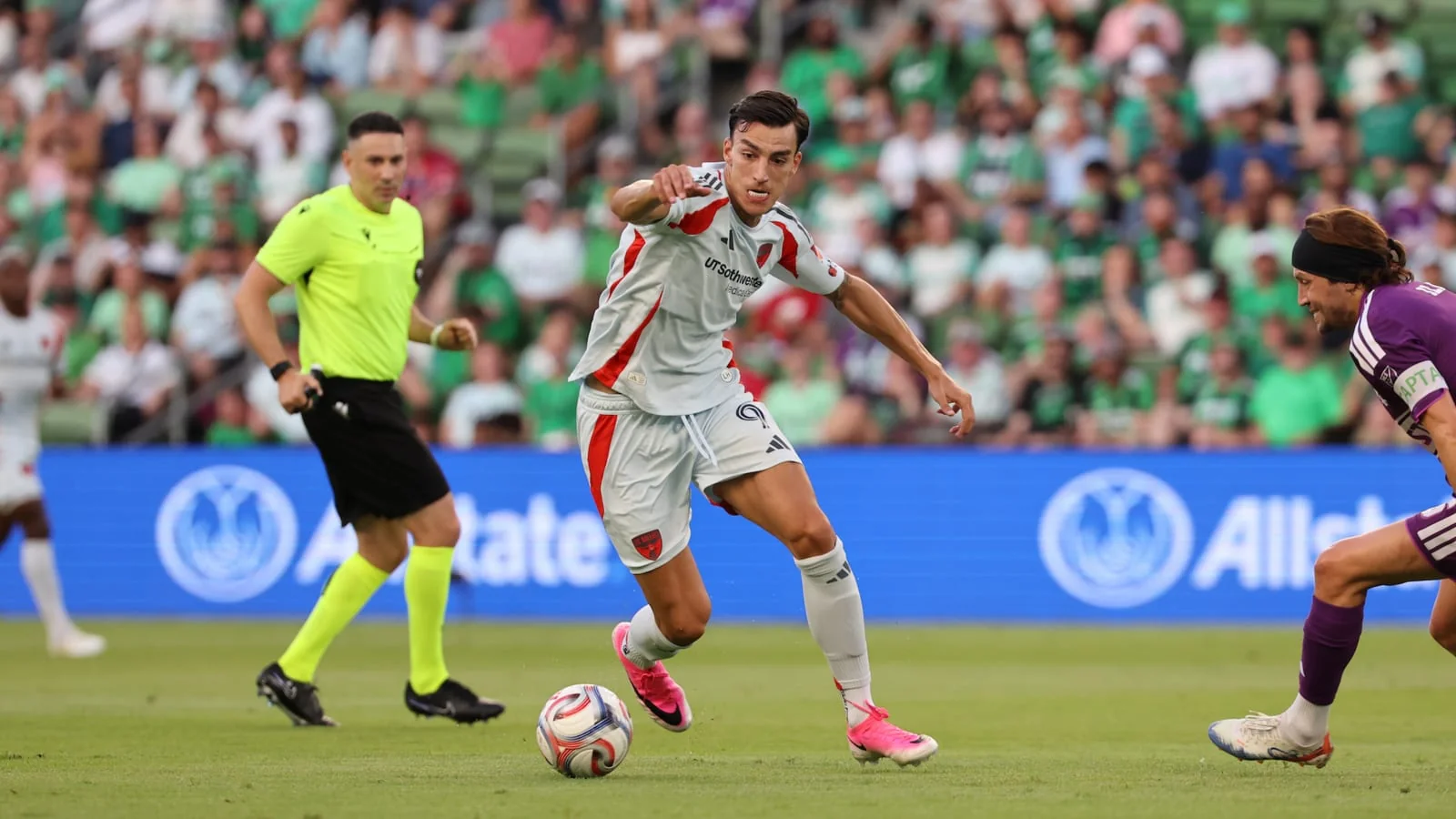
Who Leads MLS in Goals Right Now?
Updated August 19, 2026: Petar Musa leads the MLS Golden Boot race with 14 regular-season goals for FC Dallas. Nicolás Fernández of New York City FC and Chicago Fire FC's Hugo Cuypers are next on 13. This is a completed-match snapshot, not a prediction that Musa will finish first.
The cutoff matters because MLS still had games waiting to be played when the data was retrieved. The official schedule feed's latest completed record was Vancouver Whitecaps FC's 2-0 win at Seattle Sounders FC, a Matchday 20 game that kicked off August 16 at 10:30 p.m. ET, or August 17 at 02:30 UTC. Seven fixtures dated August 19 remained marked “scheduled,” so their future goals and assists are not in these tables.
Every number here covers the 2026 MLS regular season only. Leagues Cup, the FIFA World Cup, national-team matches, friendlies and any other competition are excluded. That distinction is especially important in a season interrupted by the World Cup pause: a player may have competed elsewhere without adding anything to his MLS total.
The figures come from the first-party player feed used by the official MLS Player Stats page. The query is locked to the MLS regular-season competition and the 2026 season. It returns goals, official assists, matches played and normalized minutes, allowing tied scorers to be ordered by the league's rules rather than by name or an unexplained widget order.
This page is an editorial checkpoint rather than an auto-refreshing leaderboard. Once another match reaches final whistle—or if MLS corrects a statistic—the official page can move ahead of this August 19 snapshot. Readers checking after the cutoff can first see which fixtures have been completed on our MLS games today page, then use the official player table for the newest individual totals.
The immediate answer nevertheless is clear: Musa has the most goals in completed league play at this cutoff. What remains open is the race behind him and whether his lead reflects the best scoring rate. The full table adds assists and minutes so those two questions do not get confused.
2026 MLS Golden Boot Standings
The Golden Boot is a goals award, not a combined goals-and-assists prize. MLS uses assists only when two or more players finish level on goals; if the assist totals are also tied, the player with fewer regular-season minutes ranks higher. The table applies that sequence to the August 19 snapshot. Goals per 90 is included for analysis but does not decide the award.
| GB rank | Player | Club | MP | Min | G | A | G/90 |
|---|---|---|---|---|---|---|---|
| 1 | Petar Musa | FC Dallas | 17 | 1,338 | 14 | 2 | 0.94 |
| 2 | Nicolás Fernández | New York City FC | 18 | 1,594 | 13 | 4 | 0.73 |
| 3 | Hugo Cuypers | Chicago Fire FC | 11 | 989 | 13 | 2 | 1.18 |
| 4 | Leo Messi | Inter Miami CF | 16 | 1,370 | 12 | 8 | 0.79 |
| 5 | Guilherme Santos | Houston Dynamo FC | 19 | 1,606 | 12 | 7 | 0.67 |
| 6 | Sam Surridge | Nashville SC | 13 | 908 | 12 | 0 | 1.19 |
| 7 | Tai Baribo | D.C. United | 16 | 1,284 | 12 | 0 | 0.84 |
| 8 | Evander | FC Cincinnati | 18 | 1,469 | 11 | 11 | 0.67 |
| 9 | Prince Owusu | CF Montréal | 18 | 1,451 | 11 | 5 | 0.68 |
| 10 | Marcus Ingvartsen | San Diego FC | 19 | 1,445 | 11 | 4 | 0.69 |
| 11 | Kévin Denkey | FC Cincinnati | 18 | 1,507 | 11 | 4 | 0.66 |
| 12 | Preston Judd | San Jose Earthquakes | 18 | 1,460 | 11 | 3 | 0.68 |
| 13 | Martín Ojeda | Orlando City SC | 15 | 1,315 | 11 | 1 | 0.75 |
| 14 | Denis Bouanga | Los Angeles FC | 19 | 1,639 | 10 | 7 | 0.55 |
| 15 | Pep Biel | Charlotte FC | 19 | 1,664 | 10 | 7 | 0.54 |
| 16 | Luis Suárez | Inter Miami CF | 15 | 973 | 10 | 6 | 0.92 |
| 17 | Rafael Navarro | Colorado Rapids | 19 | 1,704 | 10 | 4 | 0.53 |
| 18 | Milan Iloski | Philadelphia Union | 19 | 1,563 | 10 | 3 | 0.58 |
| 19 | Brian White | Vancouver Whitecaps FC | 17 | 1,451 | 10 | 2 | 0.62 |
The assists column materially changes several tied groups. Fernández is second because his four assists put him ahead of Cuypers' two at 13 goals. Messi leads the 12-goal quartet with eight assists, followed by Guilherme with seven. Surridge and Baribo both have zero, so Surridge's 908 minutes place him ahead of Baribo's 1,284.
The same logic continues down the list. Evander's 11 assists lift him to the top of the six-player group on 11 goals. Ingvartsen and Denkey each have four assists, making minutes the separator: 1,445 against 1,507. At 10 goals, Bouanga and Biel both have seven assists, and Bouanga's smaller minute total earns the higher position.
Those tiebreak positions are provisional because goals remain the first column that matters. One new goal lets a player jump every rival who remains behind on goals, regardless of how wide the assist gap had been. Conversely, an assist can change the order within a tied-goal group without changing anyone's goal total.
The cutoff also creates uneven samples. Cuypers has played 989 minutes, while Navarro has logged 1,704; Surridge has nine starts, while several players have started 19 matches. MLS does not normalize the Golden Boot by opportunity. The award recognizes the largest goal total, with rate statistics helping readers judge how that total was produced.
No “winner” label belongs beside any name yet. These ranks describe the race after completed Matchday 20 records in the feed. They are useful precisely because the ordering method and sample sizes are visible, rather than hidden behind a list that can become stale after the next final whistle.
Why Petar Musa Leads — and Who Has the Best Scoring Rate
Musa's advantage is the simplest one: he has scored 14 times, one more than Fernández and Cuypers. He reached that total across 17 appearances, 15 starts and 1,338 normalized minutes. His 0.94 goals per 90 is excellent, but it is not the fastest rate among the contenders. The Golden Boot rewards the largest total, not the highest rate.
The FC Dallas striker has combined a substantial workload with steady shot production. The official feed credits him with 63 shots and 30 on target. Fourteen goals from 63 attempts produce the feed's rounded 22% conversion rate, while his goal total works out to one every 96 minutes. Those measures explain different parts of the record: volume shows how often he shoots, conversion shows how often an attempt becomes a goal, and minutes per goal relates scoring to time on the field.
Cuypers offers the clearest rate comparison. His 13 goals came in only 989 minutes, equal to 1.18 per 90 and one approximately every 76 minutes. He has 47 shots, 24 on target and a 28% conversion rate. That is a faster scoring rhythm than Musa's, yet Cuypers remains one goal behind because he has played six fewer matches and 349 fewer minutes at this cutoff.
Surridge is even marginally ahead on the rounded rate: 12 goals in 908 minutes equals 1.19 per 90. His feed conversion rate is 44%, based on 12 goals from 27 shots, and 18 of those attempts were on target. The small difference between his and Cuypers' minutes-per-goal figures disappears when both are rounded to 76, which is why the two-decimal G/90 column is more informative here.
None of these comparisons turns rate into an alternate Golden Boot table. Surridge cannot pass Musa without adding goals, and Cuypers' faster pace does not count as a tiebreak while their goal totals differ. Conversely, Musa's larger total does not prove he has been the most efficient finisher in every statistical sense.
Shot conversion in this table is also descriptive rather than a complete finishing model. It does not separate penalties, shot location, expected goals, opponent strength or game state. The useful reading is narrower: Musa leads the actual award race; Cuypers and Surridge have scored faster in their current minutes; and the samples are different enough that both totals and rates belong in the discussion.
Messi and the Chasing Pack
Messi is not the 2026 MLS goals leader at this cutoff. He ranks fourth in the Golden Boot order with 12 goals because Musa has 14 and both Fernández and Cuypers have 13. Within the four-player group on 12, however, Messi's eight assists put him first. Guilherme follows with seven, while Surridge and Baribo have zero.
The minutes tiebreak separates the last two. Surridge has played 908 normalized minutes, compared with Baribo's 1,284, so Surridge ranks sixth and Baribo seventh after their goal and assist totals remain level. That position does not mean MLS adjusts everyone's goals to a common playing-time sample; minutes enter only after goals and assists are tied.
Messi's underlying line looks different from that of a low-volume finisher. The official feed records 100 shots and 40 on target in 1,370 minutes, by far the largest shot total among the players on at least 10 goals. His feed conversion rate is 12%. The combination says he is generating and taking many attempts, not that a goal on his next shot is predictable.
Guilherme has reached the same 12 goals from 56 shots, with 26 on target and a 21% conversion rate across 1,606 minutes. Surridge's 12 goals came from 27 shots and the highest displayed conversion rate in this group, 44%. Baribo has 36 shots and a 33% rate. These are useful descriptions of how the tied total was assembled, but they do not override the league's assist-first tiebreak.
The dated official tracker published when MLS resumed after the World Cup pause illustrates why current retrieval matters. That checkpoint had Cuypers on 13 goals, Messi and Musa on 12. The August feed now places Musa on 14 while Messi remains on 12. Preseason picks and the July order are valuable historical markers, but neither can stand in for the latest completed-match data.
Evander sits one goal below this group yet leads a broader production measure. His 11 goals and 11 official assists equal 22 combined contributions, ahead of Messi's 20 and Guilherme's 19. That makes Evander central to the season's attacking story and puts him eighth in the Golden Boot table through the assist tiebreak. It does not make him the Golden Boot leader, because the award starts and ends with the goals column before any tie is considered.
The chase is therefore close without being interchangeable. Messi has the strongest tiebreak position among the 12-goal players, Guilherme is immediately behind him, Surridge has the fastest current rate, and Evander leads G+A. Each statement answers a different question; none predicts who will hold the trophy after the remaining regular-season matches.
2026 MLS Assist Leaders
Evander leads the official assist table with 11, one ahead of Son Heung-Min. Anders Dreyer and Cristian Espinoza share third on nine, while five players have eight. These totals use the MLS convention that can credit both a primary and a secondary assist on the same goal, not a primary-assist-only definition borrowed from another league or data provider.
| Player | Club | MP | Min | G | A | A/90 | G+A |
|---|---|---|---|---|---|---|---|
| Evander | FC Cincinnati | 18 | 1,469 | 11 | 11 | 0.67 | 22 |
| Son Heung-Min | Los Angeles FC | 18 | 1,456 | 4 | 10 | 0.62 | 14 |
| Anders Dreyer | San Diego FC | 19 | 1,643 | 8 | 9 | 0.49 | 17 |
| Cristian Espinoza | Nashville SC | 15 | 1,065 | 3 | 9 | 0.76 | 12 |
| Leo Messi | Inter Miami CF | 16 | 1,370 | 12 | 8 | 0.53 | 20 |
| Philip Zinckernagel | Chicago Fire FC | 18 | 1,445 | 5 | 8 | 0.50 | 13 |
| Rodrigo De Paul | Inter Miami CF | 15 | 1,350 | 4 | 8 | 0.53 | 12 |
| Telasco Segovia | Inter Miami CF | 17 | 1,398 | 3 | 8 | 0.52 | 11 |
| Iván Angulo | Orlando City SC | 19 | 1,638 | 1 | 8 | 0.44 | 9 |
Evander's lead is part of an unusually balanced attacking line. He has also scored 11 times, so his 22 goals plus assists are the highest total in the frozen feed. His 11 assists across 1,469 minutes equal 0.67 per 90. That combination explains why he can be eighth in the Golden Boot order—where goals come first—yet first when goals and official assists are simply added.

Son has 10 assists in 1,456 minutes, a rate of 0.62 per 90, but only four goals. Dreyer has contributed eight goals alongside nine assists, giving him 17 combined contributions. Espinoza also has nine assists; his 0.76 assists per 90 is higher than the three players above him because his total comes in 1,065 minutes. Rate clarifies the smaller sample but does not convert nine assists into more than Son's 10 or Evander's 11.
The five-player group on eight shows different creative profiles. Messi pairs his eight assists with 12 goals and 20 combined contributions. Zinckernagel has five goals, De Paul four, Segovia three and Angulo one. Inter Miami placing Messi, De Paul and Segovia in the same assist tier suggests that the recorded final passes are distributed across several players; it does not identify who created every unconverted chance.
Another 12 players sit one step back on seven assists: Guilherme, Denis Bouanga, Pep Biel, Sebastian Berhalter, Timo Werner, Pavel Bucha, Maren Haile-Selassie, Emil Forsberg, Niko Tsakiris, Cade Cowell, Joaquín Pereyra and David Da Costa. Werner's seven came in only 799 minutes, producing 0.79 per 90, but the smaller denominator makes his rate less established than a similar pace over a full-season workload.
Assist totals require more caution than goals. A scorer must finish the move, the official scorer decides whether a pass earns credit, and MLS permits a secondary helper when the buildup merits one. A/90 therefore describes credited assists per minute; it is not identical to expected assists, chances created or passing quality. Corrections can also move a total after live scoring.
This table is separate from the Golden Boot standings. An assist may settle a tie between equal goalscorers, but there is no mechanism by which 11 assists erase a one-goal deficit. Read the assist leaders as the current creative-production race and the goals table as the award race.
How to Read and Update This Race
Start with the question you are trying to answer. “Who would win the Golden Boot today?” requires the league's award order. “Who has scored fastest?” requires a rate. “Who has produced the most goals and assists?” requires a combined column. Mixing those questions creates confident-sounding but incorrect rankings.
- Read goals first. The highest regular-season total leads the Golden Boot race.
- Use assists only for tied goals. A large assist total cannot erase a one-goal deficit.
- Use fewer minutes only after goals and assists are tied. Minutes are the second tiebreaker, not a universal handicap.
- Check MP, minutes and per-90 rates for context. They show workload and scoring or assisting frequency without changing the award order.
- Check the cutoff. A table dated before the latest final whistle may already be stale.
The competition boundary is just as important. These tables count the MLS regular season. A goal in Leagues Cup, an international match, a friendly or the playoffs belongs to that competition, not this Golden Boot total. Likewise, the 2026 race is a single-season question. It is different from an all-time career scorers list, where longevity and totals across many MLS seasons are the point.
For club context, use the MLS standings; they show team points and conference position, not player award order. For the match context after this article's cutoff, check MLS games today. A completed fixture can change both pages' stories, but a club's place in the table does not directly determine its player's Golden Boot rank.
A proper editorial refresh has five steps. First, inspect the official schedule feed and identify the newest match marked final whistle. Second, refetch the 2026 regular-season goals feed. Third, refetch the official primary-plus-secondary assist feed. Fourth, sort goals, assists and fewer minutes in sequence, then recompute G/90 and A/90 from normalized minutes. Finally, move both the visible update date and the named match cutoff.
The official MLS Player Stats page is the best destination for numbers after August 19. Even there, live scoring can be reviewed and corrected, so a postmatch total should not be treated as permanently frozen. This article intentionally preserves the inputs and method behind its snapshot rather than pretending to update itself.
That method also prevents false certainty. Current G/90 can rise or fall with the next appearance, and an assist can be added or removed after review. No rate in this article forecasts the remaining schedule, and no current position guarantees the final award. The defensible conclusion is limited but useful: Musa leads the completed-match snapshot, Evander leads assists, and every comparison is traceable to the stated cutoff.
Comments
Comments are reviewed before publication.
Spam, abusive content, personal information and policy-violating links are not published.
Sign in with Google to comment or reply.
Loading comments…