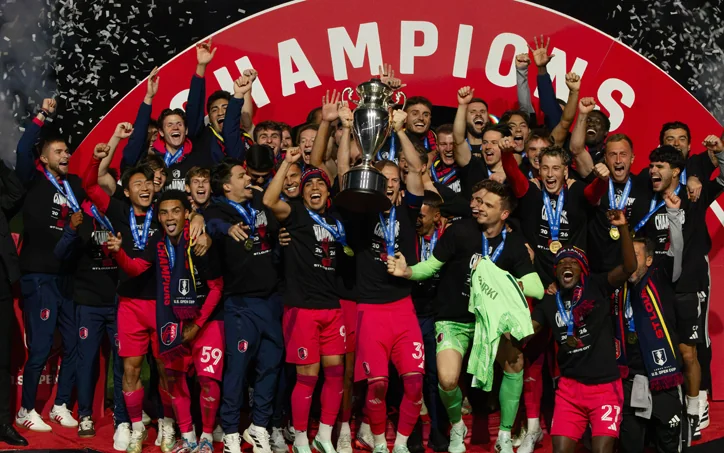
Updated October 28, 2026. St. Louis CITY SC has its first trophy. The 2026 U.S. Open Cup final ended scoreless after 120 minutes before CITY beat Columbus Crew 5–3 on penalties. Ben Lundt's emergency appearance and one decisive save helped turn a difficult away final into a championship night.
The final result: 0–0 after extra time, 5–3 on penalties
St. Louis CITY SC won the 2026 Lamar Hunt U.S. Open Cup on October 21, defeating Columbus Crew in a penalty shootout at ScottsMiracle-Gro Field in Columbus. The teams were level at 0–0 after regulation and extra time. St. Louis then won the shootout 5–3 to secure the first trophy in the club's history.
The two scorelines describe different parts of the evening. There were no goals during the 120 minutes of the match. The five St. Louis conversions and three Columbus conversions came afterward in the procedure used to determine the winner. Writing only that CITY won 5–3 can give a reader the false impression of an eight-goal final.
A clear record therefore reads 0–0 after extra time, with St. Louis winning 5–3 on penalties. That wording preserves both the goalless contest and the decisive outcome. It also explains how a team can keep a clean sheet in a final while a results display places several successful kicks beside its name.
The event happened on Wednesday night in the United States; many reports were published on October 22. The publication date does not move the match itself to Thursday. This matters when matching a news story to a fixture archive or searching for the correct replay.
It was also an away triumph. Columbus hosted the final, while St. Louis supporters traveled to watch their team compete for the cup. The subsequent trophy lift belongs to CITY's history, but it should not be confused with an MLS regular-season home win or a result that adds points to the league standings.
Why Ben Lundt replaced Roman Bürki
The goalkeeping change was forced by an injury to Roman Bürki, not a planned attempt to introduce a shootout specialist at the end of extra time. Bürki needed medical attention after a second-half collision, and Lundt entered in the 78th minute following the delay. The substitution changed the emotional setting of the final as well as the personnel on the field.
Lundt was replacing the club captain in a match that was still level and still had regulation time remaining. Extra time and penalties were possibilities, not outcomes already guaranteed. His first task was to help keep St. Louis in the game until the next whistle, then respond to whatever followed.
That sequence is important when the winning moment is reduced to a short highlight. The substitute goalkeeper did not appear only for Rodríguez's penalty. He had to settle into an away final, communicate with the defense and remain prepared through the rest of the match. The eventual save was the most memorable action, but the responsibility began well before the shootout.
A familiar emergency role from the quarterfinal
Lundt had already faced a comparable situation earlier in the cup run. In the quarterfinal against Houston Dynamo FC, he replaced an injured Bürki and later saved two penalties in the deciding shootout. TheCup.us's final report connects those two emergency appearances.
The earlier performance gave this final a recognizable subplot, but it did not make another successful shootout inevitable. An opponent changes, the takers change and the circumstances change. The useful connection is readiness: a player with fewer match minutes can still have a decisive role when the team suddenly needs him.
There is also a human element that should not disappear behind the sporting outcome. Celebrating Lundt's response does not require treating Bürki's injury as a fortunate tactical event. The team had to manage concern for an injured teammate while continuing to compete. Any later account of Bürki's condition or return should come from a current club update, rather than a prediction inferred from the celebration.
How St. Louis survived a final Columbus largely controlled
The final was not a story of St. Louis overwhelming the home side. Columbus led 11–1 in shots at halftime and finished with a 16–5 advantage in total attempts. CITY had to spend long periods preventing pressure from turning into a goal.
There is an important qualification inside those numbers: the official final statistics record three shots on target for each team. Sixteen attempts do not mean 16 saves, and an attempt blocked by a defender is different from a shot that reaches the goalkeeper. St. Louis's survival involved the backline as well as both goalkeepers.
That distinction helps explain why a match can feel tilted toward one team without producing a decisive score. Territory and repeated attacks can create pressure, but the final touch still matters. A defender who blocks an attempt or forces a shooter away from a clean angle can reduce the danger even when the attacking team keeps the ball nearby.
It would be equally misleading to turn the victory into proof that St. Louis controlled every important phase. The outcome tells us who won the cup. The match statistics and the contemporary accounts tell us that the winner had to withstand a difficult contest. Both statements can be true without diminishing the trophy or pretending the performance was effortless.
The challenge also changed as the evening continued. After the injury interruption and the remaining regulation minutes, the teams still had to play extra time before a shootout became available. CITY could not simply decide to stop defending because its substitute goalkeeper had a record of saving penalties.
For a replay viewer, watch the response after Columbus's first shot in an attack: who clears the rebound, who covers the next runner and whether the defense can move out together. Those actions explain the collective work behind a goalless score more clearly than the eventual shootout highlights alone. The winning save settled the final; the previous 120 minutes created the opportunity for it to matter.
The shootout, from the first save to the winning kick
Lundt stopped Columbus's first attempt, taken by Santiago Rodríguez, after Timo Baumgartl had put St. Louis ahead. That gave CITY an advantage it preserved for the rest of the shootout. It was one save, not a sequence of multiple stops in the final; the earlier Houston match is where Lundt made two shootout saves.
All five CITY takers scored
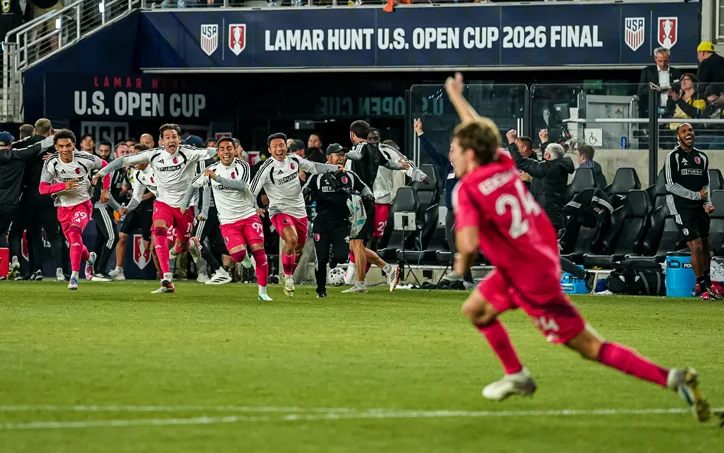
St. Louis's successful takers, in order, were Baumgartl, Lukas MacNaughton, Chris Durkin, Damion Downs and Daniel Edelman. Columbus converted its next three attempts through Malte Amundsen, Gonzalo Tapia and Andrés Herrera. Edelman then converted CITY's fifth to make the shootout score 5–3 and end the contest.
| Round | St. Louis attempt | Columbus attempt | Score after the round |
|---|---|---|---|
| 1 | Baumgartl scores | Rodríguez saved | CITY 1–0 |
| 2 | MacNaughton scores | Amundsen scores | CITY 2–1 |
| 3 | Durkin scores | Tapia scores | CITY 3–2 |
| 4 | Downs scores | Herrera scores | CITY 4–3 |
| 5 | Edelman scores | Not required | CITY wins 5–3 |
The takers' contribution is as important to the calculation as the goalkeeper's stop. A save creates an opening, but teammates still have to convert their own attempts to retain it. CITY's five successful kicks meant that one miss on the other side was enough.
Why Columbus did not take a fifth penalty
A shootout can finish before both teams take five kicks if the trailing side can no longer catch up. After Edelman's conversion, St. Louis had five goals from five attempts. Columbus had three from four, with only one of its initial five attempts left. Even a successful final kick could only have taken Columbus to four.
There was therefore no reason to continue: the winner was already determined. The unused kick was not a referee oversight, a forfeit or evidence that the shootout stopped early by mistake. It was the normal application of the mathematical stopping rule described in IFAB Law 10.
If Edelman had failed, Columbus would have had an opportunity to draw level at 4–4 with its fifth attempt. That is a hypothetical explanation of why his kick mattered, not an alternative account of what occurred. In the actual final he scored, so no sudden-death rounds were needed.
A first CITY trophy in a city with a long cup history
This was the first trophy for St. Louis CITY SC, not the first U.S. Open Cup won by a team from St. Louis. U.S. Soccer identifies it as the city's 11th title in the competition. The distinction connects a young MLS club with a history that began long before CITY existed.
Ben Millers won in 1920, and other local clubs added titles over the following decades. The most recent St. Louis winner before CITY was the 1988 Busch Seniors side. Those earlier honors belong to the clubs that earned them; they are part of the city's soccer tradition rather than trophies that can be added to CITY's own list.
That makes the occasion both a beginning and a return. CITY's supporters now have a first championship attached to their own team, while the tournament's history gains another St. Louis chapter. The long gap gives the city connection meaning without requiring the current organization to claim direct ownership of every earlier success.
The 2023 conference finish was a different achievement
CITY finished atop the Western Conference's regular-season standings in its inaugural 2023 MLS campaign. That was an important achievement, but it was not an MLS Cup victory or the national cup title won in this final. Calling the Open Cup the club's first trophy does not erase the significance of that opening season.
The 2026 breakthrough also came after a difficult start under Yoann Damet. MLS's contemporary reaction notes that CITY took six points from its first ten league matches before a major turnaround. The club later assembled a 21-match unbeaten run across all competitions, including 19 MLS matches. Those are historical stretches within the season, not a claim that the side remained unbeaten through every subsequent fixture.
A first cup title provides a different reference point from a promising debut or an impressive streak. It ends with the team completing a competition and lifting its trophy. Future squads can be measured against that concrete achievement, while the players involved retain their place as the first CITY group to do it.
What winning the cup brings beyond the trophy
The title earns St. Louis a place in the 2027 Concacaf Champions Cup. Concacaf's October 26 list of qualified clubs explicitly identifies CITY as the U.S. Open Cup winner. This is a confirmed berth, not a projection based on where the team might finish in the MLS table.
The continental organizer's qualification list describes a 27-club competition drawing teams from across North America, Central America and the Caribbean. CITY is returning to that tournament for the first time since 2024. The Open Cup route therefore gives the club a future international stage as well as a domestic title.
U.S. Soccer also lists a $600,000 winner's prize. That is the announced competition reward; it does not tell us how the organization will allocate the money or establish that a particular transfer will follow. A prize amount and a recruitment plan are different pieces of information.
Champions Cup qualification should also not be confused with direct qualification for the FIFA Club World Cup. Concacaf states that the 2027 continental champion will earn a place at the 2029 global tournament. CITY has earned entry to the continental competition, not already won it. Any further reward requires further results.
For supporters, the next planning step is the draw and the confirmed match schedule. The berth alone does not establish an opponent, a travel destination or a kickoff time. Waiting for those details prevents a qualified-clubs announcement from being mistaken for a complete itinerary.
The immediate benefit is nevertheless secure. A later league result cannot turn this particular Open Cup victory into a hypothetical achievement. St. Louis can compete for its remaining 2026 objectives with the knowledge that this trophy and the qualification earned through it are already part of the season's record.
What supporters should follow after the celebration
The first practical question is the current goalkeeping situation. Use the latest club and league availability information for each new match rather than assuming that an injured player has returned or that a cup hero is guaranteed to start. A final's lineup and a later league lineup answer different questions, and a memorable performance does not replace a current team announcement.
The same care applies to the rest of the squad after a 120-minute contest. Watch the actual selections and substitution patterns before drawing conclusions about the coach's plans. It is reasonable to ask how the staff distributes work across competitions; it is not reasonable to turn that question into an invented report about fatigue, a medical restriction or a predetermined rotation.
For fans following the bigger season, keep the competitions separate. The cup is complete, the remaining MLS campaign has its own standings and bracket, and the 2027 Champions Cup has its own draw and schedule. A celebration announcement, an MLS fixture and a continental qualification notice may all involve CITY while requiring different planning decisions.
If you want to revisit the final, a full replay offers more than a collection of penalty clips. Follow the first-half blocks and Bürki's saves, the injury interruption, Lundt's adjustment after entering and the passages of extra time before the shootout. That sequence makes the outcome easier to understand than beginning with the decisive kick and working backward from the trophy.
It also gives appropriate weight to the five takers. Lundt's save created the early advantage, but every CITY conversion kept Columbus from erasing it. Edelman supplied the final action, while the earlier kicks established the position from which it could finish the contest. The title belongs to the whole group rather than a single highlight.
What is already settled needs no prediction: St. Louis CITY completed its first trophy-winning campaign, earned a return to continental competition and added a new chapter to the city's long Open Cup record. The next results will determine what else this team can achieve. They will not change the identity of the club's first championship side.
Comments
Comments are reviewed before publication.
Spam, abusive content, personal information and policy-violating links are not published.
Sign in with Google to comment or reply.
Loading comments…