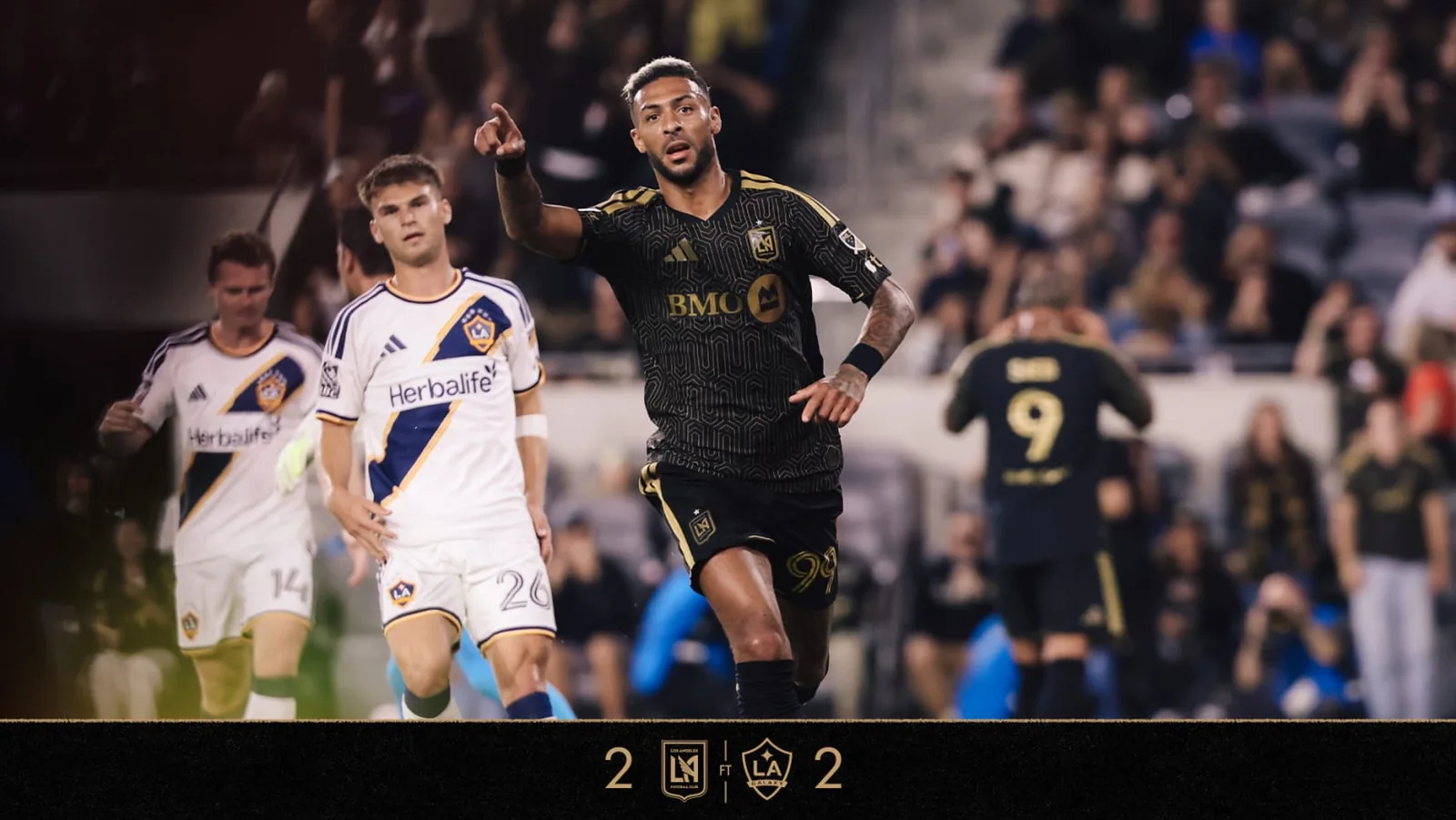
Updated October 28, 2026. The October 25 Los Angeles derby produced two disallowed LAFC finishes and a familiar offside argument: does a defender touching the ball make the attacker eligible? The answer depends on the type of defensive action and any earlier attacking involvement.
What happened to Son's goal against the Galaxy?
Son Heung-min put the ball in the net during the first half of LAFC's October 25, 2026 derby against the LA Galaxy, but the finish did not count. LAFC's official match report identifies Denis Bouanga's earlier offside as the reason. That distinction matters: the scorer's name in a no-goal notification does not necessarily identify the player who committed the infringement.
The sequence came in the 28th minute at BMO Stadium. Bouanga's attempt hit the crossbar and Son converted the rebound. The offside decision survived a lengthy video review. Later, Joseph Paintsil scored twice for the Galaxy before Bouanga and Leo Walta brought LAFC level. The game finished 2-2, and LAFC secured a playoff place.

The first task when watching this incident is to separate three questions. Who finished the move? Which attacking player was judged offside? What happened between the earlier pass and that player's involvement? Answering only the first question leaves out the part of the attack that officials actually penalized.
That also explains why a short clip beginning with the shot against the bar can be unsatisfactory. It shows the spectacular part of the move, but it may begin after the touch used to assess Bouanga's position. A freeze-frame of Son following up cannot settle a question about an earlier pass to somebody else.
Supporters understandably want a direct answer about whether the officials were right. The official recap confirms the outcome, but does not provide a complete technical explanation of the defender's touch or every attacker's influence. As of October 28, this guide has not located a published PRO assessment conclusively resolving those details. The useful approach is to explain the applicable tests and the evidence they require, while keeping that remaining uncertainty visible.
There was also a second disallowed LAFC finish near the end. It involved a different attacking sequence and a different offside player. Treating both as one Son offside controversy makes the debate harder to follow before the rules are even considered.
Why an earlier offside can cancel an onside finish
An attack is a sequence, rather than a single photograph of the player celebrating. To understand a canceled goal, work backward from the finish to the involvement being penalized. The relevant question may concern the player who took the previous shot, contested a clearance or affected a defender before the scorer received anything.
Position is assessed before the final shot
Under Law 11, position is normally assessed at the teammate's first contact when playing or touching the ball. An attacker must be in the opponents' half and beyond both the ball and the second-last opponent to occupy an offside position. Hands and arms are excluded, and being level is permitted. Position alone is not an offence; involvement must follow.
For a viewer, this means choosing the starting frame is as important as drawing a line. Pause too late and a runner may look clearly beyond the defensive line despite having timed the run legally. Pause at the shot rather than an earlier disputed involvement and the picture may answer an entirely different question. A beautiful, sharp still image can therefore be irrelevant even when nobody has edited it dishonestly.
The familiar phrase last defender can also confuse a replay discussion. The rule concerns opponents, not positions listed on a team sheet. A goalkeeper is often one of the two deepest opponents, but that is a circumstance of the play rather than a separate exemption. When the goalkeeper moves out, a viewer still needs to identify the correct second-last opponent and the ball.
The scorer and the offside offender can be different players
Consider a made-up attack involving three players. Alex passes to Ben, Ben shoots, and Casey converts the rebound. If Ben commits an offside offence on the way to taking that shot, Casey's later position cannot repair the earlier infringement. Checking only whether Casey was beyond the defenders misses the event that stopped the move from producing a legal goal.
Now change the example. Ben is standing beyond the line but never plays the ball or affects an opponent, while Alex passes to an onside Casey. Ben's location does not automatically cancel Casey's finish. The difference between these examples is involvement, not whether an attacker happened to appear near the goal in the television picture.
This is the framework for understanding the official description of Son's canceled finish. It tells you why Bouanga's name matters without assuming that the scorer personally ran offside. It does not, by itself, resolve the intervening defensive action. That is the next issue to examine, and it needs moving footage of the whole relevant phase rather than a photograph of the eventual rebound.
Does a defender's touch reset offside?
No automatic reset follows simply because the ball touches a defender. The meaningful distinction is between qualifying deliberate play, a deflection and a save. Those words have specific functions in the offside law. Using he meant to touch it as a complete explanation leaves out the question of control.
Deliberate play needs more than contact
IFAB's clarification asks whether the defender had control with a possibility of passing, possessing or clearing the ball. Useful indicators include the ball's speed and predictability, the defender's view, and time to coordinate a movement. A controlled attempt can still qualify when its execution goes badly. Success is not required.
That creates two mistakes to avoid. The first is assuming that any movement of a leg or head amounts to deliberate play. An instinctive reaction can produce contact without the opportunity the law describes. The second is treating a poor clearance as necessarily a deflection. A defender can make a considered attempt and simply misjudge the execution.
For an ordinary replay discussion, ask what the defender could reasonably do before contact. Was the ball visible for long enough to prepare? Did its path change at close range? Did the player coordinate a clearance or merely react to something arriving unexpectedly? These questions are more useful than judging the final destination alone. A ball landing at an attacker's feet does not reveal how much control preceded it.
Nor is there was pressure a complete answer. Pressure can be relevant to the circumstances, but the presence of a nearby opponent does not create a universal rule invalidating deliberate play. Another attacker's actual involvement may raise a separate offside question. Mixing those two questions makes it difficult to identify what, precisely, a referee is being criticized for.
Deflections and saves are different
A rebound or deflection does not offer the same release from an existing offside position. Deliberate saves are an express exception too: a save means stopping or trying to stop a ball heading into or very close to the goal. That can involve an outfield defender as well as a goalkeeper.
Imagine one defender controlling a pass before badly slicing a clearance. Now imagine a second defender throwing a leg at a close-range shot to keep it out. Both players want to make contact; that shared intention does not make the two situations equivalent. The purpose, opportunity and nature of the action need examining.
In Son's incident, the crossbar rebound explains how the finishing opportunity arose. It does not settle whether an earlier defensive action changed the offside analysis. Moving the argument forward requires footage beginning before that action and a clear account of the official reasoning. A claim that the ball touched a defender is a starting observation, rather than a finished technical assessment.
Can an attacker be offside without touching the ball?
Yes. The offside law includes interference with an opponent, so an attacker does not need to make the decisive touch. That is why an argument beginning and ending with he never touched it can miss an important part of a disputed goal.
Look for an effect on the opponent
The law addresses actions such as blocking an opponent's view, challenging for the ball, or making a nearby attempt that affects an opponent. Its wording requires relevant involvement. Simply appearing beyond the defensive line or distracting a supporter watching the broadcast is insufficient.
Suppose an attacker beyond the line jumps directly into a defender's aerial challenge. The attacker misses the ball, while a teammate collects it behind the challenge. A viewer following only the ball may think nothing happened. A viewer following the defender may see that the attacker participated in the contest before the teammate ever received possession. The missing touch does not make that earlier action disappear.
Change the scene again. An attacker is several yards away, makes no challenge, blocks nobody and has no clear effect on the opponent playing the ball. Merely naming that attacker and pointing to an offside position would leave a key element of the explanation unproven. The same standard needs applying whether the decision helps LAFC or the Galaxy.
This is particularly useful when a debate combines defensive play and attacking interference. First establish whether somebody has already committed an offside offence by affecting the defender. Then consider the consequence of the defensive action for another attacker. A later touch cannot retroactively make an earlier completed offence legal. Equally, an assumption that somebody must have been interfering cannot replace evidence of their action.
On a replay, watch the defender's approach as well as the ball. Look for the attacker's distance, movement and timing. Ask whether the defender was challenged, screened or otherwise affected in a way covered by the rule. Then return to normal speed. A slow-motion picture can reveal proximity while making a fleeting or irrelevant movement appear more consequential than it was.
For the October derby, discussion of another runner's influence should therefore be framed as a question requiring evidence, rather than a confirmed explanation supplied by the brief club recap. A complete technical account would identify the relevant attacker, the teammate's earlier touch and the action judged to affect the defender. Without those pieces, it is possible to explain the legal concept confidently while remaining careful about its application to this particular move.
Why Bouanga's late finish was a separate decision
Near the end, Bouanga appeared to complete the comeback by finishing after Tyler Boyd's overhead attempt. LAFC's report says Aaron Long was offside in the buildup, so that goal also did not count. The official explanation identifies a different player and a different phase from the first-half incident.
| Sequence | Apparent scorer | Offside player identified in LAFC's recap |
|---|---|---|
| First-half rebound | Son Heung-min | Denis Bouanga |
| Final attacking sequence | Denis Bouanga | Aaron Long |
This separation is important when clips circulate without much context. A caption naming Bouanga might describe his position before Son's finish or his own later attempt. A reference to a rebound might concern the crossbar in the first half or the scramble at the end. Before debating either decision, identify which move the video actually shows.
The late incident also shows why a viewer needs the beginning of the relevant attack. A striker's final connection can look straightforward while an earlier involvement creates the decisive issue. Following the scorer alone encourages a misleading comparison between the attacker's finishing position and a line used to assess somebody else.
It is possible to disagree with one decision and accept the other. There is no requirement to approve or reject both as a package because they happened in the same derby. Each needs its own timing, position, involvement and evidence. The strength of the case against the first call does not automatically strengthen an unrelated claim about the final attack.
Likewise, a hypothetical scoreline is not a match report. Saying that a canceled finish would have made the score 3-2 at that moment describes the immediate arithmetic. It cannot establish every later event in a match that would have unfolded differently after an earlier decision. That distinction is especially relevant when two canceled finishes are added to the actual score as though nothing else could have changed.
For standings and qualification, the recorded result is the one that counts. Supporters checking the MLS standings should use the 2-2 outcome, while treating technical debate about the decisions as a separate question. That preserves space for a serious discussion of officiating without confusing a contested interpretation with an amended official result.
How to assess the VAR controversy fairly
A video review can leave the original decision in place. A referee going to the monitor does not promise the attacking team a goal, and a long discussion does not prove that officials have identified an error and refused to correct it.
What a review can establish
The applicable VAR protocol distinguishes checks from reviews, keeps the final decision with the referee and uses the clear-and-obvious-error standard. Position and timing can be factual questions; judging interference can involve interpretation. Several questions can arise within one attack, so establishing contact with a defender is not necessarily the end of the process.
For a supporter, clarity depends on knowing which question was answered. An explanation limited to the word offside may communicate the outcome without telling the audience whether the issue was position, an opponent's control or an attacker's effect on somebody else. That can leave people arguing about different parts of the same move.
MLS's 2026 guidelines provide for referee announcements of VAR decisions in stadiums and on broadcasts. That is useful, but the precise wording still matters. A brief announcement and a later technical explanation serve different purposes. This article does not have a verified transcript establishing the complete reasoning for the disputed first-half sequence.
Fans can reasonably seek a clearer account. A useful request would identify the touch used for the offside assessment and ask how the defender's action and any other attacker's involvement were classified. That produces a question somebody can answer. Declaring that a lengthy review itself proves bias offers no comparable way to test the claim.
A replay checklist for the next disputed goal
Begin with the identity of the incident, especially when two finishes were disallowed in one match. Then identify the player being penalized and locate the teammate's relevant earlier touch. Watch the defensive action at normal speed before using slow motion to inspect timing or contact. Finally, separate what the footage shows from what an official statement actually says.
- Does the clip begin early enough to show the disputed involvement?
- Is the marked player the scorer or somebody earlier in the move?
- Does a defensive touch qualify as deliberate play, a deflection or a save?
- Did another attacker commit an offence before that touch?
- Is a claimed explanation an official assessment, a commentator's interpretation or a supporter theory?
This checklist will not eliminate subjective disagreement. It does make disagreements more precise: two people might accept the same positions and still differ about control or interference. Recognizing that is more productive than repeatedly posting the final shot. For the next LAFC match, use the MLS games today page to find the fixture, then apply the same evidence standard whichever team benefits from the decision.
Comments
Comments are reviewed before publication.
Spam, abusive content, personal information and policy-violating links are not published.
Sign in with Google to comment or reply.
Loading comments…