
Robert Lewandowski is a Chicago Fire FC player, wearing No.9 and playing as a central striker in MLS. Chicago announced his signing on June 29, 2026, with a contract through the 2027-28 MLS season. By October 11, the question is no longer whether the move will happen: his home-debut goals, a memorable volley against Inter Miami and his developing relationship with the Fire attack are already part of the story.
This guide focuses on that Chicago chapter. It explains the confirmed transaction, selected early milestones and the on-field questions that make his matches worth following. Statistics are tied to a stated source and period; a historical snapshot is not presented as a live scoring total. The tactical discussion is analysis of the striker role and its relationships, not a claim that every Fire match uses one fixed formation.
Robert Lewandowski's Chicago Fire signing and contract
The Fire's June 29 announcement confirmed Lewandowski as a Designated Player arriving from FC Barcelona. MLS's own transaction report described him as a free agent after four seasons with the Spanish club. The distinction matters: a confirmed acquisition is stronger evidence than a transfer link, and a free-agent move does not establish a published transfer fee.
Chicago said his contract runs through the 2027-28 MLS season. That is the wording to preserve rather than reducing it to an assumed calendar-year expiry. MLS is changing its season structure, and a season label can carry a different meaning from December 31. The announcement did not authorize a reader to infer a salary, signing bonus or every future option, so those details should not be invented.
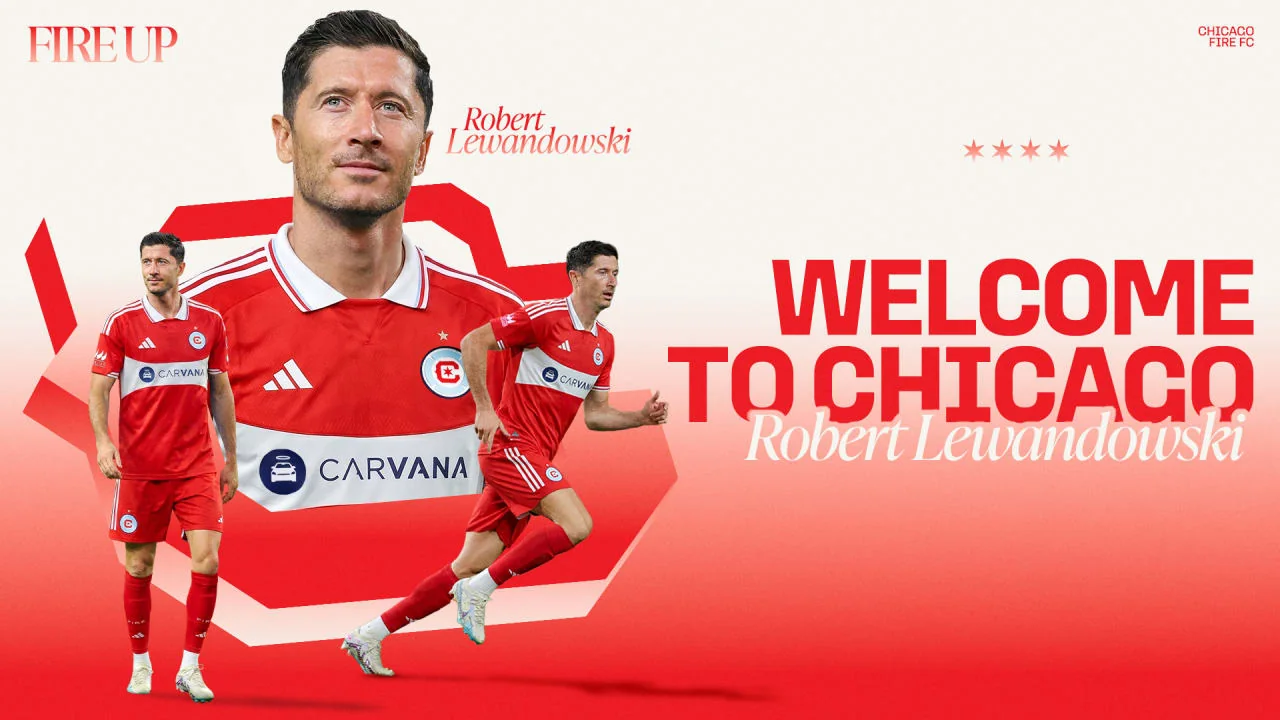
The club announcement also referred to a Designated Player slot and an international roster spot, with the usual transfer-certificate and visa conditions at the time of signing. Those were announcement-stage conditions. They should not be repeated months later as though he remains unable to play, especially when official match reports already document his Chicago appearances.
His current club profile identifies him as a right-footed striker whose preferred area is central. It lists No.9 and a date of birth of August 21, 1988, making him 38 on this guide's October 11 reference date. Age establishes context, but it is not a substitute for assessing minutes, fitness or contribution. An older striker can still influence a match through positioning and decisions; that influence has to be observed rather than assumed.
There are three dates to keep separate when describing the move. The announcement establishes that the transaction is official. The period when he joins the playing group establishes the start of his practical integration. His competitive debut establishes when he first appears on the field. A headline written during negotiations may collapse those stages, but a useful MLS guide should preserve them.
The European resume explains why the acquisition attracted attention. His success at Borussia Dortmund, Bayern Munich and Barcelona gives the move a recognizable background. It does not award him MLS goals in advance, guarantee Chicago a championship or make every teammate secondary. The meaningful new evidence comes from what happens in Fire colors, in the competitions Chicago actually plays.
For readers arriving from an older rumor page, the current conclusion is straightforward: the signing has been announced and the Chicago playing chapter has begun. The remaining questions concern his impact, the evolving attack and his availability for individual matches, rather than the basic existence of the deal.
His first MLS goals and the early Chicago record
Lewandowski's early Chicago milestones already provide a more useful picture than a generic description of his European achievements. His first home appearance produced two goals and a win; a later meeting with Inter Miami produced a volley recognized by MLS supporters. Those are established events. They should be distinguished from a prediction of how many goals he will finish with.
One official MLS impact feature reported six goals and two assists in his first ten MLS appearances, plus another goal during Chicago's Leagues Cup run. That is an early-career snapshot with two different competition scopes. It is not an October 11 live total and should not be silently updated by adding an unverified highlight. A current leaderboard requires a fresh complete match record.
A two-goal home debut against Charlotte
Chicago's August 1 home match against Charlotte ended in a 2-1 comeback win at Soldier Field. Lewandowski equalized in the 20th minute, two minutes after Charlotte had taken the lead. He cut inside onto his right foot and finished into the bottom corner. In the 68th minute, he received a Robin Lod pass and scored the winner across his body.
Those finishes offer two concrete things to watch in later matches. The first combines a change of direction with a controlled shot; the second depends on receiving a teammate's pass and preparing the finish quickly. They illustrate different solutions to a scoring chance without proving that every future goal will follow the same pattern.
MLS named him Player of the Matchday for Matchday 19. The award recognizes that performance rather than an entire season, and its name should not be confused with a Golden Boot or league MVP award. His home debut was also not his first Chicago appearance: he had already played on the road. That distinction explains why a player can have a celebrated home debut after supporters have already seen him in away highlights.
The Inter Miami volley and competition boundaries
On September 9, Chicago drew 1-1 with Inter Miami at Soldier Field. Lewandowski scored in the tenth minute, meeting Andrew Gutman's cross after Robin Lod had helped the buildup. MLS later named the finish Goal of the Matchday for Matchday 25 after it received 40.6 percent of the fan vote. The award identifies a memorable piece of finishing, not a statistical claim that it was his most important goal.
The Fire's recap listed that as his sixth league goal at that point. Miami subsequently equalized through Casemiro, so the match also provides a useful reminder: a striker can deliver a highlight and his team can still share the points. The final result depends on defending, goalkeeping and the opponent as well as the forward's finishing.
When comparing goal records, keep regular-season MLS, MLS Cup Playoffs and Leagues Cup in separate columns. Poland matches form another category, and earlier European goals belong to his broader career record. Combining them can be useful for a clearly labeled all-competitions total, but it cannot answer a question specifically about MLS regular-season production.
The safest reading habit is to pair a number with its competition and cutoff. “Six goals in the first ten MLS appearances” describes an opening spell. “Six league goals after the September 9 match” describes a dated match report. Neither promises the latest total months later, and neither should be used to guess the next result.
How Lewandowski fits Chicago's attack
Lewandowski's current role is best understood through the relationships around the central striker. The Fire do not simply need someone waiting for a cross. They need a forward who can finish, connect with nearby players and occupy defenders while other attackers move. His early Chicago match reports already provide examples of all three without requiring an invented tactical diagram.
Against Seattle on August 29, he helped create Maren Haile-Selassie's goal by touching the ball across the top of the penalty area, then later headed in the equalizer from Puso Dithejane's delivery. The same match thus contains both a supporting action and a finishing action. Watching only the scoring highlight would miss part of his contribution.
A central striker who depends on timing
A central striker's run is useful only if it matches the passer's opportunity. Leave too early and the ball may arrive after the space has closed; leave too late and the defender can recover. In the Seattle equalizer, Chicago's recap specifically described Lewandowski timing his near-post run to meet Dithejane's ball. That concrete event illustrates the importance of coordination rather than merely height or reputation.
The striker also affects the space before he touches the ball. Staying near a center back can discourage that defender from stepping into midfield. Moving toward a passing teammate can draw a marker out. Turning away after a layoff can offer a return pass. These are tactical possibilities to look for, not a claim that the club has published one permanent set of instructions.
His right-footed classification should likewise be treated as a preference, not a full scouting report. The Charlotte equalizer showed a right-footed finish after cutting inside; the Seattle goal came with his head. The useful distinction is how he prepares the chance. Body orientation, the timing of the run and the delivery can matter as much as the foot or contact used at the end.
What to watch from the players around him
The September 5 Toronto match supplies another clear combination. Jonathan Dean moved the ball forward, Philip Zinckernagel carried it through pressure and played into the area, and Haile-Selassie allowed the ball to pass through his legs for Lewandowski to finish. The goal depends on several decisions aligning. It should be read as team coordination, even though the striker receives the final scoring credit.
Zinckernagel's role is particularly relevant because MLS confirmed his new Designated Player contract in September, alongside Lewandowski and Jonathan Bamba as Chicago's designated players. That roster category describes the club's investment structure. It does not require all three to start together or define which player provides width on a particular day.
When watching Chicago, follow the first two passes before the cross or final ball. Does Lod create an angle centrally? Does Gutman have room outside? Does the winger receive facing goal or with a defender close behind? If the delivery is delayed, does Lewandowski adjust his run? Those questions connect the named players to the chance rather than attributing everything to a striker's instinct.
The MLS impact feature also described teammates continuing to learn his movement. That is a sensible theme for a midseason arrival: established patterns need time to become shared habits. A missed connection is not automatically proof of a failed signing, just as one excellent goal is not proof the attack is finished developing. Look for repeated relationships across matches, with the actual selected personnel in view.
Why the move matters for Chicago Fire
Lewandowski joined a club that had already begun improving its competitive position. Chicago returned to the MLS Cup Playoffs in 2025 after a long absence, and the attack included established contributors before he arrived. That background matters because the move should not erase the work of the existing squad or portray the striker as starting the entire project from nothing.
His arrival raises expectations, but expectations and outcomes are different. A high-profile forward can improve a team's ability to finish chances, attract new attention and provide an example for younger players. He cannot independently determine the goalkeeper's saves, the back line's concentration or the result of a knockout tie. Evaluating the signing requires both individual contribution and the team's broader performance.
The September Miami draw illustrates that distinction particularly well. Chicago received a spectacular Lewandowski goal, but the match finished level. It was a strong occasion for supporters without being a win. Keeping those two conclusions separate produces a fairer account than treating a highlight, a large crowd and three league points as interchangeable measures of success.
Standards, supporters and the club's next chapter
MLS's impact reporting described Chicago coaches and teammates observing Lewandowski's detailed training habits and high expectations. Such testimony offers a specific reason to discuss influence beyond goals. It does not prove that every younger player has improved or that one routine explains all his longevity. The useful point is that daily work is visible to teammates, not just the finishing seen by television viewers.
His Polish identity also gives the Chicago chapter a community dimension. The MLS feature discussed interest among Polish-American supporters and the attention around the team. That adds context to a signing by a club with a history of internationally recognized players, while leaving room for fans whose connection is to the Fire itself rather than to one national star.
Soldier Field hosted a club-record 63,094 supporters for the September 9 meeting with Inter Miami. That attendance is an established match figure. It is not a controlled measurement of Lewandowski's drawing power, because Messi, the opponent, the event and other factors were present too. The honest reading is that the match showcased substantial interest around Chicago, rather than that every ticket can be credited to one player.
The club has also announced McDonald's Park as its planned new stadium, targeting a 2028 opening, while its current team plays at Soldier Field. The Endeavor Health Performance Center opened in 2025. Those developments show that the club's next chapter includes facilities and a future home as well as recruitment. A stadium target remains an announced plan, not a completed move.
For someone beginning to follow Chicago because of Lewandowski, the wider club story is worth keeping in view. Watch the established attackers, the defensive unit and the developing players alongside the headline striker. That makes the match more understandable and gives the season meaning even on a day when he is rested, unavailable or does not score.
How to follow Lewandowski's next Chicago match
Use the MLS games today page to locate the current league fixture, then confirm the event through Chicago's official match information. Check the opponent, competition, venue, kickoff time and status. The next event shown beside a player's name may be a Poland international or a cup match rather than an MLS regular-season game.
Chicago's match previews and recaps provide practical viewing information, including Apple TV listings and local radio options for the specific fixture. The MLS TV schedule is useful for scanning upcoming games, but the event listing should settle the precise platform and time. A channel listed for one Chicago match is not automatically the listing for every later match or every competition.
Chicago announcements commonly state times in Central Time. Read the timezone before converting, especially when comparing a club preview with an app that localizes the display. A kickoff shown on your device may appear on another calendar date for an international viewer. Save the localized event rather than assuming that an unlabeled hour means Chicago time.
Then check Lewandowski's availability separately from the fixture. The club's September 18 announcement confirmed his Poland call-up for the September/October international window, and a later Charlotte match guide specifically explained his absence for that event. Those are examples of why a scheduled Fire game does not promise his participation. They should not be carried forward as proof that he is absent after the window ends.
The confirmed team sheet distinguishes starting, being a substitute and not being selected. If he starts, that establishes the opening lineup; it does not guarantee ninety minutes. If he is on the bench, it does not guarantee an appearance. If he is missing, use an official explanation before attributing the absence to injury, rest or international duty. A famous player's name can remain in promotional material even when the selection changes.
Finally, connect the individual story with the club's stakes. The MLS standings show what the next regular-season result means, while the playoff guide explains the route after qualification. Lewandowski's Chicago chapter is more informative when goals are viewed within those competitive demands: the team is pursuing results, and his role is one important part of that shared task.
Comments
Comments are reviewed before publication.
Spam, abusive content, personal information and policy-violating links are not published.
Sign in with Google to comment or reply.
Loading comments…