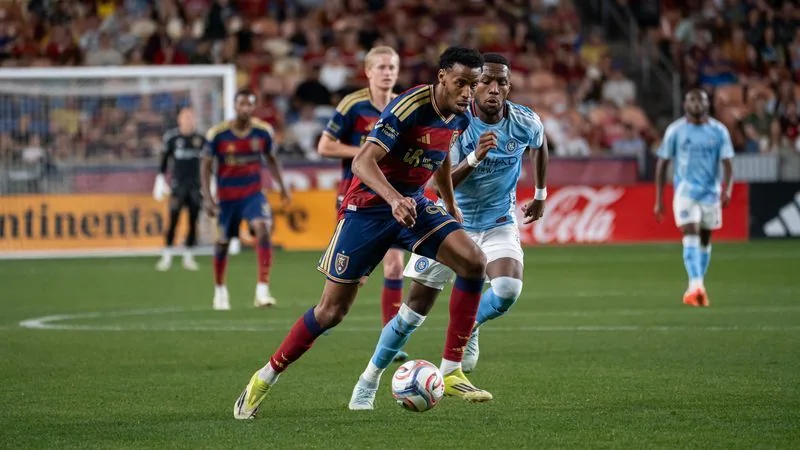
As of September 26, 2026, Real Salt Lake's troubles have several causes, and Diego Luna's knee injury is only the latest blow. The team's MLS winless run began in May, months before Luna was hurt in Houston on September 9. By the September 23 loss in Seattle, RSL had gone a club-record 13 league matches without a victory. Recent scoreless games, weak road results and a changing lineup show why this is a team problem as well as a missing-star problem.
The September 26 snapshot: a club-record slump, not just one bad week
RSL's September 23 match report says the 2-0 defeat at Seattle extended its league winless sequence to 13 games, a new single-season club record. The club stood at eight wins, 13 losses and five draws, with 29 points after that match. In its September 25 preview, it listed itself 13th in the Western Conference, still on 29 points before hosting New England on September 26. The rank had been 12th immediately after Seattle, a reminder that a live table can move even when RSL has not played again.
The 13-game figure describes MLS regular-season matches and is accurate through the Seattle result. It is not a count of 13 straight defeats. Earlier in the run RSL earned draws, including an LAFC result, but could not turn them into a win. Likewise, the club's separate road streak includes an all-competition match and should not be quietly substituted for this league measure. A fresh result against New England could end or extend the league run, so every mention of the count in this article is tied to the pre-match September 26 snapshot.
The slide has implications beyond a disappointing line of form. RSL had been aiming to reach the MLS Cup Playoffs again, yet by late September it was chasing the Western Conference qualifying places instead of protecting one. The immediate need is points; the analytical question is why both goals and results dried up. Three scoreless September defeats and a multi-month period without a league win point to underlying issues that one player's absence alone cannot explain.
How RSL's winless run reached 13 MLS matches
Search results for this story still show headlines about 11 or 12 matches without a win. Those articles were accurate when written, then overtaken by another loss. The club's own dated recaps let us reconstruct the sequence. The progression also helps avoid a misleading causal story in which Luna's season-ending diagnosis supposedly started the downturn.
The decline began before Luna's September injury
RSL's last MLS victory before this review was a 2-1 home win over Colorado on May 16, according to its September 23 recap. The team played through the late spring, a World Cup pause and the summer without another league win. Before the Vancouver game on September 19, Field Level Media counted an 0-7-4 sequence over 11 MLS games. That record included draws, but the absence of a win over such a long span steadily eroded the points cushion.
Luna was still part of the team for much of that slide. His knee injury occurred during the September 9 loss at Houston, according to the club's medical update. September 9 came nearly four months after the previous league win. The injury can explain an additional challenge in the final stretch; it cannot explain the entire 13-game sequence. Earlier difficulties with finishing, defending, availability or opponents must be examined on their own terms.
The timeline matters for judging decisions. A club that struggles for months cannot reasonably expect one recovered player, one formation change or one new signing to restore every lost point. Conversely, a late injury to an important creator can make an existing weakness more visible. Keeping “when did the slump start?” separate from “what made it worse?” is the clearest way to assess RSL's 2026 campaign.
Three September shutouts exposed the scoring problem
New York City FC won 2-0 in Sandy on September 12, taking the winless total to 11. Vancouver then won 3-0 there on September 19, making it 12. Seattle won 2-0 on September 23, completing a third straight scoreless league defeat and pushing the run to 13. Across those three games, RSL conceded seven goals and scored none.
The official Seattle recap reported a 284-minute scoreless stretch at full time. RSL took 12 shots in that match but put only two on goal, while Seattle scored twice in the second half. Those numbers do not prove the attack generated nothing: the report describes an opening that Sergi Solans could not finish shortly before Seattle's first goal. They do show how narrow the margin becomes when opportunities are few or poorly converted. A near miss cannot earn a league point, and falling behind forces a team already short of confidence to chase a match.
The order of results also explains why older “12 games without a win” summaries should not be copied into a September 26 article. They describe the state after Vancouver, before Seattle. For a live streak, the date is part of the statistic. RSL's next home match against New England was still scheduled when this analysis was prepared; its outcome is not incorporated into the 13-game count.
What Diego Luna's injury changed
Luna's absence is a major setback for the closing stretch because he had been one of RSL's most productive attacking players. It removes an established link between midfield possession and a final pass or shot at exactly the point the team has struggled to score. The medical news is serious, but the timing also protects the analysis from an easy mistake: this injury made the outlook harder; it did not create a winless run already months old.
The Houston injury, surgery and expected return
RSL said Luna was injured on September 9 during a 2-1 defeat at Houston, leaving after 70 minutes. An MRI the next day identified a meniscus tear in his knee. The club announced on September 22 that a repair operation performed the previous Friday, September 18, had been successful. It expected him to miss the remainder of the 2026 season and spoke of seeing him back on the field in 2027. Its later September 25 preview described an expected absence of about six months.
That is the club's current recovery expectation, not a promise that a particular match will be Luna's return. Rehabilitation after surgery is managed by medical and performance staff, and an exact competitive date may move. Readers should use a later official team health update if one is published, rather than calculating a return fixture from the six-month estimate. There is also no basis in the public medical release for implying that he played through a diagnosed tear for months or that the injury was caused by the team's bad results.
Why his absence deepens but does not explain the whole slump
RSL credited Luna with five goals and eight assists in 22 games across all competitions in 2026. Those contributions show why losing him hurts an already fragile attack. A player who can receive between lines, draw defenders and supply a decisive action is especially valuable when the team is creating only a few clear openings. His absence asks teammates and the coach to redistribute that work, rather than merely put another name in the same place on the lineup graphic.
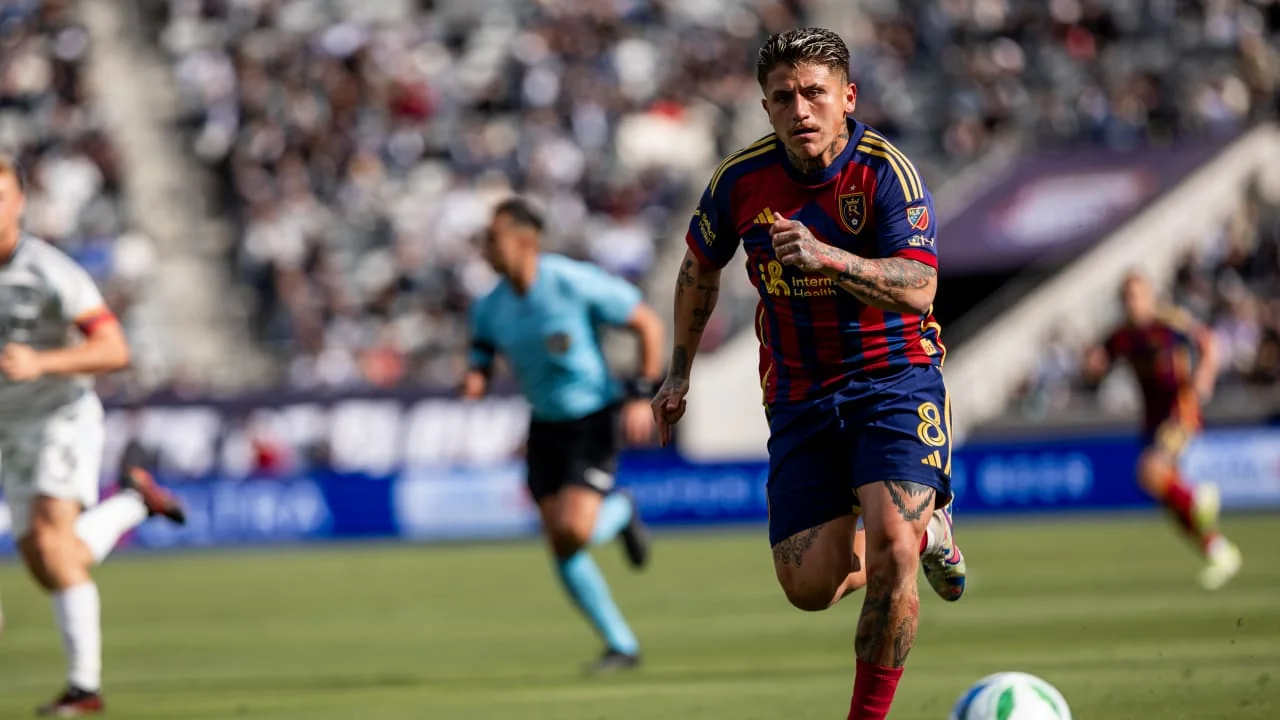
RSL had, however, already gone winless since May 16 by the time he was hurt in September. Even with Luna available for part of the run, the team had not solved its broader results problem. It is therefore more accurate to say the injury narrows the possible fixes for late 2026 than to say it caused the slide. It may affect how many chances the team creates from now on, but assessing that requires comparing the actual matches after his absence, with opponent strength and other missing players in mind.
The problems on the field beyond one player
The recent losses suggest more than a single missing playmaker. RSL have at times moved the ball into attacking areas without turning enough possessions into dangerous shots. They have struggled for points away from Sandy, then stopped relying on home matches as a guaranteed correction. Frequent changes in player availability have made combinations harder to settle. None of these observations assigns a precise percentage of blame; together they show why the slump has been persistent.
Too few decisive chances despite some possession
In Seattle, RSL's official statistics show 12 attempts but only two on target. Against Vancouver, the club recorded 11 attempts, three on target, while Vancouver had 20 attempts and six on target. Totals alone do not describe the danger of every shot, but the pattern is consistent with a side struggling to convert territory or possession into enough clean opportunities. Three consecutive games without a goal make even one early concession feel large.
The Seattle match offered a sharp example. RSL's recap describes Solans reaching a promising one-on-one situation just after halftime, but the chance ended without a shot on target. Seattle scored soon afterward through Danny Musovski. That sequence does not mean the entire result hinged on a single moment; Seattle added another goal and RSL continued to struggle. It does show the difference between reaching a dangerous area and finishing a move decisively. In a low-scoring stretch, a missed opportunity can quickly change the game state.
Coach Pablo Mastroeni's post-Seattle remarks reported by Salt City Soccer similarly separated effort and play between the boxes from the decisive actions near goal. The next improvement therefore has to be visible in clear chances and goals, not only in energy or possession figures. It would be too simple to call RSL a team that never attacks; the evidence points to a gap between attempts and effective finishing, with defensive lapses compounding it.
Road form and a weakening home edge
RSL's September 23 recap put its MLS road record at 1-9-4 and its last away win at Atlanta on March 7. A team chasing a playoff place cannot rely on home dates alone if it goes months without taking three points on the road. Yet the familiar strength at America First Field has also weakened: after Vancouver's September 19 victory, the club reported five consecutive home MLS games without a win, its longest such stretch in years.
Home and road form should still be read with opponent context. Vancouver came to Sandy as a strong Western team, and Seattle was trying to end its own winless sequence. Those are not identical tests. But RSL's problem is precisely that it has struggled to find a result under different conditions. Draws can keep a team close for a time; repeated losses against direct rivals or difficult visitors turn a catchable playoff position into a moving target.
Availability problems and lineup turnover
The club's September 25 preview said RSL had lost nearly 170 player-games in 2026 through injuries, suspensions and visa issues. Those categories are different: a player recovering from surgery, one serving a ban and a new arrival awaiting paperwork do not pose the same coaching problem. All can narrow selection. Against Seattle, Mastroeni changed five starters from the Vancouver match; an additional pregame injury forced another adjustment. International absences then further limited the group before New England.
It would overreach to convert that availability number directly into points lost, since every MLS team manages missing players. The narrower observation is that sustained lineup turnover makes it harder to build recurring partnerships and a stable attacking pattern. Academy players and new arrivals can provide energy, but expecting them all to solve a months-long scoring problem at once is a heavy burden. RSL needs workable combinations among the players who are available now, while avoiding the assumption that health alone would reverse every result.
What fan frustration does and does not tell us
A club-record winless streak naturally produces anger and questions about decisions beyond the field. Those reactions are part of the 2026 story, especially when a talented player has undergone season-ending surgery and a playoff place is slipping away. But “the fans” are not one measurable voice. An online discussion, a full stadium and a private conversation with the club can express different things; none alone is a representative poll of RSL supporters.
Online criticism of results and club leadership
A Reddit thread in the RSL community asked whether supporters should protest the owners and management. The question shows that at least some online fans were considering a stronger response to the team's direction. It does not establish that a protest happened, that a supporters' organization endorsed one, or that most matchgoing fans agree. Those would require evidence outside a discussion prompt.
The underlying frustration is understandable without treating every comment as a fact. RSL had not won a league match since May, was shut out three times in succession in September and lost a key playmaker for the rest of the year. Supporters can reasonably ask whether roster planning, coaching adjustments or medical luck best explain the situation. This article can identify the public results and club-reported availability problems; it cannot infer the precise quality of every internal decision from a forum thread. Attributing criticism to the people expressing it is more useful than speaking for a whole fan base.
Sellout crowds complicate a simple support narrative
Attendance-related reporting points in another direction. The club's September 25 preview said the Vancouver match had been RSL's 15th consecutive MLS home sellout and that another sellout was expected against New England. Even during a five-game home league winless streak, tickets continued to be claimed or sold in sufficient numbers for the club to use that description. That shows the support base remained engaged with matchdays; it does not prove supporters were happy with results or leadership.
“Sellout” is also a ticket-status term, not necessarily a count of every seat physically occupied. A supporter might hold a season ticket, miss a match and still contribute to a sellout announcement. Another might attend precisely because they care enough to demand change. The more defensible reading is that dissatisfaction and strong ticket demand can coexist. If anyone later documents a coordinated protest, that would be a separate development to report with its organizers, date and turnout, not something to assume from one online question.
What to watch in the remaining 2026 matches
The season was not finished on September 26. RSL had an opportunity to alter both the streak and the mood when New England came to America First Field that evening. One result would not rewrite the previous four months, but it could matter in a tight Western Conference playoff chase and give a clearer view of whether the attack can function without Luna. The next useful assessment is based on results and performances over several matches, not on a prediction masquerading as a final table.
A realistic path back toward the playoff line
MLS's 2026 competition guidelines say the top nine clubs in each conference reach the playoffs, with eighth and ninth meeting in a Wild Card game. RSL was 13th in the West with 29 points in its September 25 preview, outside those places. Its 8-13-5 league record accounted for 26 matches of the scheduled 34, leaving eight on the regular-season calendar at that snapshot. A route remained, but it required RSL to collect wins and gain on teams ahead, not just wait for the line to come down.
New England's September 26 visit was scheduled for 7:30 p.m. Mountain time, according to the club. That match is an immediate chance to end the run, but no result is known within this article's pre-match reporting window. The precise point gap to ninth can move when other Western clubs play or when postponed games are completed, so a single static “points behind” figure would date quickly. Fans should check the current MLS standings after each match before deciding whether the race is still live.
How to judge improvement before Luna returns
The most convincing short-term sign would be goals from repeatable chance creation rather than one fortunate deflection. RSL can examine whether more of its attempts reach the goalkeeper, whether attacking moves give Solans and others clean finishes, and whether the team avoids conceding quickly after a missed opportunity. A road win would address another long-running weakness, while a settled lineup could show how the available players are combining. These are practical observation points, not a statistical model that guarantees victories.
Luna is expected to miss the rest of 2026, so evaluating the stretch as if his return were imminent would be unfair to the players and misleading to readers. The club needs points with its current group, including young players and recent arrivals, and it needs to manage the other availability problems it has documented. Even if the playoff race ends early, evidence of a functioning attack and steadier performances would matter for the next season. Conversely, a single win followed by more scoreless losses would change the streak count without fixing its underlying pattern.
As this review closes, the evidence supports a clear diagnosis rather than a certain forecast: RSL's winless spell preceded Luna's injury; the injury removed a productive creator; September brought three straight shutouts; road results and player availability remained problems; and frustrated online supporters still sat alongside strong reported home ticket demand. The September 26 New England result and later official injury updates are the next facts that should update the story.
Comments
Comments are reviewed before publication.
Spam, abusive content, personal information and policy-violating links are not published.
Sign in with Google to comment or reply.
Loading comments…