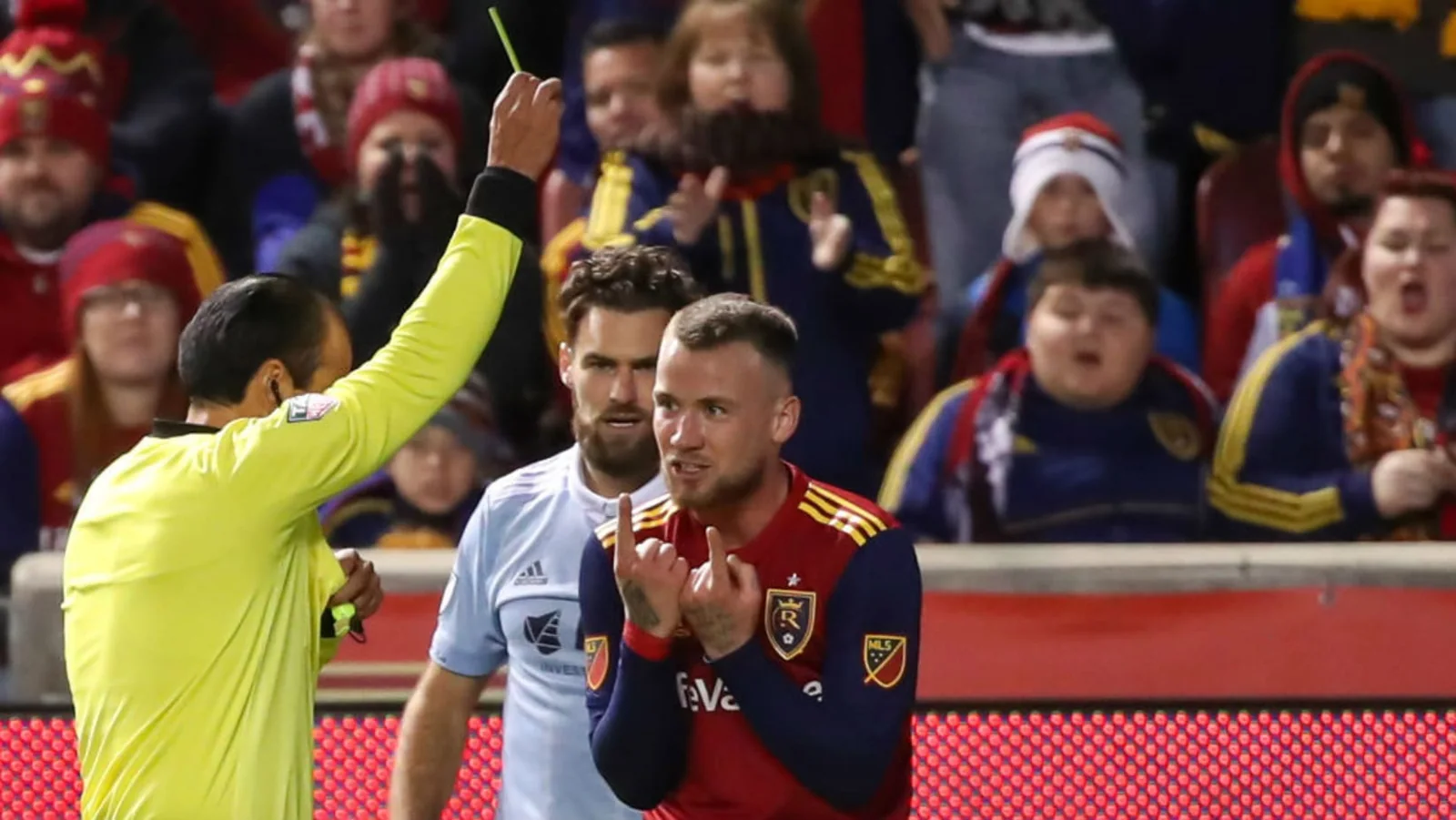
Updated October 28, 2026. MLS yellow-card accumulation resets at specified stages, but red cards and additional league suspensions do not simply disappear. This guide follows the 2026 rules and explains the differences that matter when checking a playoff lineup.
What triggers a regular-season yellow card suspension?
MLS separates a season-long caution balance from being sent off in a particular match. Those are different paths to missing the next fixture. A player can complete a game with only one yellow card that day and still trigger an accumulation suspension.
Player thresholds and the next match
The regular-season player thresholds are five, eight, eleven and thirteen accumulated cautions, then another suspension at each additional two. The sanction applies to the next MLS regular-season match, subject to the specific end-of-season provisions explained below. Coaches and other team officials have a different regular-season threshold: three.
Serving the first accumulation suspension does not make every earlier caution disappear from a season-statistics table. The next threshold is eight, rather than another five newly counted cards. For someone reading a match preview, the useful question is the player's current disciplinary position and the applicable next threshold, not merely whether the player has ever served a ban before.
Do not transfer a coach's three-card rule to a starting midfielder, or a World Cup rule to an MLS club match. A search result can contain the right words and still concern a different competition, participant or season. The 2026 MLS competition guidelines are the reference for this guide.
How the Good Behavior Incentive changes the count
MLS can reduce a player's accumulation balance by one after five consecutive appearances without a yellow card, red card or supplemental discipline. The incentive applies after a completed match, up to three times during the regular season, and cannot create a negative balance.
That explains why counting every yellow icon in a player's season log may not reproduce the league's current disciplinary balance. Imagine a player with four cautions who then completes the required clean run. The relevant balance can fall to three even though the historical event log still records four actual bookings.
Appearance is an important word. Five calendar weeks without a booking are not automatically five qualifying appearances. An unused substitute or an absent player has not established the same participation record simply because the club played. A suspension forecast based on an unfiltered list of dates can therefore be misleading.
Before describing somebody as one card away, check whether the record reflects an applicable incentive and whether the latest game has finished. A live graphic can describe the immediate match situation accurately while remaining insufficient to establish the finalized season disciplinary calculation.
Do regular-season yellow cards carry into the playoffs?
Regular-season accumulation resets entering the playoffs. The 2026 rules specifically protect eligibility when somebody reaches an accumulation threshold in the final regular-season match. That caution alone does not cause a ban for the first playoff match or the following season's first regular-season game.
The type of sanction matters more than the simple fact that a card was shown. Compare two fictional Decision Day situations. Dana receives a fifth accumulated caution and completes the match without being sent off. Morgan receives a straight red card. Dana's accumulation situation benefits from the end-of-season provision; Morgan's sending-off is handled separately and can affect the next eligible game.
Now add a third possibility: the league later issues supplemental discipline for an incident. A yellow-card reset does not erase that sanction either. These three records can all be described loosely as disciplinary problems, but the loose description is not enough to determine playoff availability.
This is why a preview saying that all cards are wiped clean can be dangerous shorthand. It might intend to describe only the season accumulation balance while a reader assumes that every outstanding ban disappears. The accurate question is which disciplinary mechanism applies to the individual.
The distinction also helps when a player misses a regular-season fixture shortly before Decision Day. Check when the suspension was incurred and whether it has already been served, rather than treating the last match on the calendar as a universal reset button for every earlier event.
For supporters following qualification, use the MLS playoffs page for the competition stages, then inspect the relevant player or club disciplinary update. Knowing that a team qualified does not establish that every player is eligible for its opening postseason lineup.
When does playoff yellow card accumulation reset in 2026?
The specific 2026 postseason disciplinary section uses a three-caution threshold before a reset entering the Conference Finals. The round names matter: a Conference Semifinal and a Conference Final are consecutive stages with different consequences for an accumulated caution.
The three-caution playoff threshold
Round One being a best-of-three series does not mean the caution balance restarts after each game. A player can accumulate cards across those separate fixtures. A Wild Card appearance can also be part of the postseason record.
Consider a fictional player booked in Game 1, Game 2 and Game 3 of Round One, with no other disciplinary complications. The third accumulated caution triggers a suspension for the next playoff match, which would be the Conference Semifinal if that player's club advances. Winning the series does not create a fresh balance at that point.
The example is useful because a supporter might treat each playoff round as a new competition, or assume that the series winner's roster becomes unrestricted immediately. Neither assumption follows from advancing. Track the actual cautions and the stated reset stage, then distinguish that accumulation calculation from any separate sending-off.
If a club is eliminated after the third cumulative postseason caution, the accumulation suspension does not carry into the next regular season. That treatment is different from a red-card suspension, so elimination alone cannot answer every disciplinary question.
The Conference Final reset matters
The current postseason wording specifically says that a third cumulative caution in the Conference Semifinal does not prevent participation in the Conference Final, because accumulation resets there. Use that specific 2026 provision when assessing the boundary.
This makes timing important. In the fictional Round One example, the player reaches the threshold before the Conference Semifinal and misses that match. Change the sequence so the third caution comes in the Conference Semifinal itself, and the stated Conference Final reset produces a different outcome. The same number of cautions can therefore lead to different availability depending on the stage.
Older MLS explainers can be misleading here. A widely surfaced article discusses the 2019 playoffs and a two-caution system. Its presence on the official website does not make its old threshold the 2026 rule. Check the season in the body, not just the current news links surrounding it.
The reset concerns accumulation. A straight red card, a sending-off for two cautions in one match or an additional league suspension still requires its own assessment before declaring a player available for the next round.
Do red cards disappear when yellow cards reset?
No. Sending-off suspensions remain separate from accumulation resets. A red card in the Conference Final can rule a player out of MLS Cup if the club advances. A sending-off in the club's last postseason game can carry into the following regular season.
The immediate disappointment of elimination does not remove the next eligible fixture from the disciplinary process. The calendar can move into another season while a suspension still has to be served. Conversely, a player whose accumulation balance resets has not necessarily had a red-card sanction canceled.
Two yellows in one match are a sending-off
Two cautions producing a sending-off are not equivalent to two separate-match cautions sitting below an accumulation threshold. The first situation ends the player's participation and creates a suspension for the next eligible match. The second needs to be evaluated against the accumulation rules and the stage of the competition.
Imagine a fictional defender entering a playoff match without any prior postseason cautions. Two bookings during normal play can still result in dismissal and a next-match suspension. Starting with a clean accumulation record is no protection against the consequences of two cautionable offences in that game.
The reverse misunderstanding also occurs. A player with several separate-match bookings is not automatically sent off when the referee shows a first yellow that day. The immediate match sanction and the future eligibility calculation operate together, but they answer different questions.
Where a threshold-triggering caution and a later straight red occur in one match, more than one disciplinary consequence can exist. MLS specifies that the red-card sanction is served first. The applicable reset stage and any additional league decision still need checking before forecasting every later fixture.
A standard next-match suspension should not be read as a guarantee that one game is the maximum punishment for every red-card incident. Supplemental discipline can add consequences. The official notice and any review outcome provide the case-specific detail that a colored icon in a live score app cannot supply.
There is one further phase distinction when a match reaches penalties: a caution during normal play and a caution during the shootout are treated differently for dismissal. That does not erase the need to track the postseason accumulation record.
How do yellow cards work in a penalty shootout?
A shootout introduces a distinction between the caution record used for immediate dismissal and the record used for later MLS playoff accumulation. Understanding both explains why a player can remain in the shootout yet become unavailable for the next fixture.
Match cautions and shootout cautions are separate for dismissal
Under the applicable IFAB framework, cautions during the match, including extra time, are not carried into the shootout for a second-yellow dismissal. A player booked once during the match and once during penalties is therefore not sent off merely by adding those two cautions together.
That does not create immunity inside either phase. Two cautions during normal play, including extra time where applicable, still produce a sending-off. Two cautions within the shootout can do the same. The important boundary is between the match and the shootout, rather than a belief that penalties are free of disciplinary consequences.
For a fictional example, Alec is cautioned during regulation and then receives a caution during the shootout. Those belong to separate phases for dismissal. Change the example so both cautions occur during the shootout, and the outcome changes. A broadcast showing two yellow symbols without identifying their phases can obscure that difference.
Both can still matter to playoff accumulation
The phase distinction does not mean the cautions cease to exist for the MLS postseason balance. The 2026 league guidelines give a goalkeeper example in which an earlier playoff caution, a later regulation caution and a caution during that later shootout combine to trigger an accumulation suspension.
That produces two answers that can look contradictory until the question is specified: the goalkeeper is not dismissed from that shootout for the regulation-plus-shootout pair, but the playoff total can still require missing the next match. Immediate permission to continue is not the same as eligibility for a future fixture.
When two cautions within a phase do cause dismissal, MLS specifies that only the first of that pair counts toward the accumulation total. The sending-off still has its own next-match consequence. Simply adding every icon in the match log can therefore produce another inaccurate forecast.
For viewers, keep two separate notes: what happened in each phase of this match, and what cautions were already present from earlier postseason fixtures. Then check whether the next round crosses a reset boundary. A headline saying that shootout cards are separate answers only part of the problem.
This distinction is particularly useful in Wild Card and Round One games that can reach penalties after regulation. You do not need an extra-time period for the separate shootout phase to matter.
Can the Disciplinary Committee add a suspension or change the record?
Yes. The referee's decision during the match is not always the final information relevant to future availability. MLS can impose supplemental discipline under its review framework, and those suspensions can apply in the playoffs, MLS Cup or the following regular season.
Keep the roles separate. PRO trains, assigns and evaluates match officials. Its technical explanations help readers understand on-field decisions. The MLS Disciplinary Committee deals with the league's supplemental disciplinary process. A technical review article and a suspension notice answer different questions.

A match report might accurately say that a player received a yellow card while a subsequent notice adds a suspension. That is a reason to read both records in sequence, rather than accusing one of inventing the other. The postseason guidelines also specify that a yellow replaced by a committee suspension is not counted toward the accumulation total.
Appeals have defined limits too. The Independent Review Panel can consider specified disciplinary decisions, including red cards, second-yellow dismissals and certain deception-related caution cases. That is not a general invitation to erase any ordinary booking because a club dislikes the referee's judgment.
For a supporter, the practical distinction is between an appeal being announced and an appeal being decided. A promise to challenge a sanction does not itself establish the player's eligibility. Read the official outcome before treating a suspension as removed, reduced or unchanged.
It is also possible for money and match availability to diverge. A fine notice does not necessarily announce a suspension, and a suspension notice can specify more than a financial penalty. The relevant text is the sanction actually imposed, not an assumption based on a dramatic headline or a player's reaction.
Before a playoff match, check for updates after the original game report. The most useful evidence identifies the individual, the incident, the sanction and when it applies. A clip showing the initial card can be informative about the incident while remaining incomplete evidence for the next lineup.
How to check whether a player can appear in the next match
Start by identifying the competition, season and participant. Then identify the disciplinary event: an ordinary caution, an accumulation threshold, a second-yellow dismissal, a straight red or a subsequent league sanction. Those details determine which rule to apply.
Next, locate the fixture the sanction actually concerns. Check the club's latest availability communication, any league disciplinary notice and any completed appeal outcome. Read dates as well as headlines. A report published before a later decision can be accurate about what was known then while no longer supplying the full current position.
Finally, distinguish eligibility from selection. A player can be legally available and still miss the lineup through injury, rotation or a coaching decision. Absence alone does not prove a suspension, just as a player returning to training does not establish that a match ban has been removed.
Postponed matches need an extra timing check
A fixture moved before kickoff is not the same situation as a match that starts and is later recommenced. MLS publishes a separate postponement policy because the chronology can affect disciplinary service and the players allowed to complete the original contest.
For a regular-season match that has started and is postponed, a caution received before the interruption is added to the season total after the match is completed. The policy specifically explains that a fifth caution before postponement does not automatically suspend the player for the next regular-season game while the original match remains incomplete.
A player sent off before that interruption cannot return for the remainder when the match resumes, and the team remains short-handed. The corresponding red-card suspension is served in the first regular-season match after the recommenced match has concluded. That sequence is more precise than assuming the next date printed in the calendar must always be the suspension date.
These exceptions are a reason to read the official communication about the actual interruption. A brief live-score label such as postponed does not describe every legal consequence. First determine whether the game began and whether the upcoming entry is its continuation or a separate fixture.
Use the MLS games today schedule to identify what is being played, then match the disciplinary notice to that event. For a postseason availability question, also check the round and the applicable reset boundary. That combination gives a more reliable answer than a raw season yellow-card total or an old explainer found through search.
Comments
Comments are reviewed before publication.
Spam, abusive content, personal information and policy-violating links are not published.
Sign in with Google to comment or reply.
Loading comments…