What MLS has confirmed for the 2027 U.S. Open Cup
All 27 United States-based MLS clubs will enter the 2027 Lamar Hunt U.S. Open Cup. U.S. Soccer and MLS confirmed the arrangement on September 2, 2026, with those clubs joining in the Round of 64 in July. The announcement also changes the tournament's calendar, hosting priorities and matchday roster size. This is an announced format, rather than a proposal awaiting a decision.
The headline needs one qualification: it means every U.S.-based MLS club, not every club in a league that also includes Canadian teams. The Open Cup is the United States' national club knockout competition. Its identity comes from bringing different levels of the domestic game into the same tournament, with a single defeat capable of ending a much bigger club's campaign.
What “return” actually means
The full U.S. MLS contingent is returning for the first time since 2023. That does not mean MLS disappeared from the competition during the intervening editions. Some clubs continued to participate, and the distinction matters when assessing either the tournament's recent winners or the significance of this announcement. Full participation restores a common entry point for the league's eligible clubs; it does not restart a competition that stopped existing.
For supporters, the immediate change is the possibility of an Open Cup campaign for their own team. A league fixture against a familiar opponent and a knockout match against a lower-division club offer different stakes. In the latter, the next round is the entire reward for that evening, and a long season's league standing cannot protect a favorite from elimination.
Participation also needs to be separated from team selection. Entering an MLS club does not promise that its strongest available eleven will start every tie. Coaches will still make football decisions, and the announced roster flexibility is part of that picture. The format establishes which club competes and when it enters; the lineup establishes how that club approaches an individual match.
The useful way to evaluate the return is therefore through three questions: how many matches each entrant must survive, where those matches can be played, and how the dates fit around its other commitments. Those details explain much more than the return headline alone.
How the 96-team field becomes a Round of 64
The tournament has 96 entrants, but they do not all start together. The First Round pairs 32 lower-division professional clubs with 32 amateur Open Division teams. Those 64 starters produce 32 winners. The winners then meet the 32 clubs entering with a bye: the 27 MLS sides and five seeded USL Championship clubs. That is how a field of 96 produces a Round of 64 without requiring a round bearing the larger number.
| Entry point | Teams joining | What happens next |
|---|---|---|
| First Round | 32 lower-division professionals and 32 Open Division clubs | 32 match winners advance |
| Round of 64 | 27 MLS clubs and five seeded USL Championship clubs | They join the 32 First Round winners |
| Round of 32 onward | No new entrants | The remaining field halves each round |
Why five USL clubs start alongside MLS
The five seeded places recognize results in the USL Championship ecosystem. The announced categories are the Players' Shield winner, the Championship playoff winner, the Eastern and Western Conference top seeds, and the Prinx Tires USL Cup champion. Those are qualification categories, not a list of five clubs already known on September 6.
There is a potential overlap question when one club satisfies more than one category. The format announcement lists the routes but does not provide a complete replacement ladder for every combination. It would be premature to turn those categories into a definitive team list or assume that a specific runner-up automatically inherits a place.
The difference between the two routes
Counting the announced knockout rounds gives an MLS entrant six matches to win the trophy, while a First Round entrant must survive seven. That calculation concerns the tournament proper; an amateur club may also have played qualifying matches before reaching it. A bye therefore removes one elimination risk and one match from the path, even before the hosting advantage is considered.
For an underdog, reaching an MLS opponent is itself an achievement rather than a guaranteed opening-night attraction. Its first assignment is another knockout tie. For an MLS supporter, the opening opponent may arrive with competitive evidence already on the board: it has won the match required to reach that meeting. The entry structure creates unequal starting distances, but it still requires every eventual champion to keep winning once its campaign begins.
The 2027 Open Cup dates, from April to December
The announced competition stretches from April to December, with the final five rounds taking place after Labor Day. MLS clubs do not participate in the April opening round. Their first window is July 8-11, followed by the Round of 32 in September if they advance.
| Round | Announced 2027 dates | Planning detail |
|---|---|---|
| First Round | April 13-14 and April 20-21 | Lower-division professionals against Open Division teams |
| Round of 64 | July 8-11 | MLS and seeded USL Championship entry |
| Round of 32 | September 14-15 | First round after the July entry window |
| Round of 16 | To be confirmed | No date should be inferred from neighboring rounds |
| Quarterfinals | November 23-24 | Eight clubs remain |
| Semifinals | December 1 | Four clubs remain |
| Final | December 15 | Championship match |
U.S. Soccer labels these dates subject to change. They are round windows, not a match-by-match schedule with confirmed kickoff times. A club appearing in the July window has not thereby announced a July 8 home game, and a final scheduled for December 15 does not identify its host.
How to read the calendar alongside MLS
MLS says its July entry aligns with preparations for the 2027-28 regular season as the league changes to a summer-to-spring calendar. The Open Cup remains an edition labeled 2027, with a December final. These are different competitions using different season labels, so a search for an MLS league schedule will not necessarily answer an Open Cup travel question.
The spacing also creates a distinctive campaign. An opening win in July does not immediately lead to another tie the following week: the next announced round is in September. Supporters can enjoy advancement without expecting an instant sequence of cup nights, while clubs will need to carry the campaign across changes in their wider competitive rhythm.
For planning, reserve the round window in a calendar and attach the opponent, venue and local kickoff only after the fixture is assigned. The MLS calendar is useful for league context, but the Open Cup's own draw and scheduling announcements remain the authority for these ties. In particular, leaving the Round of 16 blank is more accurate than filling it with a plausible-looking date.
Why hosting priority is the controversial change
The key hosting provision operates in two stages. Clubs entering in the Round of 64 receive priority to host that round. This covers both the MLS contingent and the five seeded USL Championship entrants. For the Round of 32, U.S. Soccer says advancing lower-division teams receive hosting priority.
That arrangement creates a clear tradeoff. More MLS clubs are available as opponents, but a lower-division side reaching the Round of 64 does not receive an equal starting claim to bring that opponent to its own ground. A community hoping for a major cup night at home may instead have to follow its team on the road.

A hypothetical lower-division path
Consider a professional club starting in April. It first has to beat its Open Division opponent. If its July opponent is an MLS club, the MLS side has hosting priority. Only after surviving that second match does the lower-division team reach the round where priority turns in its favor. The later benefit is real, but it is conditional on winning the earlier tie.
This is why the September provision does not completely cancel the July objection. Hosting a higher-profile opponent can give local supporters an occasion that an away tie cannot reproduce. It may also offer commercial opportunities, although the size of any benefit depends on attendance, costs and tournament arrangements rather than a guaranteed windfall.
Priority is not a complete hosting rulebook
The official wording concerns advancing lower-division teams, not only amateur clubs and not only teams that began in the First Round. Readers should therefore avoid narrowing the September rule beyond the announcement. Equally, two lower-division survivors could meet, and a priority statement alone does not resolve every situation in which both clubs seek to host.
Venue availability and later draw procedures still matter. Nor does the announcement give MLS clubs automatic home priority throughout the tournament. The July preference is attached to a named round; carrying it into the quarterfinals or final would change the rule.
Our assessment is that full participation strengthens the range of possible matchups, while the July hosting preference weakens the immediate home opportunity for many underdogs. Supporters can reasonably welcome the first development and question the second. Evaluating both is more useful than treating the entire format as either an unconditional victory or a loss for the cup.
One club, one entry and the new matchday roster
The Open Cup retains its one-club, one-entry principle. A professional organization enters its highest-level professional team. For an MLS organization, that means the MLS club enters rather than adding its affiliated MLS NEXT Pro team as a second independent chance to win the same tournament.
Club entry and player selection are different questions
MLS says clubs may select from contracted first-team, MLS NEXT Pro and academy players for the competition. U.S. Soccer also states that players from affiliated MLS NEXT Pro teams may appear for their MLS affiliate, subject to competition roster regulations. Those provisions broaden the pool from which a coach can build a cup team; they do not create a separate reserve-team entry.
The matchday roster expands from 18 to 20 players. That is the number available on the matchday list, not permission to field twenty players at once or make twenty substitutions. The separate statement that there is no numerical cap on eligible competition-roster players should not be confused with an unlimited bench on the night.
For a supporter watching the team sheet, the practical question becomes how the selected players fit together. A side containing prospects can still represent the MLS club properly, while an experienced lineup can still lose. A useful assessment looks at the balance of the eleven, the options available from the bench and the demands of the opponent rather than treating every unfamiliar name as proof that the club has withdrawn.
Which MLS NEXT Pro clubs are eligible separately?
U.S. Soccer identifies Carolina Core FC, Chattanooga FC and Connecticut United FC as the eligible MLS NEXT Pro entrants in the announced field. They belong to the lower-division route, not the 27-club MLS group. Affiliated teams belonging to organizations already entering through MLS are excluded by the one-entry rule.
Professional eligibility also depends on having played in the relevant league's most recent competition year beginning before January 1, 2027. The important distinction is between an established eligible entrant and a newly announced organization that has not met the participation condition. A club announcement alone is not evidence of an Open Cup place.
These rules preserve a single competitive identity for each organization while allowing the cup to provide meaningful minutes across its player pathway. They leave coaches choices about selection, but they do not erase registration requirements or guarantee any individual player's eligibility.
What the cup offers beyond another fixture
The announced 2027 field will compete for a $1 million tournament purse and a Concacaf Champions Cup place. The purse is an overall competition figure; it should not be presented as a promise that the champion receives the entire million dollars. The continental berth gives the sporting outcome a consequence beyond the domestic trophy.
A separate route to a defining season
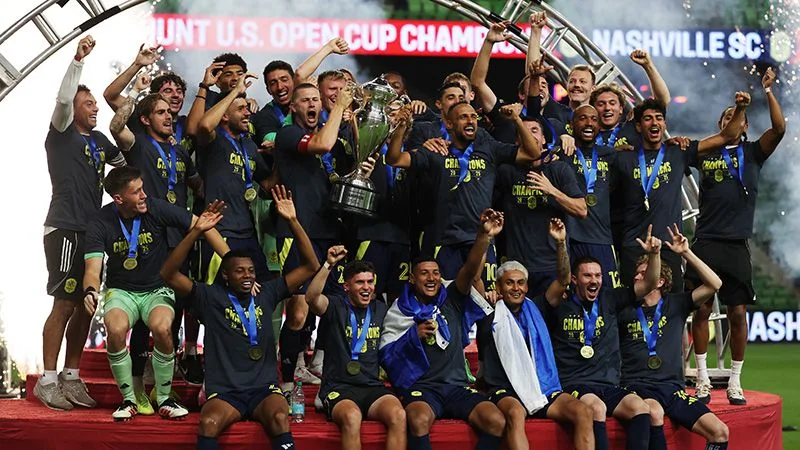
Nashville offers a recent example. Its 2-1 victory at Austin in the October 1, 2025 final delivered the first trophy in the club's MLS history and qualification for the 2026 Concacaf Champions Cup. The cover photograph shows that historical celebration. It is an example of what a completed cup campaign can mean, not a prediction about who will win in 2027.
D.C. United's three Open Cup titles, earned in 1996, 2008 and 2013, illustrate another kind of value: the competition can add distinct chapters across different eras of a club. A supporter does not need to confuse those titles with MLS Cup championships to consider them meaningful. The competitions reward different paths, and a club's history can contain both.
Winning an Open Cup tie advances the club in this knockout bracket; it does not add points to the MLS standings. Likewise, a strong league position does not make a lost cup tie disappear. Keeping those records separate makes it easier to judge a season that contains a good cup run alongside uneven league results, or excellent league form followed by a sudden cup exit.
The football decision behind rotation
From a coaching perspective, a cup campaign creates a balance between opportunity and workload. Giving minutes to less-used players may help the wider squad, but the match still has to be won. Selecting more regular starters may improve continuity while using players who also have league responsibilities. Neither choice guarantees the right outcome.
That tension becomes more interesting as the bracket shrinks. An early tie is one step in a potentially long campaign; a semifinal offers a direct route to a final. Supporters can assess selection against that specific stage and opponent instead of applying the same expectation to every fixture. The format creates the opportunity, while each club's decisions and performances determine whether it becomes a memorable season.
What supporters can and cannot plan yet
As of September 6, 2026, club participation and the broad tournament framework are confirmed. The next useful milestones concern opponents and individual fixtures. U.S. Soccer says First Round pairings will be announced in early 2027, with each pairing geographically connected to a team entering in the Round of 64. The first live draw comes after that July round and reveals the Round of 32 and Round of 16 matchups and hosting scenarios.
Which questions still need a match announcement?
- Who is the opening opponent? A place in the field is confirmed; a specific matchup is a separate announcement.
- Which ground and kickoff apply? Hosting priority gives a club a preference, but the finalized fixture supplies the venue and time.
- Is a cup ticket included in a season package? That depends on the club's ticket terms, not the tournament's participation announcement.
- Where can the match be watched? The format release does not establish the match-specific 2027 television or streaming listing.
- When is the Round of 16? Its date remains to be confirmed in the published calendar.
A geographically organized bracket also does not mean every fan can predict the opponent simply by finding the nearest club on a map. U.S. Soccer describes geography, knockout arithmetic, venue availability and random selection where a logical geographic fit is lacking. Several considerations can shape a pairing.
What to follow next
The official U.S. Open Cup hub is the most useful starting point for the tournament's next draw and schedule releases. Once a fixture exists, the participating clubs can supply ticket access, stadium arrangements and the relevant viewing information. For an away supporter, the assigned venue is the point at which a general July plan becomes a specific trip.
The central football questions will then become concrete: whether an underdog can survive the July road test, whether a September home opportunity materializes, and how seriously each MLS lineup attacks a six-win path to the trophy. Those are the consequences to watch as the confirmed format turns into actual matches.
Comments
Comments are reviewed before publication.
Spam, abusive content, personal information and policy-violating links are not published.
Sign in with Google to comment or reply.
Loading comments…