Which 2026 MLS playoff rounds go straight to penalties?
A tied Wild Card or Round One game in the 2026 MLS playoffs goes straight to a penalty shootout after regulation. From the conference semifinals onward, a tied match first goes to two 15-minute extra-time periods. If it remains level after those periods, a shootout decides the winner.
The rule changes with the round, so the most useful question is not simply “Are there penalties in MLS?” Identify which stage you are watching. The same clubs can meet under different match-resolution rules as they move through the postseason. A remembered shootout from Round One does not tell you what happens in a conference final.
| 2026 stage | If level after regulation | What the result decides |
|---|---|---|
| Wild Card | Penalty shootout | One knockout match |
| Round One | Penalty shootout | One win in a best-of-three series |
| Conference semifinal | Extra time, then penalties if needed | One knockout match |
| Conference final | Extra time, then penalties if needed | A place in MLS Cup |
| MLS Cup | Extra time, then penalties if needed | The championship |
“After regulation” includes the referee’s allowance for time lost. It does not mean the players stop the instant a broadcast display reaches 90:00. The first distinction is between regulation and stoppage time; the second is between the completed regulation phase and any extra time required by the competition.
Nor does “straight to penalties” mean there is literally no pause. The teams still have to organize the shootout. It means there is no additional thirty-minute playing phase between regulation and the kicks. If you see players preparing at the halfway line during a level Round One game, you have not necessarily missed an extra-time period.
A second distinction is just as important: winning tonight’s game and winning a Round One series are separate achievements. A shootout can decide the first without completing the second. That is why a team may celebrate a match victory while a further meeting remains on the schedule.
This guide uses the confirmed 2026 rules as checked on October 28. The postseason is scheduled to begin November 18 and end with MLS Cup on December 18. Follow the MLS playoffs page for the live bracket; the examples below explain how to interpret its results rather than predicting which clubs will advance.
Round One is first to two wins, not an aggregate contest
A best-of-three series ends when one club has won two games. Each match supplies one series win, whether it was decided by a comfortable scoreline, a late goal or a penalty shootout. Add the match victories to track the series. Adding all the goals instead answers a question the format does not use to select the winner.
A 5–0 win can be followed by a 1–0 defeat
Imagine Club A wins Game 1 by five goals to nil. Club B then wins Game 2 by one goal to nil. The series is tied at one victory each. A has scored five goals across the meetings and B has scored one, but A has not advanced. Game 3 is required because neither has collected a second win.
If B wins that third match 1–0, B advances by two match wins to one. A would still have scored five goals to B’s two across the entire series. That apparent contradiction disappears once you keep the correct unit: the deciding count is games won, not combined goals.
This can be surprising after an emphatic opening result. A five-goal margin makes the first win memorable but does not give the winner a four-goal cushion for the next meeting. Game 2 begins with its own score at zero. The lower-scoring side in the overall series can still progress by winning two individual contests.
The regular-season goal-difference tiebreaker does not rescue A in this example. Nor do away goals get a special weighting. Those are different ideas from a first-to-two-wins series, and combining them would create a format MLS is not using here.
A shootout win counts as one series win
Try a separate hypothetical series. A wins Game 1 by 2–1. Game 2 finishes 1–1 in regulation, then B wins the shootout 4–3. Each club now has one series win, so a third game is needed. B’s shootout success is a full match victory for deciding the series.
Change only the shootout winner: if A instead wins that Game 2 shootout, A has two victories and the series ends 2–0. The decisive factor is who won the shootout, not whether the regulation portion was tied. There is no remaining draw to resolve in a separate league-points calculation.
Keep the shootout score distinct from the match score. A 1–1 match followed by a 4–3 shootout does not become a 5–4 football score. You need the regulation score, the shootout winner and the series tally to describe the whole outcome clearly. A short result headline may show only some of that information.
The 2025 Minnesota–Seattle series makes the rule tangible
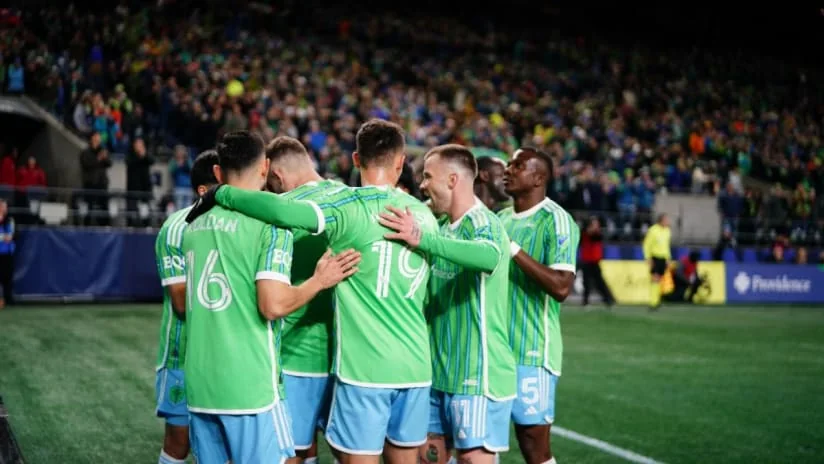
A completed series offers a concrete historical example. In the 2025 Round One matchup between Minnesota United and Seattle, Minnesota won Game 1 on penalties, Seattle won Game 2 in regulation, and Minnesota won Game 3 on penalties. Those were last season’s results, not a forecast or a result from the upcoming 2026 playoffs.
Game 1 finished scoreless before Minnesota took the shootout 3–2. Seattle then won the second match 4–2 at Lumen Field. That emphatic response left the series at one win apiece. It did not put Seattle through, even though the Sounders had scored more goals over the first two games.

The deciding match at Allianz Field finished 3–3 in regulation. Minnesota prevailed 7–6 in a ten-round shootout and advanced. Seattle’s larger Game 2 victory had restored the series, but it did not carry a goal cushion into that final meeting.
Exclude the shootout kicks and add only the football goals: Seattle scored seven across the three matches, while Minnesota scored five. Minnesota nevertheless won the series two games to one. That is the real-world version of the hypothetical example above. It demonstrates why an aggregate-goals calculation can identify a different club from the one that actually advances.
The case also explains a potentially misleading result line. “3–3, Minnesota wins 7–6 on penalties” describes one match’s resolution. “Minnesota wins the series 2–1” describes the broader contest. Neither number can replace the other without losing information.
Use our 2025 playoff results and bracket recap for the historical campaign. Here the case serves a narrower purpose: recognizing the scoring unit in a best-of-three series. It does not establish who will qualify in 2026, how a particular current squad will perform, or whether a goalkeeper’s past shootout success will repeat.
Conference semifinals, conference finals and MLS Cup use extra time
Once the tournament reaches the conference semifinals, each pairing is a single knockout match. There is no next game in that round to balance a defeat. A level score after regulation leads to extra time, with a shootout needed only if the teams are still tied when that additional playing phase ends.
That change is easy to miss if your first playoff viewing was Round One. Check the round label before announcing that penalties are coming. A broadcast preparing for another half in a conference semifinal is following the later-round procedure, even though an earlier series between different clubs went directly to kicks.
Both extra-time periods are played
The two 15-minute periods are played in full. A goal in the first period does not immediately finish the match, and leading at the extra-time interval does not remove the second period. The trailing team still has the remaining playing time to respond.
Consider an invented conference semifinal tied 1–1 after regulation. A scores in the 97th minute to lead 2–1. Play continues. If B equalizes in the 113th minute and there are no further goals, the teams finish extra time at 2–2 and proceed to a shootout. If B does not equalize and A keeps the lead through the final whistle, A advances without penalties.
Allowance for time lost can apply in extra time too. A screen reaching 120:00 is therefore not a guarantee that the referee has already ended the match. For transport and viewing plans, leave room for the additional phases and their organization rather than assuming the regulation finish is the end of the evening.
Penalty shootouts are a separate contest
The standard shootout begins with teams taking kicks alternately, up to five each, and can finish earlier if the trailing side cannot catch up. If the totals remain level after five each, the contest continues until one team leads after both have taken the same number of additional kicks.
That last condition matters. A side scoring first in a sudden-death pair has not necessarily won at that instant: the opponent may still have its corresponding attempt. Likewise, a goalkeeper’s save can be decisive or merely keep the contest alive, depending on the count.
A useful viewing habit is to track attempts as well as goals. “Four scored” means something different after four attempts than after six. Read the sequence or penalty markers before interpreting a reaction shot. When the shootout ends, preserve the match score and add the separate penalty result instead of merging them into a larger football score.
Seeding determines the route and the home dates
The top seven clubs in each conference enter Round One directly. Eighth hosts ninth in a Wild Card match, and the winner faces that conference’s first seed. The other opening series pair second with seventh, third with sixth, and fourth with fifth. A lower seed number indicates a higher regular-season finish.
In Round One, the higher seed hosts Game 1 and, if necessary, Game 3. The lower seed hosts Game 2. That home–away–home sequence is why a series can move to a different city even after a very one-sided opening score. The venue order comes from seeding, rather than the winning margin in the previous match.
Conference semifinals and conference finals are hosted by the higher seeds. MLS Cup is hosted by the finalist ranked higher in the Supporters’ Shield standings. Home status does not give a team permission to advance from a tied match without following the relevant playing and shootout procedure.
Why Game 2 is guaranteed but Game 3 is conditional
No team can reach two wins after only one match. Every Round One series therefore needs a second game, and both clubs receive a home date. A third meeting is needed only when the opening two games produce one win for each club. A 2–0 sweep ends the series without playing the conditional third match.
For the fan looking at a ticket or a calendar, “if necessary” is a sporting condition with a precise meaning. It is not a promise that Game 3 will happen just because a date has been reserved. Check the completed series results before planning around that reservation, and read the seller’s own terms for any ticket or travel consequences.
MLS has announced these 2026 round windows. They are schedule windows, not a guarantee of a particular club’s kickoff time, and the league notes that dates can change.
| Stage | Announced 2026 dates |
|---|---|
| Wild Card | November 18 |
| Round One Game 1 | November 20–24 |
| Round One Game 2 | November 27–28 |
| Round One Game 3, if needed | December 1–2 |
| Conference semifinals | December 5–6 |
| Conference finals | December 11–12 |
| MLS Cup | December 18 |
A useful personal calendar separates confirmed attendance from possible attendance. Keep a provisional third game labeled that way until the series reaches 1–1. Once a fixture is assigned a precise date and time, record its time zone too. A broad playoff window is sufficient for understanding the format but insufficient for choosing a train or knowing when to open a stream.
Check our current playoff schedule and bracket for the developing matchups. A hypothetical series in this article cannot supply the actual opponent, host or start time for an unresolved slot.
A matchday reading guide for scores, stakes and remaining time
When joining a playoff broadcast late, read three things before interpreting the score: the round, the phase of the match and any series tally. A 1–1 display does not by itself tell you whether a team is minutes from elimination, about to start extra time or preparing for a shootout that might only force another game.
Keep three different numbers separate. The football score describes the goals in the current match. The shootout score, if there is one, describes successful kicks in the deciding contest. The Round One series score describes match wins. A result can contain all three without any contradiction.
Consider a hypothetical Game 2 with A leading the series 1–0 and the match level late in regulation. If A wins the ensuing shootout, the series ends. If B wins it, the teams go to Game 3. B cannot advance from that Game 2 shootout alone because it would still have only one series victory.
Now imagine a level Game 3. The same direct-shootout rule applies after regulation, but the consequence is different: the shootout winner takes its second series victory and advances. The organization of the kicks may look similar to Game 2; the stakes change because the series state is different.
Before a conference semifinal or later round, leave room in your evening for extra time as well as possible penalties. Do not promise someone an exact pickup time based on a ninety-minute calculation. Stoppage time, halftime, additional playing periods and the shootout process all affect the wall-clock finish.
- Identify the season and round on the fixture page.
- Check whether the displayed score is live, final, after extra time or after penalties.
- For Round One, find the match-win tally rather than adding the goals.
- Read any Game 3 listing as conditional until the series requires it.
- Use the match’s current date, time zone and viewing details when planning.
Coverage of possible formats for a later MLS season concerns a different question from the 2026 procedure described here. Read the season attached to an explainer before applying it. For the upcoming match’s channel and stream, use the MLS TV schedule; for what happens when the score is tied, return to the rule for that round.
Comments
Comments are reviewed before publication.
Spam, abusive content, personal information and policy-violating links are not published.
Sign in with Google to comment or reply.
Loading comments…