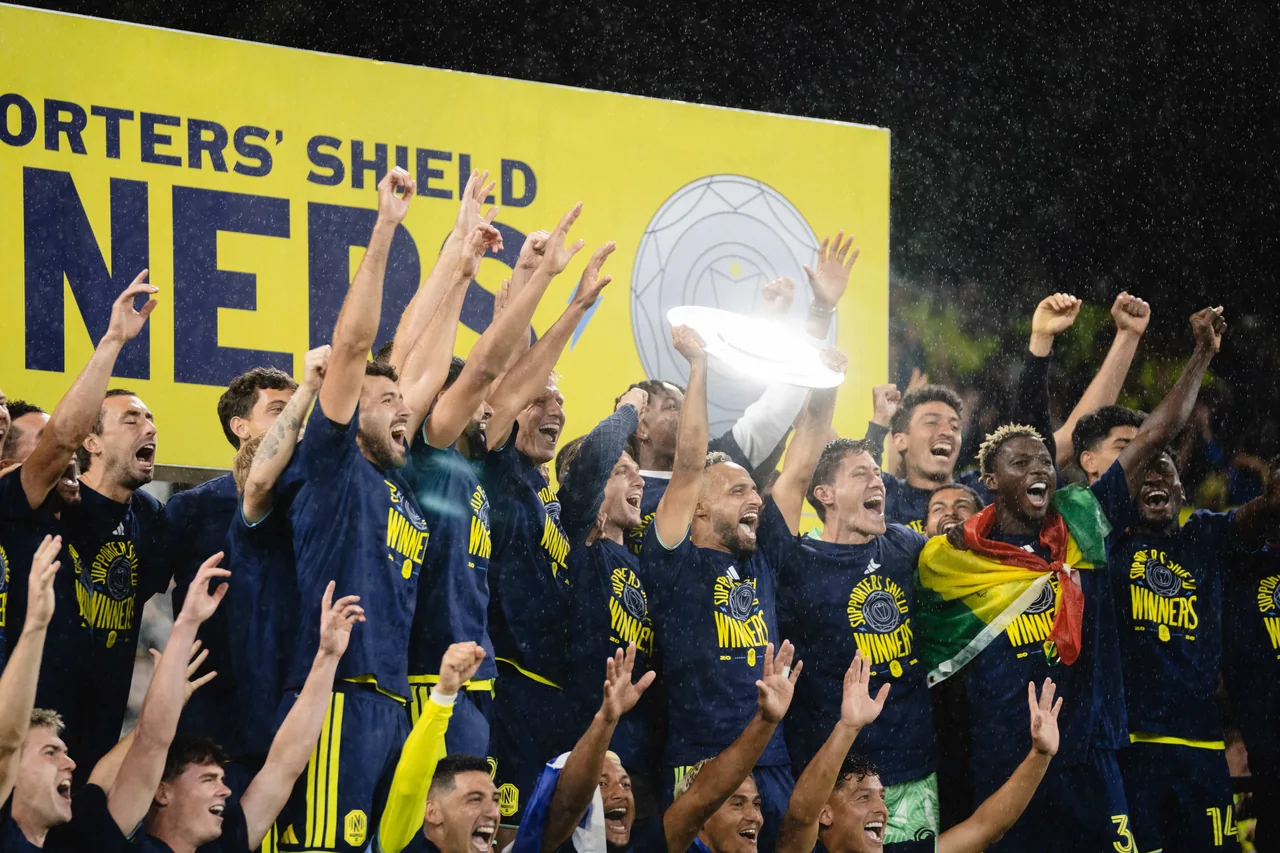
What the Final 2026 MLS Standings Show
Nashville SC finished the 2026 MLS regular season first overall with a league-record 77 points. Nashville also led the Eastern Conference and won its first Supporters’ Shield. Vancouver Whitecaps FC led the Western Conference with 64 points. The standings below are final as of Saturday, November 7, 2026, when all 30 clubs finished a 34-match regular season on Decision Day. They give each team’s conference finish, its match record and its postseason position at the final whistle.
Nashville entered the last day with the Shield secured and 74 points, tied with Inter Miami’s 2024 single-season mark. The 2–0 win at FC Cincinnati moved Nashville three points clear of that record, leaving it with 23 wins, eight draws and only three losses. Nashville scored 71 goals and allowed 25, a difference of 46 across the full schedule. It was a 13-point Shield margin, even with Vancouver winning its own finale to reach 64. That separation is worth keeping in mind when looking at the two No. 1s. Each led its conference. Nashville put together the strongest regular-season record across the league. The Nashville Shield guide follows the club’s run to the trophy.
The tables use each team’s record in MLS regular-season play. A result from the Leagues Cup, Concacaf Champions Cup or the MLS Cup Playoffs belongs to a different competition or stage and stays outside these totals. That matters if you are comparing a club’s season summary, where all competitions may be combined, with the figures governing playoff qualification. It also explains why the Shield winner can be known as soon as the season standings are settled, while MLS Cup is decided by the matches that follow.
Start with the rank and points columns if you want to know where your club finished. The wins, draws and losses give the record behind those points, and the goals columns show whether goal difference separated two clubs with the same points and wins. The playoff column marks a second distinction that the rank alone can obscure: seventh reached Round One directly, eighth and ninth entered the Wild Card, and tenth ended its regular season outside the field. For later seasons and match-by-match updates, use the current MLS standings. The November 7 table stays fixed as an archive.
Final 2026 MLS Eastern Conference Standings
Nashville’s 17-point lead over Inter Miami was the largest gap between adjacent positions in the final Eastern table. The next group was much closer. Miami finished on 60, New England on 58, Chicago on 55 and Charlotte on 54, so six points separated second from fifth. At the other end of the postseason field, seventh-place Columbus finished just one point ahead of both Wild Card teams. The first number answers how far apart the teams finished. The cutoffs explain why some of the smaller differences changed what happened next.
| Rank | Club | Pts | GP | W | D | L | GF | GA | GD | Playoffs |
|---|---|---|---|---|---|---|---|---|---|---|
| 1 | Nashville SC | 77 | 34 | 23 | 8 | 3 | 71 | 25 | +46 | Round One |
| 2 | Inter Miami CF | 60 | 34 | 16 | 12 | 6 | 80 | 59 | +21 | Round One |
| 3 | New England Revolution | 58 | 34 | 18 | 4 | 12 | 55 | 47 | +8 | Round One |
| 4 | Chicago Fire FC | 55 | 34 | 16 | 7 | 11 | 64 | 54 | +10 | Round One |
| 5 | Charlotte FC | 54 | 34 | 15 | 9 | 10 | 66 | 51 | +15 | Round One |
| 6 | Philadelphia Union | 50 | 34 | 14 | 8 | 12 | 66 | 52 | +14 | Round One |
| 7 | Columbus Crew | 47 | 34 | 14 | 5 | 15 | 59 | 52 | +7 | Round One |
| 8 | Orlando City SC | 46 | 34 | 13 | 7 | 14 | 63 | 78 | −15 | Wild Card |
| 9 | FC Cincinnati | 46 | 34 | 12 | 10 | 12 | 67 | 75 | −8 | Wild Card |
| 10 | Red Bull New York | 42 | 34 | 12 | 6 | 16 | 48 | 62 | −14 | Eliminated |
| 11 | New York City FC | 42 | 34 | 10 | 12 | 12 | 49 | 45 | +4 | Eliminated |
| 12 | Toronto FC | 39 | 34 | 9 | 12 | 13 | 52 | 67 | −15 | Eliminated |
| 13 | Atlanta United | 33 | 34 | 9 | 6 | 19 | 43 | 60 | −17 | Eliminated |
| 14 | D.C. United | 33 | 34 | 7 | 12 | 15 | 39 | 61 | −22 | Eliminated |
| 15 | CF Montréal | 26 | 34 | 6 | 8 | 20 | 37 | 69 | −32 | Eliminated |
GP is games played, W is wins, D is draws and L is losses. GF and GA are goals for and goals against. GD is the difference between them. Miami scored 80 and allowed 59, while Nashville scored 71 and conceded 25. Nashville’s larger positive goal difference came despite scoring nine fewer goals. The two clubs illustrate how a team can finish ahead in the standings without topping every category on the table.
Miami and New England offer another way to read the records. New England won 18 games, two more than Miami. Miami had 12 draws against New England’s four, so those results supplied eight more points and outweighed the six-point difference from wins. That is how Miami finished two points higher even with fewer wins. Wins would have mattered as the first tiebreaker had the clubs ended level. Here their points separated them before any tiebreaker was needed.
The Direct Playoff Line and the East Wild Card
Columbus held the last place that went straight into Round One. Its 47 points were enough to avoid the extra match that Orlando and Cincinnati faced. Both of those clubs finished on 46, and the competition’s first tiebreaker put Orlando eighth because it had 13 wins against Cincinnati’s 12. Cincinnati had the better goal difference, by seven, but goal difference comes into play only after a tie in wins. Orlando therefore earned the home match. A table sorted by goal difference immediately after points would send readers to the wrong venue.
There was more breathing room between the Wild Card and the eliminated clubs. Red Bull New York and New York City FC each finished with 42, four behind Cincinnati for ninth. Their tie mattered to the order of the table, with Red Bull New York’s two additional wins putting it tenth. Neither club was close enough to use that tiebreaker to enter the postseason. The best shorthand for the East is three separate numbers: 47 secured direct entry, 46 was enough to qualify by the Wild Card, and 42 was the best return among the teams that missed out. Those are outcomes of this season’s table, not thresholds fixed by MLS rules.
Final 2026 MLS Western Conference Standings
Vancouver finished six points ahead of FC Dallas at the top of the West. Three teams below Dallas finished within three points of each other, from St. Louis in third to Houston in fifth. Lower down, Portland and Seattle finished level on 46 on opposite sides of the direct-entry line. Seattle and Real Salt Lake made the Wild Card with 46 and 45 respectively. The western cutoff was one point lower than the eastern cutoff, and its ninth-place team held a narrower margin over the first club out.
| Rank | Club | Pts | GP | W | D | L | GF | GA | GD | Playoffs |
|---|---|---|---|---|---|---|---|---|---|---|
| 1 | Vancouver Whitecaps FC | 64 | 34 | 19 | 7 | 8 | 74 | 34 | +40 | Round One |
| 2 | FC Dallas | 58 | 34 | 16 | 10 | 8 | 62 | 51 | +11 | Round One |
| 3 | St. Louis CITY SC | 54 | 34 | 15 | 9 | 10 | 59 | 48 | +11 | Round One |
| 4 | San Jose Earthquakes | 52 | 34 | 14 | 10 | 10 | 57 | 51 | +6 | Round One |
| 5 | Houston Dynamo FC | 51 | 34 | 14 | 9 | 11 | 43 | 43 | 0 | Round One |
| 6 | LAFC | 47 | 34 | 12 | 11 | 11 | 52 | 40 | +12 | Round One |
| 7 | Portland Timbers | 46 | 34 | 13 | 7 | 14 | 62 | 61 | +1 | Round One |
| 8 | Seattle Sounders FC | 46 | 34 | 12 | 10 | 12 | 44 | 46 | −2 | Wild Card |
| 9 | Real Salt Lake | 45 | 34 | 13 | 6 | 15 | 53 | 52 | +1 | Wild Card |
| 10 | Minnesota United FC | 44 | 34 | 11 | 11 | 12 | 56 | 58 | −2 | Eliminated |
| 11 | LA Galaxy | 44 | 34 | 11 | 11 | 12 | 50 | 57 | −7 | Eliminated |
| 12 | Colorado Rapids | 43 | 34 | 12 | 7 | 15 | 47 | 50 | −3 | Eliminated |
| 13 | San Diego FC | 38 | 34 | 9 | 11 | 14 | 57 | 63 | −6 | Eliminated |
| 14 | Austin FC | 34 | 34 | 8 | 10 | 16 | 42 | 65 | −23 | Eliminated |
| 15 | Sporting Kansas City | 26 | 34 | 7 | 5 | 22 | 40 | 81 | −41 | Eliminated |
The West Leaders and the Gap to Seventh
The Whitecaps won 19 matches, three more than any other Western club. Their 74 goals scored and 34 conceded were both club records for a regular MLS season, and the resulting plus-40 goal difference was by far the West’s strongest. Dallas and St. Louis both finished at plus-11, with Dallas four points ahead. Those figures show two things about the race. Vancouver pulled away from second place on both measures, and equal goal differences elsewhere did not mean clubs earned the same number of points.
Dallas and Portland each scored 62 goals, but Dallas gave up 51 to Portland’s 61 and won three more matches. They finished 12 points apart and drew one another for Round One. That difference shows up most clearly at the venues. Dallas entered at No. 2 with the right to host the opener and a potential third match. Portland’s late recovery secured direct entry at No. 7 and guaranteed the club a home match in the series. The scoring column gives you two similarly productive teams. The points and final ranks explain Dallas’s home-field advantage.
The West’s Final Playoff Cutoff
Portland’s 13 wins gave it the higher seed over Seattle, which won 12 but drew three more games. Seattle took eighth and the remaining West home date in the Wild Card. Real Salt Lake finished one point behind Seattle and one point ahead of Minnesota and the LA Galaxy. Salt Lake’s 13 wins were the same as Portland’s, yet it had one fewer draw and one more loss. That was the point separating a direct qualifier from a Wild Card visitor in this year’s table, even though the clubs finished two positions apart.
Minnesota and the Galaxy had the same 11 wins, 11 draws and 12 defeats. Since their wins were also level, the next ranking measure applied: Minnesota’s minus-two goal difference beat the Galaxy’s minus-seven. This differed from Portland’s tie with Seattle, which was already resolved by wins. Neither Minnesota nor the Galaxy reached the field. In the East, four points separated ninth from tenth, whereas in the West it was one. That is why an extra point would have mattered more to the eliminated clubs nearest the Western line.
What Changed on Decision Day
The nine Eastern playoff teams were known before kickoff, so the East was playing for seeds, opponents and venues. In the West, six teams were chasing the last three places. MLS scheduled the Eastern matches for 4 p.m. ET and the Western matches for 7 p.m. ET. The Vancouver game at Montréal was the only cross-conference fixture and started in the earlier window. That timing mattered because score changes in one stadium could move a team in another while both matches were still in progress. The November 7 schedule and results has the full slate.
Three Western Teams Won the Remaining Places
The LA Galaxy opened the day in seventh on 44 points. Portland and Colorado occupied eighth and ninth on 43, with Seattle also on 43 but sitting tenth. Real Salt Lake was another point back, and Minnesota started on 41. When the matches finished, Portland was the only team of the three that began the day above the line to stay there. Seattle and Salt Lake took the other two slots. The final order records a change for each of the teams that made it: Portland climbed one place, Seattle climbed two, and Salt Lake went from eleventh to ninth.
Portland took care of its own qualification by beating Austin 2–0. Seattle defeated LAFC 2–1 at Lumen Field after Albert Rusnák scored in the opening minute and Sebastian Gomez added the second goal. The Sounders still needed a favorable result elsewhere. The Galaxy and Colorado both lost, and two of Seattle’s published qualification routes were satisfied. Salt Lake’s path depended on Colorado dropping points once the other matches played out. Sergi Solans and Zach Booth put Salt Lake two up inside 13 minutes against the Galaxy, and RSL held on to win 2–1. In Texas, Dallas came from behind to beat Colorado 3–1. Those two results together put Salt Lake above the cutoff.

Minnesota did its part with a 3–1 win over San Jose, rising to tenth. It still needed two of the other relevant results to go its way and finished on 44. In the same match, San Jose failed to add to its total but retained fourth because St. Louis beat Houston. One of the afternoon’s peculiarities was that a team could win and miss the playoffs, as Minnesota did, while its opponent could lose the match and still secure the Round One hosting advantage. The standings capture both outcomes because each was decided against a different group of teams.
Which Eastern Teams Moved Before the Playoffs
Columbus changed its route in stoppage time. The Crew trailed Chicago three times and were level at 3–3 in the final minutes. At that point, with Orlando beating New England 1–0 and Cincinnati losing to Nashville, a draw would have kept Columbus on 45 points and sent it to Cincinnati for the Wild Card. Brais Méndez scored in the 93rd minute to make it 4–3. The win moved Columbus to 47 and seventh, leaving Cincinnati to visit Orlando and sending the Crew straight into a series with Miami. One late goal changed two postseason pairings.
Chicago’s defeat opened the door for Charlotte to take fourth with a win. Charlotte erased a 3–0 halftime deficit in Miami, but the match finished 3–3. Chicago kept fourth by one point and earned home field for the series against Charlotte. Miami also kept second because New England lost in Orlando. Three of the final Eastern positions thus make more sense together: Columbus rose by winning late, Chicago retained fourth after a loss, and Miami held second after surrendering a large lead.
How the Final Table Became the Playoff Bracket
The two conference tables produced an 18-team postseason field. Fourteen teams went straight to Round One, seven from each conference. The eighth and ninth seeds in each conference had to play a single-elimination Wild Card match. Its winner took the remaining Round One spot on that side of the bracket, against the No. 1 seed. The other Round One pairings matched second with seventh, third with sixth, and fourth with fifth. This is why the direct-entry line matters even when two teams finish on the same number of points.
MLS assigned both Wild Card matches to November 19. In the East, Orlando was assigned to host FC Cincinnati at Inter.co Stadium, with a scheduled kickoff of 7:30 p.m. ET. The winner would advance to meet Nashville. In the West, Seattle was assigned to host Real Salt Lake at Lumen Field at 10 p.m. ET, or 7 p.m. PT, with the winner due to face Vancouver. The bracket paired Miami with Columbus and Dallas with Portland directly in Round One. Those draws were set by the final standings and are part of the archive regardless of how the series unfold. For results and updated dates, see the MLS playoffs schedule and bracket.
Home Games, Tiebreakers and MLS Cup
The standings first award three points for each win and one for each draw. A loss earns zero. When two teams have the same points, MLS checks wins, then goal difference, then goals scored. That order explains why readers need the wins column even when goals look like the obvious way to sort tied teams. It also means that a club far ahead in goal difference can still rank behind another if its points match and it has fewer wins. After discovering a tie, move across the table from wins to goal difference and then goals scored. Check the published league order where clubs remain level through those measures.
In each Round One series, the higher seed hosts the first game and a third game if one is necessary. The lower seed hosts Game 2. Chicago and Charlotte illustrate the difference one point made. Chicago’s 55 secured the first home date and the potential deciding home game, while Charlotte’s 54 made it the visitor for those matches. The later rounds within each conference use the higher advancing seed as host in one-match ties. Winning the conference’s regular-season table therefore gives a club home-field priority on its side of the bracket for as long as it advances.
The Cup final uses a separate comparison between the two finalists. The club higher in the league-wide Supporters’ Shield standings hosts the match scheduled for December 18. Nashville ranked first and Vancouver second league-wide, so Nashville would host if both reached that final. The Shield was earned over the 34-match schedule. The Cup goes to the team that wins the final after advancing through the postseason. For another finished season’s records and qualification line, see the 2025 MLS final tables.
Comments
Comments are reviewed before publication.
Spam, abusive content, personal information and policy-violating links are not published.
Sign in with Google to comment or reply.
Loading comments…