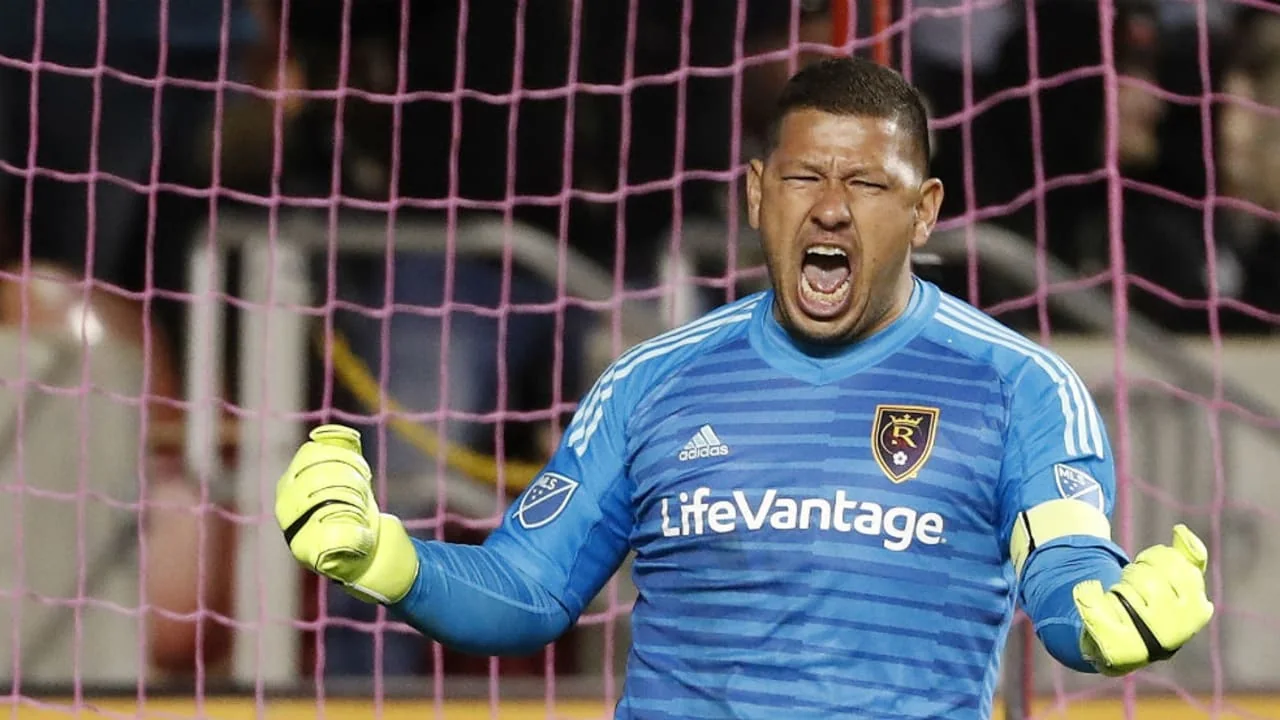
Our MLS all-time best XI and the rules behind it
Our MLS all-time best XI uses a 4-2-3-1: Nick Rimando; Frankie Hejduk, Eddie Pope, Chad Marshall, Todd Dunivant; Kyle Beckerman, Osvaldo Alonso; Landon Donovan, Carlos Valderrama, Dwayne De Rosario; Chris Wondolowski. The selection prioritizes sustained MLS achievement and a workable team shape. It is our editorial lineup, not a newly announced league award.
| Position | Player | Job in this team |
|---|---|---|
| Goalkeeper | Nick Rimando | Shot-stopping and an experienced foundation |
| Right back | Frankie Hejduk | Provide width and recover into the back four |
| Center back | Eddie Pope | Defend space beside the other center back |
| Center back | Chad Marshall | Protect the box and contest aerial balls |
| Left back | Todd Dunivant | Balance the flank behind De Rosario |
| Holding midfield | Kyle Beckerman | Offer the safe passing outlet |
| Holding midfield | Osvaldo Alonso | Challenge advancing opponents |
| Right attack | Landon Donovan | Run beyond the striker and combine inside |
| Central attack | Carlos Valderrama | Supply the final pass |
| Left attack | Dwayne De Rosario | Move inside to create and shoot |
| Striker | Chris Wondolowski | Find finishing positions in the penalty area |
MLS careers count more than worldwide fame
We assess what players contributed in MLS, with completed seasons through 2025 forming the cutoff for this September 2026 selection. A World Cup medal or a European club career does not automatically win a place. Equally, a player does not have to spend his whole professional life in MLS to qualify.
We weigh peak quality, sustained contribution, major MLS achievements and the requirements of each position. Longevity matters when the level remains high; appearances alone are insufficient. The result deliberately includes specialists whose jobs would disappear if we simply selected eleven famous attackers.
This is different from the official 2005 selection
MLS named an All-Time Best XI during its tenth-anniversary era in 2005. Its later 25 Greatest celebration was another historical selection with a different scope. Those lists help establish context, but neither should be presented as an official verdict incorporating every season since publication. Our lineup also differs from a general ranking of the greatest players: fitting the team is part of winning a position.
Goalkeeper: Nick Rimando supplies the foundation
Rimando finished his MLS career in 2019 with 514 regular-season appearances and 154 clean sheets. He won MLS Cup with D.C. United in 2004 and Real Salt Lake in 2009. Those achievements give his selection a combination of sustained responsibility and championship experience.
The workload matters because goalkeeping is a position where repeated decisions can be as important as isolated spectacular saves. A goalkeeper must judge when to intervene, when to trust a defender and how to recover after an error. Rimando's career provides a much larger MLS body of work than a reputation based primarily on performances overseas.
What we would ask him to do
In this hypothetical team, Rimando would first protect the goal and keep the defensive unit organized. We would not require every possession to begin with a risky short pass. With Valderrama and Donovan ahead, the objective would be to get the ball safely to players who can advance the attack, rather than make the goalkeeper responsible for breaking every opposing press.
His selection also avoids a common historical mistake: turning the most decorated international goalkeeper to appear in MLS into the automatic choice. International achievement is relevant background, but this exercise rewards the work performed within the league.
The strongest objection
Tony Meola's peak offers a different argument, and fans can reasonably prefer another keeper for a single final. Our decision gives greater weight to the full MLS career. It does not claim that Rimando won every individual goalkeeping award or was the best goalkeeper in every year he played. A strong all-time case does not require either assertion.
Defense: four specialists with complementary responsibilities
Right back: Frankie Hejduk
Hejduk captained Columbus during its 2008 championship season and scored the late goal that secured breathing room in the MLS Cup final. The Crew's retrospective shows how he recognized space, attacked it and finished the move. That is a useful example of a fullback contributing something an extra central playmaker cannot provide.
We would use Hejduk to support Donovan on the right. When Donovan moves inside, the fullback would offer an outside passing option. The instruction would be selective: join an attack when the ball is secure, then recover into the defensive line when possession changes. His place comes from choosing an actual right-back solution, rather than hiding another attacker in defense.
Center back: Eddie Pope
Pope earned four seasonal Best XI selections and the 1997 Defender of the Year award. His winning goal in the inaugural MLS Cup is part of his legacy, but his defensive career provides the stronger reason to start him here. An unforgettable header should not be the sole qualification for an all-time center back.
In our pairing, Pope would take particular responsibility for space beside and behind the fullbacks. That assignment is an editorial choice based on his mobility, not a claim that he and Marshall formed this exact partnership in MLS. The key would be coordination: one defender engages while the other protects the route toward goal.
Center back: Chad Marshall
Marshall won Defender of the Year three times. That repeated recognition supports a place built on sustained defensive quality rather than a short run of form. His aerial strength also gives this lineup an important answer when opponents bypass midfield and send the ball directly into the penalty area.
We would make Marshall the central reference when defending crosses, with Pope positioned to respond to runners and second balls. The same partnership would be useful on attacking set pieces, but advancing both center backs would require someone else to remain behind. Even an imaginary best XI needs to account for the opponent's counterattack.
Left back: Todd Dunivant
Dunivant's career included five MLS Cup titles and a 2011 Best XI selection. The Galaxy's own player profile identifies him as a long-serving primary left back. Those credentials give him a strong positional case even though his name is less prominent than those of several attackers left out of this team.
His assignment would be to balance the left side behind De Rosario. Sometimes that means an overlap; sometimes it means staying available for the backward pass that lets the attack restart. We prefer that clear responsibility to selecting a more celebrated central defender at left back simply to fit another famous name into the eleven.
The fullback choices are among the lineup's most debatable. They reward position-specific MLS careers. A three-center-back system could accommodate a different defender, but it would also create wingback duties that someone else must perform. Changing the formation changes the selection problem rather than making it disappear.
Holding midfield: Kyle Beckerman and Osvaldo Alonso
Beckerman keeps the team connected
Beckerman retired after 498 regular-season MLS appearances and captained Real Salt Lake's 2009 championship team. His official player profile emphasizes positional awareness and accurate passing. Those qualities make him a good choice for a lineup with several players who want freedom ahead of the ball.
We would ask Beckerman to remain available underneath Valderrama. If the forward pass is blocked, he would offer the shorter route that preserves possession and changes the angle of the next attack. That may sound modest beside a goal or assist, but it is a specific job this team needs.
His selection is not an argument that defensive midfielders should never advance. It is an allocation of responsibility. With Donovan running beyond the striker and De Rosario moving inside, somebody must recognize when another forward run would leave too much space behind.
Alonso provides the more aggressive challenge
Alonso's MLS career included Seattle's 2016 Cup-winning season and a 2012 Best XI selection. His retirement in 2024 closed a long career built around defensive midfield. We choose him beside Beckerman because protecting the center is worth two places in this particular arrangement.
In our proposed partnership, Alonso would be the first to confront an opponent carrying the ball through midfield when Beckerman is positioned to cover. If Alonso were drawn wide, Beckerman would guard the central route. The roles could reverse when the situation demanded it; the principle is that both should not chase the same opponent at once.
Why not use another attacking midfielder?
Replacing a holder with a creator would increase the number of passing options around the box. It would also change the demands on the fullbacks and Valderrama. We prefer to begin with a stable base and make that attacking change if the game requires it.
Diego Chara is an especially strong alternative for this unit. Choosing him would preserve the underlying logic of the lineup. The real disagreement is which outstanding MLS defensive midfielder best serves the partnership, rather than whether a famous attacking player should be allowed to ignore the position altogether.
Attacking midfield: Donovan, Valderrama and De Rosario
Landon Donovan starts on the right with freedom to move
Donovan won six MLS Cups: two with San Jose and four with the Galaxy. That record gives him championship evidence across different teams and periods. We would select him even without adding his international achievements to the argument.
Starting him on the right does not mean asking him to remain beside the touchline. His task in this lineup would be to move between combining with Valderrama and running beyond Wondolowski. If the striker holds the attention of the center backs, Donovan can attack the space that opens beside them.
That movement creates a practical reason for Hejduk's selection behind him. The fullback provides an outside option when Donovan leaves the flank. Both players would need to read the same situation rather than make the same run. The proposed relationship is part of our team design, not a claim that this exact eleven shared a club dressing room.
Carlos Valderrama receives the central creative role
Valderrama recorded 26 assists in the 2000 regular season. It is a concrete example of the passing contribution behind his selection. We give him the central role because this team already contains runners and finishers; it needs a player tasked primarily with finding them.
His starting position would be between the opposing midfield and defense. If an opponent follows him away from that space, a teammate can move into it. If nobody follows, Beckerman has a forward passing target. We would not ask Valderrama to solve every defensive problem that arises when the fullbacks advance, which is one reason for selecting two holders.
The objection is obvious: another creator may offer more scoring or a different kind of pressing. This is a conscious choice to value an extended MLS playmaking career and build the surrounding roles accordingly.
Dwayne De Rosario attacks from the left toward the center
De Rosario won four MLS Cups and the 2011 MVP award. In that MVP season, he produced 16 goals and 12 assists. The combination supports choosing him as a player who can create a chance or finish the move himself.
We would start him on the left of the attacking three, with permission to come inside. This is a proposed role for the lineup, not a claim that he spent his entire MLS career as a conventional left winger. Dunivant's positioning behind him would become particularly important whenever he moved centrally.
De Rosario and Donovan should not both crowd Valderrama every time the ball enters midfield. One can offer a short combination while the other attacks beyond the defense. That simple division would help turn individual talent into different passing options, rather than leave three excellent players asking for the same ball in the same patch of grass.
Striker: Chris Wondolowski gets the finishing job
Wondolowski retired in 2021 with 171 MLS regular-season goals. His four-goal performance against Chicago in May 2019, when San Jose won 4-1 and he passed Donovan's career scoring mark, is a memorable illustration of the scoring record behind this choice.
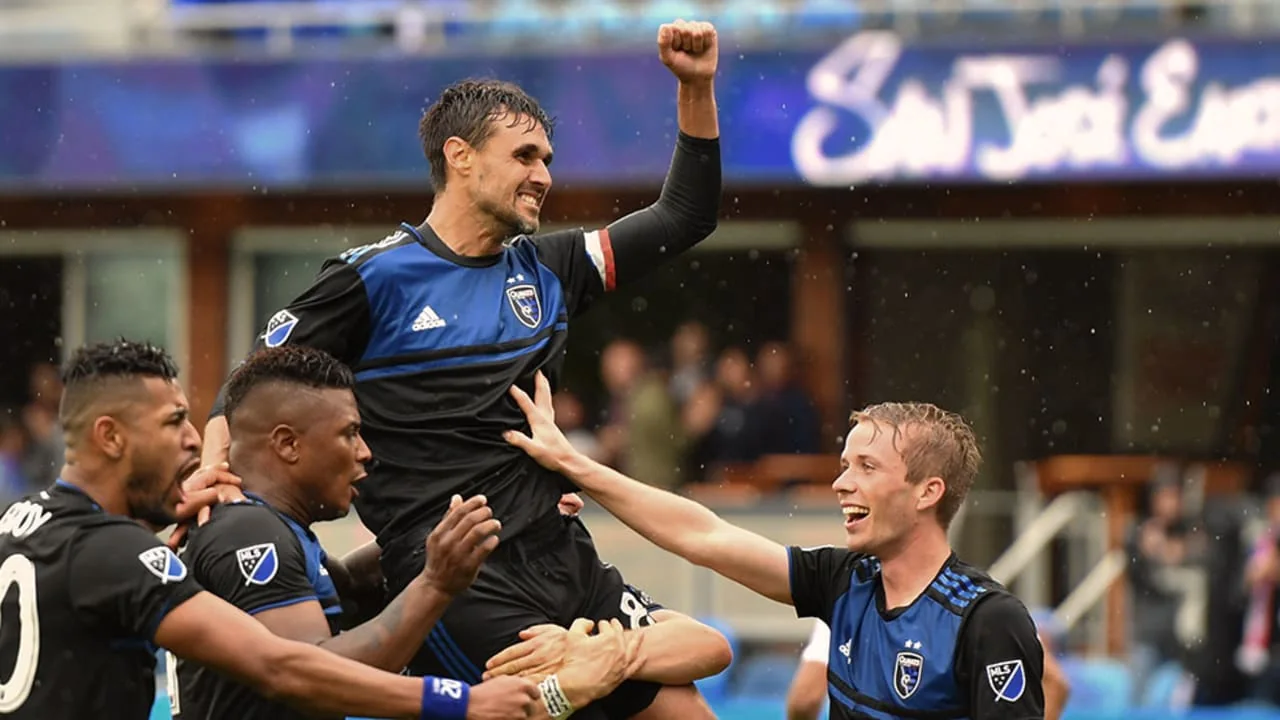
We choose him to occupy finishing positions rather than make him the main creator. Valderrama can seek the pass, Donovan can threaten the space beyond him, and De Rosario can arrive from the other side. Wondolowski's responsibility would be to remain a target when those movements draw defenders away from the most dangerous area.
Why his role matters to the other attackers
If every attacking player drops toward midfield to receive the ball, the opposing back line can step forward. We would ask Wondolowski to resist that tendency. Even when he does not receive the pass, staying near the center backs can preserve space for the creators behind him.
There would still be moments to combine outside the box. The distinction is about the first responsibility, not a prohibition on passing. In a team with this much creativity, we want the striker thinking early about where the move might finish.
Why Robbie Keane is a credible alternative
Keane would be a strong choice for a coach who wanted a different relationship between the striker and attacking midfielders. Our preference for Wondolowski gives substantial weight to his completed MLS scoring career and the clearly defined job available in this eleven.
That is not a claim that a goals total measures every part of forward play. It explains which part of the comparison decides the selection here. Switching to two strikers would let Keane join him, but it would require removing a player elsewhere and revisiting the team's defensive responsibilities.
How the team would play, and the changes from the bench
A clear shape when the ball is lost
Our starting instruction would be a compact 4-4-1-1 without possession. Donovan and De Rosario would recover beside the two holding midfielders, leaving Valderrama behind Wondolowski. That is a proposed defensive arrangement for this fictional team, not evidence that eleven outstanding players would automatically execute it perfectly.
When attacking, only one fullback should advance aggressively at a time unless the game situation demands more risk. The opposite fullback and the holding midfielders would preserve cover. This gives the creative players room while recognizing that possession can end with a misplaced pass.
The principal weakness is the demand placed on the wide attackers to recover. If they stay high while both fullbacks overlap, even an exceptional midfield pair can become outnumbered. The remedy is a shared instruction and a willingness to change the lineup, rather than assuming historical reputation prevents tactical problems.
Where Lionel Messi fits in the discussion
Messi won MLS MVP in both 2024 and 2025 and helped Miami win MLS Cup in 2025. His case is therefore already based on major MLS achievements, not simply fame earned elsewhere. Any serious contemporary all-time selection must acknowledge that evidence.
Our starting eleven gives greater weight to longer completed MLS careers. That preference keeps Valderrama in the central role, but it is one of the lineup's most contestable decisions. If the question were the highest attacking peak for one match, Messi would be an entirely reasonable starting choice. He would be our first attacking alternative when seeking a different solution against a deep defense.
Substitutions should change a job, not just a name
Keane could join Wondolowski when chasing a goal, with one holding midfielder withdrawn and the shape adjusted to support two forwards. Chara could replace a holder without changing the basic midfield plan. Robin Fraser would be a strong defensive alternative, while Meola supplies a different goalkeeper choice.
Those are tactical options rather than a second ranking of everyone omitted. A bench has to address different match situations. Adding another creator, another forward and a replacement defender provides more practical flexibility than filling every seat with players who require the same central attacking role.
Readers building their own XI should begin with the formation, identify who protects the defense and decide who supplies width. Then make the difficult player choices. For the current generation rather than this historical selection, the MLS games today page provides a starting point for following the league's next candidates.
Comments
Comments are reviewed before publication.
Spam, abusive content, personal information and policy-violating links are not published.
Sign in with Google to comment or reply.
Loading comments…