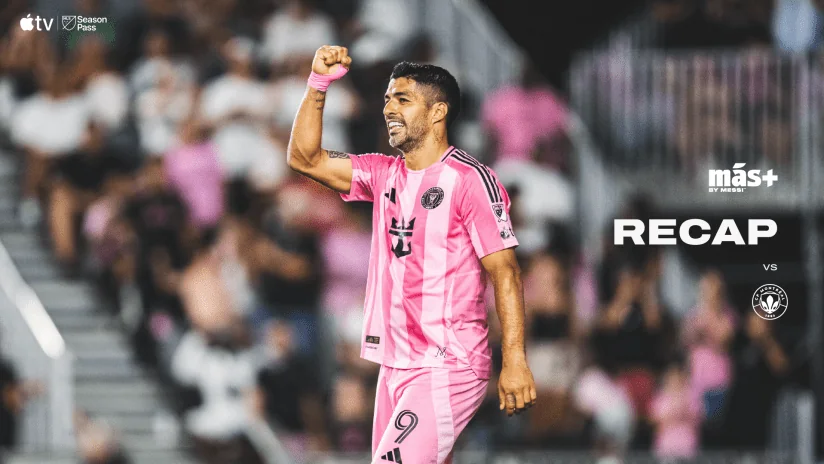
Luis Suárez remains an Inter Miami CF forward in 2026, following the new contract announced in December 2025. His Miami career combines a productive first MLS season, a championship-winning second year and a changing attacking environment in his third. The clearest way to understand it is to keep those stages separate, and to label every goals total by competition.
This guide was checked on October 11, 2026. It focuses on Suárez's Inter Miami work: what he has scored, how his partnership with Lionel Messi functions, and why his influence extends beyond a list of finishes. Completed-season numbers are historical records; midseason match examples are dated observations.
Is Luis Suárez still an Inter Miami player in 2026?
Yes. Miami's official announcement confirmed a contract through the 2026 MLS season, and the league's current player header lists Suárez as Inter Miami's No. 9. He was born in Salto, Uruguay, on January 24, 1987, making him 39 during the 2026 season. A contract through this season does not establish a further extension, retirement date or guaranteed starting place.
The club first announced his signing on December 22, 2023, ahead of the 2024 campaign. He arrived after playing for Grêmio in Brazil. That timing matters: he was reunited with familiar teammates, but he was joining a Miami project that had already begun before his arrival. He should not be credited with appearances in the club's 2023 MLS or Leagues Cup campaign.
His previous Barcelona experience helps explain why the Messi partnership attracted immediate attention. Familiarity can reduce the time needed for attacking players to recognize each other's choices: when one comes short, when another attacks the box, and how quickly a pass can be delivered. It does not eliminate the work of adapting to a new team. Miami still needs defenders and midfielders to move the ball into useful areas before its forwards can combine.
There are three different kinds of status to keep in mind. A roster entry answers whether he belongs to the club. A current match report or squad update can establish involvement in a particular period. A starting lineup answers whether the coach has selected him to begin one particular game. Mixing those categories is why an accurate contract article can be misread as a promise about next weekend.
For Suárez, that distinction is especially practical because his Miami career has covered several competitions and a changing cast of attackers. The useful question is how he fits the team selected for the match in front of you. His reputation establishes why supporters know his name; the Miami evidence establishes what he is doing here.
Suárez's Inter Miami goals by competition
There is no single useful answer to “how many goals has Suárez scored for Miami?” without a cutoff and a competition. The table below compares his two completed Miami seasons. The all-competitions figures come from the club's end-of-2025 contract announcement; the regular-season and playoff figures come from the separately filtered player statistics.
| Season | MLS regular-season goals | MLS playoff goals | Club goals, all competitions | Club appearances, all competitions |
|---|---|---|---|---|
| 2024 | 20 | 1 | 25 | 37 |
| 2025 | 10 | 0 | 17 | 50 |
The 2024 Supporters' Shield season
Suárez scored 20 regular-season goals in 27 appearances during his debut MLS season, adding nine assists. He also scored once in the playoffs. The larger club-season total was 25 goals across all competitions. Use 20 when discussing his position in that year's MLS regular-season scoring race; use 25 when discussing his full competitive work for Miami.
Inter Miami won the Supporters' Shield and set the MLS single-season points record that year. The Shield rewards regular-season performance, while MLS Cup is decided by the postseason. A forward's excellent league output can therefore be part of a major achievement even when the same team does not finish the playoffs as champion. Our MLS Cup winners archive explains the separate championship history.
His first-year numbers also challenge a narrow reading of his role. Nine league assists sit alongside the goals. For a center forward, a productive season can include receiving a pass, drawing pressure and supplying a teammate as well as finishing the final action himself. Those contributions help explain why Miami renewed the partnership beyond the original 2024 deal.
The 2025 championship season
In 2025, his league scoring total was lower: 10 regular-season goals in 28 appearances. He also had 10 regular-season assists. His club-wide season ended with 17 goals and 17 assists in 50 appearances, according to Miami's announcement. Those broader figures cover a much busier competitive year than a league-only filter can show.
Miami won the Eastern Conference championship and MLS Cup in 2025. Suárez's playoff statistics list four appearances and no goals, a reminder that being part of a championship team is not the same as scoring in every championship round. The team's success and his personal totals should be described accurately alongside each other. Neither needs to be exaggerated to make the season significant.
For a fair comparison with 2024, first use the same regular-season column. Then consider the separate question of his club's wider calendar. A 50-appearance year can contain different opponents, rotations and tournament demands from a 37-appearance year. Raw goals alone cannot explain all of those changes, and an all-competitions number should not be used to inflate a league-specific achievement.
The two years give you a more useful picture than a single career total: an especially strong first league-scoring campaign followed by a broader, assist-rich championship year. They also establish the historical baseline for assessing 2026, without assuming an older player's role must remain identical from one season to the next.
What Suárez brings to the Messi partnership
The familiar description places Suárez at the end of the attack and Messi behind the decisive pass. Miami's actual match history is more interesting. They have repeatedly exchanged those jobs within the same game: the center forward can supply the creator, and the creator can arrive in the box to finish. Understanding that exchange explains more than calling them former Barcelona teammates.

The center forward and the creator
The May 4, 2024 win over the New York Red Bulls offered a striking example. Suárez scored his first MLS hat trick, while Messi recorded five assists. Earlier in the same second half, Suárez had supplied Messi after Miami won the ball back. The partnership worked in both directions, rather than following a rule that only one player could be the passer.
A center forward changes what a creator can see. By occupying a central defender, he can leave a teammate with a little more room to face forward. By coming toward the ball, he can offer a short passing option and invite a runner to move behind him. The defender must decide whether to follow that movement or hold the line. That uncertainty is useful even before anyone receives an assist.
For Messi and Suárez, the return pass is especially instructive. Watch whether the first pass invites a defender forward, and whether the next touch sends the ball into the space that defender has just left. The quality of the move lies partly in the finish and partly in deciding quickly enough that the defense cannot reset. Familiarity can help those decisions, but the surrounding players still need to provide width and passing routes.
Another direct example came against Montréal on May 28, 2025. Messi supplied Suárez for a volley, and later a give-and-go with Suárez helped Messi finish with a chip. Each scored twice in Miami's 4–2 win. Those are concrete actions you can study in the replay, without assuming that every attack in every Miami lineup uses the same pattern.
Why assists and movement belong in the picture
Suárez's earliest big MLS performance already contained the same balance. Against Orlando on March 2, 2024, he scored twice and assisted twice in a 5–0 win, including a cross for Messi. The value of that evening was not confined to being first to a loose ball in the box. He also recognized when another player had the better finishing opportunity.
The July 2025 Leagues Cup win over Atlas shows another distinction. Suárez participated in a give-and-go with Messi before Marcelo Weigandt scored the late winner; the official assist belonged to Messi. An important attacking touch does not automatically become a recorded assist. If you discuss Suárez's part in that sequence, describe the action rather than inventing a statistic.
His pass for Jordi Alba's goal in the 2025 Champions Cup semifinal against Vancouver illustrates a wider connection, too. Miami lost that second leg 3–1, but the move demonstrated how a forward's position can support a fullback arriving into the attack. Such examples help explain the team's attacking relationships while keeping the result and competition clear.
When assessing the partnership, therefore, look for the passes that release pressure, the runs that remove a marker and the choices that bring a third player into the move. Goals and assists provide an essential record, but they cannot list every helpful decision. The footage supplies the missing context.
How his role evolved during the 2026 season
Miami's 2026 attack cannot be understood simply by repeating its original Barcelona reunion. Sergio Busquets and Jordi Alba retired after the 2025 championship, while Suárez and Messi continued. The familiar attacking relationship survived, but the surrounding team changed. Historical photographs of the four together establish a chapter of Miami's past rather than the current starting eleven.
Suárez's summer performances demonstrate that he could carry attacking responsibility while international schedules affected others. He scored a brace against Chicago in July as he reached his 100th Miami appearance. The club's account described one of the goals as a combination with Germán Berterame. That is evidence of another connection in the attack, rather than a reason to describe the whole team as depending on one partnership.
In the August 1 draw with Columbus, Suárez scored from long distance while Messi returned as a second-half substitute following World Cup duty. The sequence offers a useful reminder of his range: the center forward is not restricted to finishing a teammate's pass from close to goal. An unusual long-range finish is a specific match event, however, and should not become a claim about his usual shot selection.
The most recent completed example checked for this guide is Miami's 4–0 win over D.C. United on October 10. Suárez scored in the third and 39th minutes, before Messi added two goals after halftime. MLS' subsequent account placed Suárez on 15 regular-season goals and nine assists for 2026. That is a dated, post-match checkpoint, newer than the 13-goal, eight-assist snapshot available in the player-profile extraction.
The new figure is already higher than his 10 league goals across the completed 2025 season. It supports a straightforward claim that his regular-season scoring has improved on that particular total; it does not establish where he will finish in the 2026 scoring race. Remaining matches, selection and teammates' opportunities can still change the picture.
These examples show three different versions of influence: linking with an additional striker, supplying a decisive finish while Messi's minutes were managed, and combining with Messi in a convincing late-season victory. None requires pretending that Suárez is the same age or has the same workload as during his Barcelona years. The useful evaluation is whether he is effective in Miami's actual 2026 situations.
As you compare performances, consider who is playing around him. A second forward can change the space he receives; a midfielder's return can change how early Miami reaches the final third. The club's evolving lineup therefore belongs in any explanation of his output. A career reputation alone cannot describe those new relationships, while a single season total cannot show how they developed.
Following Suárez's next Inter Miami appearance
Begin with the club's fixture rather than searching for a promised Suárez appearance. Our MLS games today page helps identify the opponent and competition, while the MLS TV schedule helps locate the relevant broadcast. Miami's own match listing remains the place to confirm late changes and the currently announced coverage.
When watching a replay, use the match date to connect what you see with the correct statistical period. A 2024 highlight compilation may be a good demonstration of technique, but it does not establish his 2026 goal count. For the partnership, watch the buildup before a goal as well as the finish: Suárez may have played a decisive earlier touch even when another player receives the official assist.
What a contract or a preview cannot guarantee
The contract confirms his relationship with the club through the announced season. It cannot guarantee that he will start, complete 90 minutes or appear alongside Messi in a specific game. The final team sheet and subsequent substitutions answer those questions. A promotional photograph often shows a player because he is recognizable, rather than because the coach has made a binding selection decision.
If you are attending, choose the event for the club, opponent and setting as well as an individual star. Our Inter Miami ticket guide explains the distinction between admission and a player's participation. For Suárez's football, keep the dated evidence in view: his strong debut season, his assist-rich championship year and the fresh October 2026 scoring checkpoint each describe a real part of his Miami career.
Comments
Comments are reviewed before publication.
Spam, abusive content, personal information and policy-violating links are not published.
Sign in with Google to comment or reply.
Loading comments…