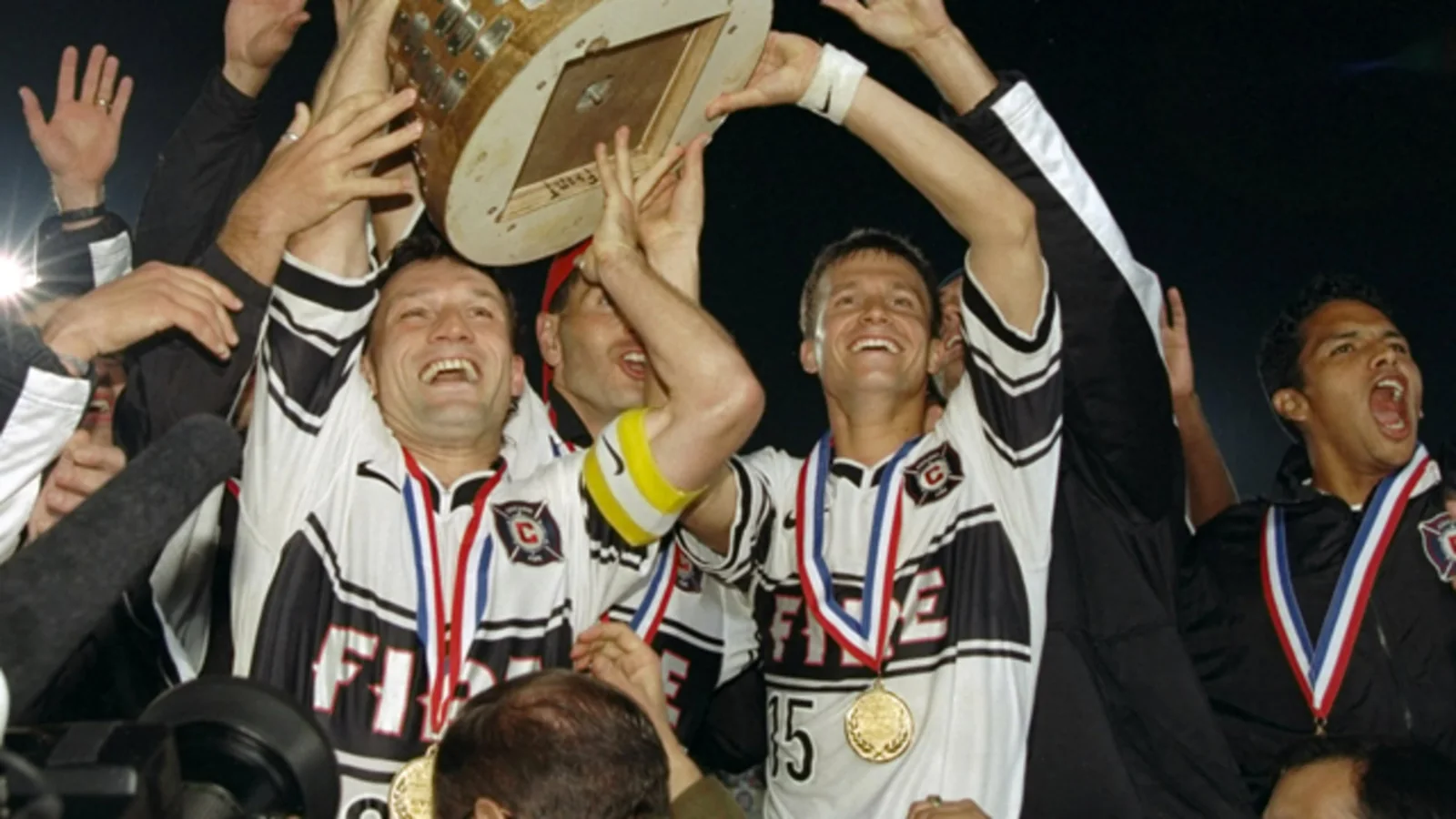
Chicago Fire FC was founded on October 8, 1997 and began MLS play in 1998. Its first season produced both MLS Cup and the U.S. Open Cup, an extraordinary beginning that still anchors the club's identity. Later cup successes, changing home grounds and repeated rebuilding efforts give the history more depth than that opening achievement alone.
This guide follows the major eras rather than listing every result. Historical trophies are identified by competition, and announced future projects remain plans. The reference date for the modern chapter is October 18, 2026.
A 1997 founding rooted in Chicago identity
The founding date was a deliberate civic reference. October 8 marked the anniversary of the Great Chicago Fire of 1871, and the new soccer club adopted the Fire name when it was introduced in 1997. The official retrospective describes the unveiling at Navy Pier, with general manager Peter Wilt involved in keeping the name under wraps before the announcement. The connection to Chicago history came before the team had played a competitive match.
That explains a common discrepancy in short club summaries. “Founded in 1997” describes the institution's launch; “inaugural season in 1998” describes its first year on the field. Both can be correct. Replacing one with the other removes a stage of the story and makes later anniversary dates confusing. A club can organize its identity, people and preparations before appearing in the league calendar.
The name belongs to a soccer organization, so searches need that context. Chicago Fire can also refer to the historical disaster, the city's fire service or entertainment using the same words. Adding MLS, FC or a player's name helps identify the sporting subject. The historical connection is commemorative; it should not be read as a claim that the club is a department of the city or an extension of a television production.
Chicago's introduction also came early in MLS history. The league had started in 1996, and the Fire's arrival belonged to its first expansion period. That made the challenge different from joining a mature competition decades later. The club had to establish a team while the wider league was still developing its own habits, audience and competitive standards.
Anniversary observances have kept the founding story visible through later changes. The club's 2021 celebration connected a new crest launch with the Great Fire's 150th anniversary and the soccer organization's own founding date. That does not make every design decision universally popular; it shows why October 8 remains an important reference when supporters talk about the institution.
Keep that civic foundation in mind when moving to the sporting history. Results explain what a team achieved, while a name, anniversary and community explain some of the framework in which supporters remember it. The Fire's first league season soon supplied something more immediate: a group of players capable of turning a newly announced identity into a championship-winning side.
The 1998 expansion team won an immediate double
Bob Bradley's first Fire team combined experienced international players with a strong group of domestic professionals. Peter Nowak, Luboš Kubík, Chris Armas, C.J. Brown, Zach Thornton and their teammates helped turn a new squad into a competitive unit. The club's oral history emphasizes veteran leadership and shared focus; the results show how quickly that group learned to win important games.
Chicago initially competed in the Western Conference. Its 1998 playoff route passed through Colorado and the LA Galaxy before reaching the final against D.C. United. That conference placement can surprise readers familiar only with the Fire's current Eastern Conference setting. League structures change, so historical brackets should be read under the rules and geography of their own season.
The MLS Cup breakthrough
On October 25, 1998, Chicago beat D.C. United 2–0 at the Rose Bowl to win MLS Cup. Jerzy Podbrożny and Diego Gutiérrez supplied the goals, with Nowak central to the attacking sequences and Thornton protecting the advantage. D.C. had won the league's first two championships, making the expansion team's victory a direct interruption of the competition's opening dynasty.
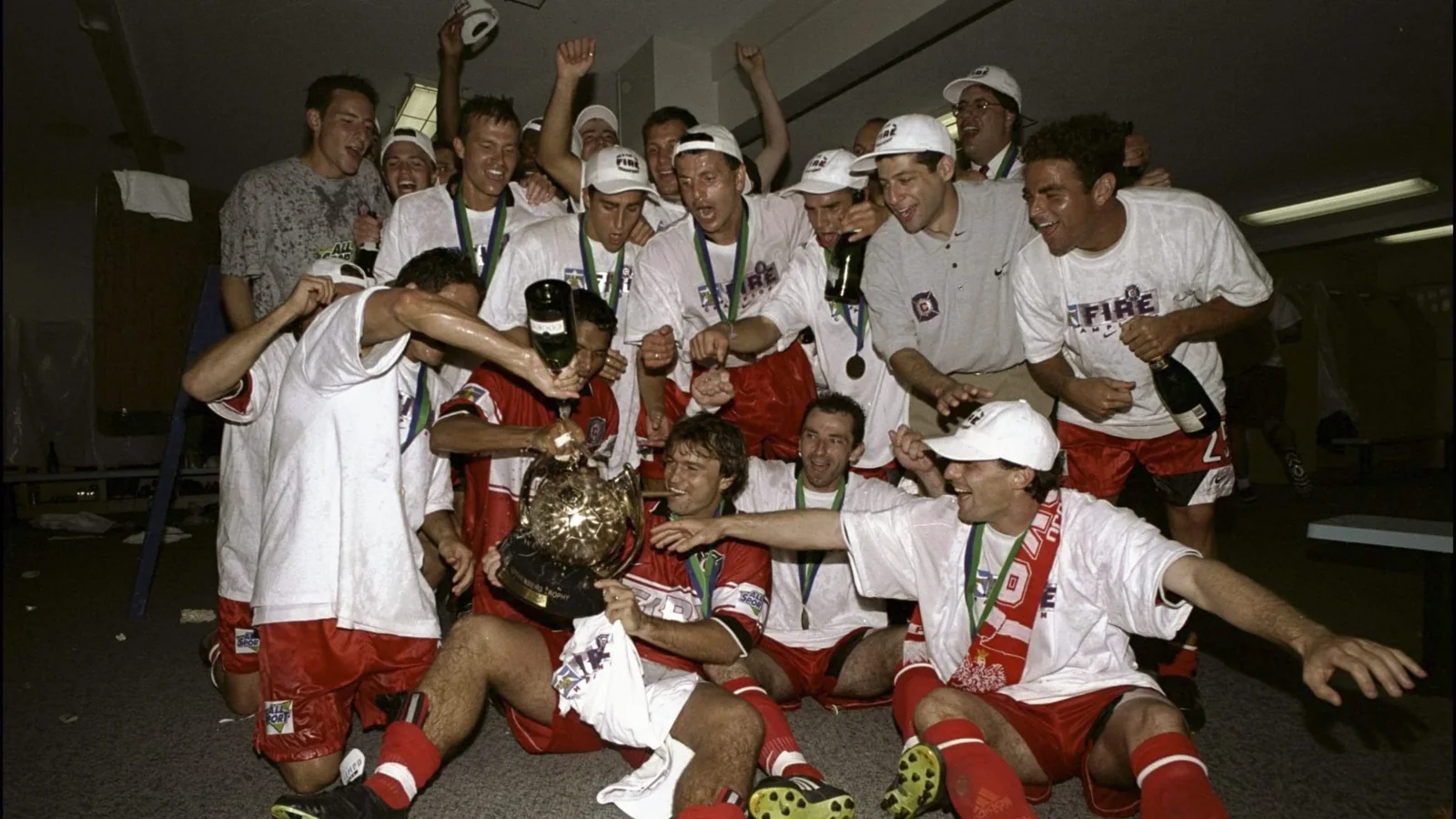
The achievement was remarkable because it belonged to an expansion season, not because winning a single match proves an organization had solved every future problem. It created an enduring standard immediately. Supporters did not have to wait through years of near misses before seeing a trophy, and later rebuilding periods would be measured against a beginning that was unusually successful.
A second trophy in the U.S. Open Cup
The season was still unfinished after the Rose Bowl celebrations. Five days later, Chicago faced Columbus in the U.S. Open Cup final at Soldier Field. Podbrożny's penalty gave the Fire the lead, Stern John equalized and substitute Frank Klopas delivered the extra-time winner. The final supplied a home-city celebration to accompany the league championship won in California.
The two trophies came from different competitions. MLS Cup decided the league's postseason champion; the Open Cup was a separate national knockout tournament. Calling the achievement a double preserves that distinction. It should not be retold as two MLS Cups or as a Supporters' Shield, which the Fire had not won in that opening season.
The oral history adds texture that a trophy table cannot: players had to recover from travel, refocus after celebrating and adapt during another demanding final. Those recollections help explain how participants remember the achievement. They should remain recollections, rather than being turned into invented dialogue or a simple claim that one tactical choice alone caused the result. The enduring fact is the completed first-season double, with separate opponents, venues and competitive demands.
The early 2000s extended the trophy era
The Fire continued to collect trophies after 1998. Their major domestic honors establish why the club's early history cannot be reduced to one surprise postseason. Further Open Cup victories and a Supporters' Shield extended the winning era, even though another MLS Cup title did not follow. The table separates the competitions so the achievements can be understood on their own terms.
| Competition | Fire winning seasons | What it recognizes |
|---|---|---|
| MLS Cup | 1998 | The league's postseason championship. |
| U.S. Open Cup | 1998, 2000, 2003, 2006 | A separate national knockout tournament. |
| Supporters' Shield | 2003 | The best MLS regular-season record. |
The 2000 team reached MLS Cup again, losing 1–0 to the Kansas City Wizards at RFK Stadium. That is an important near miss rather than an additional championship. In a club history, reaching a final says something about competitiveness even when the trophy goes elsewhere. In a winners list, however, it belongs in a different column. The distinction keeps a strong era from being inflated or dismissed.
In 2003, Chicago won the Shield and Open Cup while also reaching the MLS Cup final. San Jose won that final 4–2. The season therefore combined sustained league performance, knockout success and postseason disappointment. It offers a particularly clear example of why a single label such as “champion” is not enough unless the competition is named.
The 2006 Open Cup became another major reference point. It reinforced the tournament's place in Fire memory and extended the list of cup-winning seasons beyond the original group's opening triumph. An article written in an earlier period may call Chicago the competition's leading MLS club; that comparison needs a date because other clubs continue to play and win. The title years themselves are stable historical facts.
These early achievements created an unusually demanding inheritance. Later squads could be judged against both a first-year double and a longer period when trophies and finals were recurring possibilities. That does not mean every subsequent team should be described only as a failure to reproduce the past. It does explain why supporters often treat the Open Cup and the club's early standards as central parts of the institution.
For a league-wide comparison, the MLS Cup winners list places Chicago's 1998 title alongside other champions. Here, the important transition is from building that trophy record to maintaining an identity through new personnel, changing venues and less consistently successful periods. The physical setting of the club soon became a significant part of that story.
Stadium moves changed the setting of the club
The Fire's home-ground history is not a straight line from one stadium to another. It includes a temporary relocation, a soccer-specific suburban home and a return to Soldier Field, followed by an announced new project within Chicago. These changes explain why different generations of supporters associate the same club with different approaches, stands and matchday routines.
Soldier Field, Naperville and Bridgeview
Soldier Field was the club's original primary home. During its renovation period, the Fire played in Naperville at Cardinal Stadium in 2002 and 2003. That was an interlude in the Soldier Field era, not the opening of the later Bridgeview ground. Keeping the two moves separate makes historical venue references much easier to follow.
In June 2006, Chicago played its first match in Bridgeview, beginning the era associated with Toyota Park and, later, SeatGeek Stadium. Those sponsor names refer to the same venue. A name change on an old match report does not necessarily mean the club relocated again. Match dates and the physical location are more reliable guides to the chronology than sponsor names alone.
A soccer-specific home gave supporters a different setting from the large shared stadium where the club began. It also required a different journey for many visitors. Those are meaningful parts of club memory, but they should not become an automatic explanation for every result during the period. Stadium design, travel and competitive performance are connected aspects of an institution, not a simple cause-and-effect formula.
The return to the city and a future stadium plan
The Fire returned to Soldier Field for the 2020 season. The return changed the central location of its home-match operation again and became part of a broader modern reset. It did not erase the Bridgeview years or make historical achievements there belong to a different club. The organizational history continues across the venues.
A further chapter is now under construction. Chicago officially broke ground on its privately funded soccer stadium at The 78 in the South Loop on March 3, 2026. The club's current project presentation calls the venue McDonald's Park and states an expected spring 2028 opening. That is an announced future home, not an operating stadium available for a 2026 visit.
Project milestones should be described at the level confirmed: announcement, groundbreaking, construction and expected opening. An expected date is not a guarantee that every later fixture has already been assigned there. A visitor should still verify the named venue for an actual match, including any alternative site used for an individual event.
The full sequence helps explain the emotional importance of the next ground. The Fire have already carried their identity through several settings. A new stadium can provide another place to gather, but the meaning of that place will develop through the matches, people and routines it hosts. Historical continuity comes from remembering the earlier homes alongside the ambition for the next one.
Continuity, rebuilding and the next Fire chapter
Joe Mansueto became the Fire's sole owner and chairman in September 2019 after acquiring Andrew Hauptman's controlling interest. That ownership change belongs beside the return to Soldier Field when describing the modern reset. It should not be confused with the club's original founding: new ownership changed the leadership of the existing institution rather than creating a new expansion team.
Visual identity became another important part of the period. The club unveiled a new crest in June 2021 following a process that invited extensive supporter input, with the design entering the kit cycle for 2022. The dates matter because an announcement, merchandise launch and first use on a season's playing shirts can occur at different times. Older photographs remain part of Fire history even when their badge differs from the current one.
These changes show why club identity involves more than the result of the latest match. A crest, a color, a founding anniversary and a familiar gathering place can carry meaning across different squads. That does not mean every supporter interprets every change identically. A careful history can record the process and its timing without claiming unanimous approval or reducing a complex relationship to a marketing statement.
The sporting rebuild gained another major appointment in October 2024, when Gregg Berhalter was named Director of Football and Head Coach. The combined title describes the role the club announced. Its success must be assessed through later sporting evidence, rather than treating a prominent appointment as a trophy already won. The same principle applies to new players and facilities: they form part of a project whose results still need to be played.
For a present-day view, use the MLS standings and current match reports alongside this chronology. A live table answers where the Fire stand now; the history explains why supporters recognize particular dates, names and competitions. Mixing those purposes can turn an old statistic into an apparent current total or make an unfinished season sound like a completed era.
The clearest way to carry the history forward is to keep its layers visible. The 1997 founding established the civic identity. The 1998 double supplied an immediate sporting standard. The early 2000s added cups, a Shield and near misses. Later moves and rebuilding efforts changed the setting and leadership, while the planned South Loop ground offers another future home. Each chapter belongs to the same club, and the next one will be defined by confirmed milestones and actual matches rather than the scale of its promises.
Comments
Comments are reviewed before publication.
Spam, abusive content, personal information and policy-violating links are not published.
Sign in with Google to comment or reply.
Loading comments…