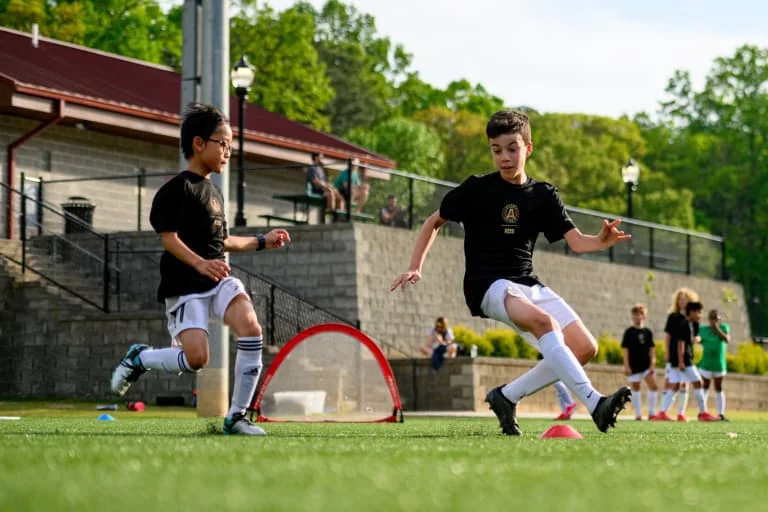
Searching for Atlanta United Academy tryouts in 2026 can lead to several different programs. The most important first step is to identify the program behind the registration link. Atlanta United's Regional Development School, Futures program and Academy are connected parts of a development environment, but they have different entry processes and commitments.
Checked on October 18, 2026, this guide explains those distinctions and gives families a practical way to choose the correct next step. The official pages reviewed do not establish a dated, currently open public Academy tryout. A listing for an RDS tryout should therefore be understood as an RDS opportunity, with its own selection process.
What an Atlanta United Academy tryout search actually leads to
Atlanta United describes its Academy as a pathway for players with the potential, ability and desire to progress toward the first team. Its development page also recognizes college opportunities. That is a long-term development purpose, rather than a promise that completing a registration form places a player on an Academy roster.
RDS is a tryout-based training program that supplements a player's existing environment. Futures provides another selected development opportunity, with invitations coming through Atlanta United's Academy scouting department. Those distinctions help explain why the same search results can include open program information, tryout registration pages and invitation-based opportunities.
For a family, three questions should come before making a payment or arranging travel. What exact program is being offered? What decision does this session actually make? What commitment follows acceptance? A session selecting an RDS training group answers a different question from an assessment concerning an Academy place, even if both involve Atlanta United coaches and promising players.
A year in the search title does not answer those questions. An old registration page can remain visible after its event has finished, while a general program page may describe a recurring structure without confirming a particular session's capacity. Read the event details and follow the current links from the club's official youth pages.
This matters especially when the word “tryout” is used loosely. It can describe selection for additional training, a club-team evaluation or an invitation to be observed. Use the organizer's precise program name when asking a question. Saying that you want to understand an RDS location's next evaluation is more actionable than asking generally how to join Atlanta United.
The useful goal is to find a suitable development opportunity and understand what it offers now. Academy interest may be a longer-term ambition, but it should not obscure whether the immediate program fits the player's age, level, existing team and weekly schedule. The following comparisons make that choice clearer.
Choose the right Atlanta United development program
The programs should be compared by their immediate purpose and entry process. A younger player seeking additional technical work needs a different opportunity from an older player already competing in an advanced team environment. The Atlanta United badge connects the programs, but it does not make every session interchangeable.
RDS provides additional training after a tryout
The Regional Development School is aimed at advanced players and adds training alongside their existing teams. The main RDS page describes weekly ninety-minute sessions, with eight-week fall and spring programs and shorter winter cycles. Players must try out again for each season and for the particular location they intend to attend.
The main page lists boys aged seven to fourteen and girls aged seven to sixteen, although another official promotional panel shows a different upper age for boys. Families near the boundary should confirm the specific event's birth-year eligibility with staff. A broad age range on an overview page is less precise than the age groups attached to an actual registration.
For a player already receiving useful team coaching, RDS can be evaluated as an additional training environment: the coaching, the appropriate level of challenge and the chance to work on individual skills. Acceptance means joining that program. The immediate value should be understandable even before any question about later scouting consideration arises.
Futures offers an Academy environment by selection
The Futures page describes weekly fall and spring training for selected boys aged eleven to fourteen at the Children's Healthcare of Atlanta Training Ground. Participants continue playing with their existing youth clubs. The club's FAQ identifies Futures as invitation-only, with invitations coming from the Academy scouting department.
RDS coaches can recommend players for Futures consideration, but a recommendation is not the final invitation. That separation gives families a clearer way to interpret encouraging feedback. Ask what opportunity is actually being discussed and which department communicates the next decision, rather than assuming that an informal conversation changes the player's status.
The Academy and professional pathway are later decisions
Atlanta's Academy page currently links teams at Under-13, Under-14, Under-15, Under-16 and Under-18. The club's development reporting describes connections from the Academy to Atlanta United 2 and then the first team. These are separate environments: MLS NEXT youth competition, MLS NEXT Pro with the second team, and MLS with the senior team.

The professional examples show that progression is possible; they do not supply a timetable for every participant. Some players need more development time, and the club also recognizes education and college soccer opportunities. A useful family plan keeps those possibilities visible instead of treating one selection outcome as the only meaningful measure of progress.
To see the adult team context, use the Atlanta United schedule. Watching first-team players can help a young player ask better football questions about receiving, movement and teamwork. It should complement the immediate development environment, rather than turn every youth session into a demand to imitate a professional career overnight.
How to approach an RDS registration and evaluation
Start at the official RDS page and follow its registration link. Match the location, season and birth-year group to the player before selecting an event. Because evaluation is location-specific, choosing a convenient tryout at one field does not establish eligibility for a different training location.
A practical registration check has five parts: the exact program name, eligible age group, field address, evaluation date and recurring training schedule. Compare the recurring schedule with the player's existing team commitments before registering. Getting accepted into a session you cannot attend consistently is a different problem from finding an appropriate level of training.
Save the event confirmation and read the instructions attached to it. A search snippet is too short to capture changes to arrival procedures or the event's terms. If the current listing does not answer an essential question, resolve it through the program's official contact before treating an old page as an instruction for this season.
Prepare for the session and read the payment terms
The club describes RDS tryouts as birth-year groups playing small-sided games, with players rotating for evaluation. Its equipment guidance includes suitable athletic clothing, cleats or turf shoes, shin guards and water; coaches provide the balls. Parents are asked to remain in the spectator area and avoid sideline coaching.
For the player, small-sided games reward decisions as well as isolated technique. Looking before receiving, offering a passing option and reacting when the team loses the ball are useful habits to practice. These are general football preparation ideas, rather than a published Atlanta United scoring formula or a guaranteed way to be selected.
A simple preparation session can focus on receiving and making the next pass with either foot, followed by a small game that requires decisions under pressure. The aim is to arrive ready to participate and listen. Trying to perform a spectacular action on every touch can make it harder to show how you help teammates solve the game.
The RDS page describes a $25 credit-card hold to reserve a tryout spot, with the remaining balance processed upon acceptance. That hold is not the full program price. Read the event's total charge and acceptance terms so the family understands what financial commitment follows selection. Do not assume a price or cancellation rule for a different camp applies to seasonal RDS.
Afterward, separate the family's own reflection from the organizer's decision. Discuss what the player found challenging and which actions felt comfortable, then wait for the official outcome. A useful conversation asks what was learned and what to practice next. It does not require turning every mistake into an imagined reason for the selection result.
Use player feedback without treating it as an Academy ranking
Atlanta United's player development tools describe end-of-season RDS evaluations that include strengths, areas to improve and development goals. They also contain numerical ratings. The club explicitly says those subjective scores are not used for Academy recommendations. A player card therefore should not be interpreted as an Academy admission score or a position in a scouting queue.
The written feedback is more useful when it becomes a specific next action. For example, imagine a player is asked to become more comfortable receiving under pressure. That is a hypothetical development issue, not a quotation from an Atlanta evaluation. A productive response would identify the situation: whether the player looks before the pass arrives, receives with an appropriate body position and has a next option available.
From there, the player and coach can choose a manageable practice focus. The family does not need to construct an elaborate private ranking system. It needs a clear understanding of what the player is trying to improve and an opportunity to practice that skill in a game context. Ask the coach to clarify an unfamiliar term rather than guessing what a single number means.
A short development note can have three columns: the situation, the action to try and what the player noticed afterward. For receiving under pressure, the situation might be a pass arriving with a defender close behind. The action might be checking the shoulder earlier. The observation might be whether that helped the player choose a safer first touch. These are practical examples of reflection, not official selection criteria.
Revisit the note after several appropriate opportunities instead of judging it from one isolated success. A difficult opponent or a new role can make the same action harder. Comparing the player's decisions in context is more informative than treating every changed rating as proof that the player has moved closer to or farther from an Academy place.
It is also reasonable to keep enjoyment and confidence in the conversation. The player should understand the purpose of the extra training and have room to describe what feels useful. If every session becomes a referendum on a future professional contract, the immediate learning task can disappear. A good development goal is something the player can work on now, with feedback from the coaches responsible for that environment.
Encouraging progress and a recruitment decision can both be real without being identical. Treat feedback as information for development, and treat an official invitation as communication about a particular opportunity. Keeping the two clear helps families make better decisions at each stage.
A practical next step for players and families
Choose the next action from the player's present situation. A family looking for advanced additional training can review the current RDS locations and evaluations. A family asking about Futures should read its selection information and use the club's official information form or contact. An Academy inquiry should clearly identify that purpose rather than rely on a registration link for another program.
Match the program to your actual weekly schedule
Build the calendar around the full week, including school, existing team practices, matches and travel to the proposed field. For example, an additional session that appears free on the calendar may still require a difficult journey immediately after school. Comparing realistic door-to-door times gives a better picture than counting only the ninety minutes on the pitch.
The FAQ says missed sessions cannot be made up at another location. That makes regular availability a meaningful part of the decision. If a family already knows that several dates conflict with its team schedule, it can ask about a later program cycle instead of registering first and expecting the location rules to change afterward.
Goalkeepers also need a specific location check because dedicated goalkeeper training is offered only at selected sites. A field-player program at a convenient venue may not answer the goalkeeper's development needs. Confirm the actual offering before assuming every location has the same coaching structure.
Keep the player involved in choosing the purpose. One child may want more confidence receiving the ball; another may be seeking stronger opponents; another may prefer to settle into an existing team before adding sessions. The relevant question is what the program helps the player learn, within a schedule the family can sustain.
Questions to resolve through official contacts
For RDS information and account questions, the official contact is [email protected]. The Futures page lists [email protected] and an information form. Begin from those club pages so the inquiry reaches the department responsible for the program.
A concise first inquiry can state the player's birth year, position, current playing environment, preferred location and the exact program question. For instance: the family wants to confirm whether a goalkeeper of that birth year is eligible for a named seasonal evaluation and whether acceptance commits the player to the stated weekly session. That gives staff a concrete question to answer.
Before paying, resolve any missing total price, acceptance procedure or event-specific eligibility detail. Before treating a message as an invitation, confirm which program it concerns and how the club communicates that decision. The point is to make the immediate opportunity understandable, with the player's longer-term ambition kept in proportion.
A development pathway is useful because it offers several places to learn and demonstrate progress. Start with the correct program, prepare for its actual requirements and use the resulting feedback. That gives the family a grounded next step while leaving Academy and professional decisions with the staff responsible for making them.
Comments
Comments are reviewed before publication.
Spam, abusive content, personal information and policy-violating links are not published.
Sign in with Google to comment or reply.
Loading comments…