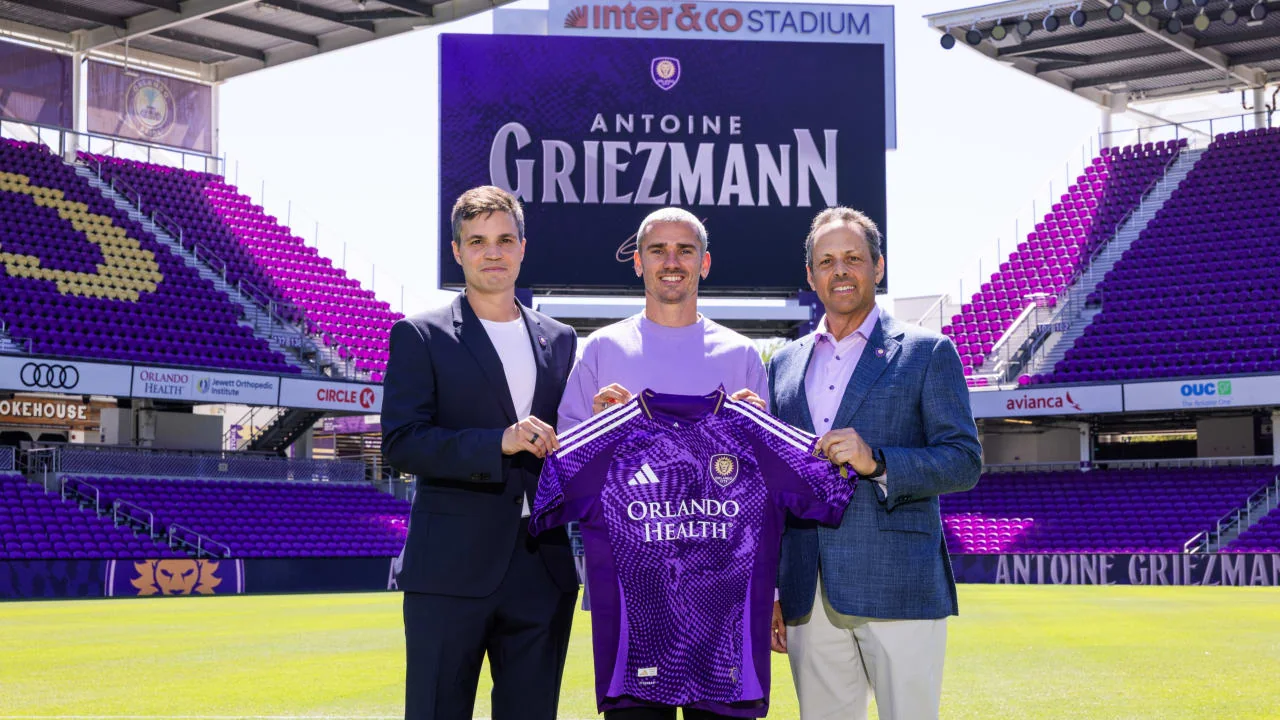
Antoine Griezmann is an Orlando City player, and his MLS story already extends well beyond the announcement that brought him from Atlético Madrid. Wearing No. 7, the French attacker has supplied goals, created chances and helped the Lions recover from a difficult first half of the 2026 season. His arrival also gives viewers an unusual opportunity to watch a World Cup winner work alongside players still establishing their professional careers.
This guide follows the confirmed move, explains his attacking role and separates the milestones that are easily mixed together. A July friendly appearance is different from an MLS debut, while an all-competition goal total is different from a league total. The information below is checked through October 11, 2026; individual statistical snapshots retain their original dates.
Griezmann's confirmed Orlando City contract and squad identity
Orlando announced Griezmann's acquisition from Atlético Madrid on March 24, 2026. The contract begins in July 2026 and runs through the 2027-28 season, with an option for 2028-29. That optional season is a contractual possibility. It should not be presented as an extension that has already been exercised.
The club announced him as a Designated Player, and its current player profile lists him in that category alongside an international designation. His squad number is 7. The same profile identifies a left-footed forward with the more specific position description of second striker. Born on March 21, 1991, he is 35 at this guide's October cutoff.
Those labels answer different questions. The number identifies him on a team sheet and shirt. The position describes where his football is organized. The Designated Player designation concerns MLS roster construction; it does not, by itself, reveal a transfer fee, annual pay figure or a promise that he will play every minute. Evaluating his contribution still requires watching the matches.
The original announcement mentioned medical clearance, an International Transfer Certificate and a P-1 visa. Those were conditions attached to the announced summer arrival. Reading that March wording today should not lead a supporter to assume that a player who has subsequently appeared in MLS is still merely a prospective signing. Transaction announcements preserve the situation at publication, while current profiles and completed match records establish his subsequent club identity.
Griezmann brings the experience of France's 2018 World Cup victory, but Orlando's investment has to be understood through the work ahead of him in purple. The useful questions are whether he receives the ball in dangerous spaces, improves a teammate's opportunity and helps his side manage decisive moments. A reputation built elsewhere explains the attention around the move; his Orlando performances explain what the signing actually produces.
The transition from Atlético Madrid to playing in Orlando
Griezmann's Orlando connection began publicly before he could play for the club. On March 23 he visited the stadium, completed signing and media activities, and toured the training facility with captain Robin Jansson. He then returned to Spain to finish his Atlético season. That sequence explains why photographs of him holding an Orlando shirt existed months before his MLS performances.
The visit also introduced the everyday setting of his next job. Inter&Co Stadium would be the public stage; Orlando Health Training Grounds at Osceola Heritage Park in Kissimmee would be where relationships and combinations developed. A transfer changes those working surroundings as much as it changes the badge on the shirt. Signing photographs record a commitment, while training and matches turn that commitment into a football partnership.
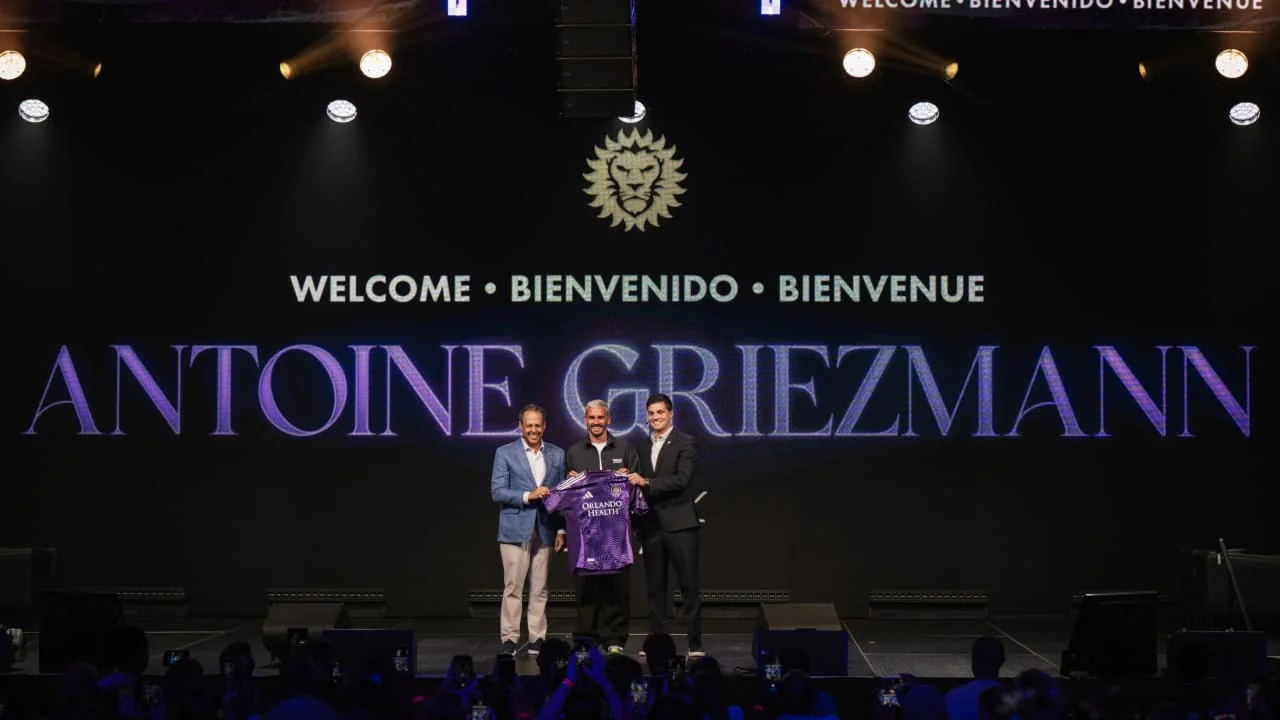
His public introduction took place at Full Sail Live on July 7. By then, the future signing had become a summer arrival whom supporters could welcome in person. The gap between March and July was part of the announced transition, rather than evidence that an agreement had fallen through. Keeping the dates in order makes older reports much easier to interpret.
Why the July friendly is separate from his MLS debut
On July 8, Orlando beat the Tampa Bay Rowdies 6-0 in a friendly held for Season Ticket Members. Griezmann supplied a goal and an assist during just over an hour on the field. His goal came in the 32nd minute, and pressure on the opposing goalkeeper helped create the chance he laid on for Iván Angulo.
That evening offered an encouraging first look at his involvement, but it did not add a goal to his MLS league record. A friendly can show movement, sharpness and understanding between teammates without carrying the same competitive stakes or statistical classification as a regular-season fixture. Anyone reconstructing his first Orlando goals should keep the Rowdies match in a separate line.
The first MLS goal followed at San Jose on July 22, when Orlando won 4-0. MLS also credited him with five key passes in that performance. His early league contribution therefore involved creation as well as scoring. It was a competitive beginning to a much larger assignment: helping a team recover points after the season's interruption. The friendly established an initial connection with home supporters; the San Jose game established his first league goal.
How a second striker fits Orlando's attacking group
The club's second-striker description is a useful starting point for watching Griezmann. It suggests an attacker whose influence can run through the space around a central forward, rather than a player judged only by how long he occupies the penalty area. In practical terms, look for the connection between receiving a pass, drawing a defender and deciding whether to shoot or release someone else.
That is a way to interpret his work, not a declaration that Orlando must use one formation throughout the season. A player's role can change with the teammates selected, the opponent's defensive line and the state of the match. His left foot matters when a shooting angle opens, but it does not confine him to a single lane.
Creating chances as well as finishing them
The October 10 win over Columbus illustrates the range. In the opening minute, Angulo reached a through ball and cut a pass back to Griezmann. Instead of treating that reception as an automatic shooting opportunity, he found Harvey Sarajian for the finish. The goal was a connected attack: a run outside, a decision inside and a teammate ready to complete the move.
Griezmann then scored from a left-footed free kick in the 16th minute. Those two contributions came through very different routes. The assist depended on recognizing another player's position during open play; the goal depended on executing a dead-ball opportunity. A highlight package of the free kick alone would miss a substantial part of his influence on that game.
For a viewer, the most revealing moment is often just before he receives possession. Is a teammate moving into a gap? Does his body position preserve both a pass and a shot? Those details help explain why chance creation and scoring can reinforce each other. They are also better evidence of fit than assuming that every prominent European attacker will perform the same task in MLS.
Working with established attackers and emerging teammates
Orlando's current squad includes fellow Designated Players Martín Ojeda and Marco Pašalić, as well as Daryl Dike, Justin Ellis and Sarajian among its forwards. Their presence supplies different selection possibilities, rather than a guaranteed combination. An official roster describes who belongs to the group; a match team sheet describes who is available and chosen that evening.
His early Orlando connections have also extended to younger players. September's Toronto win featured a first-time Griezmann finish from a delivery associated with Zakaria Taifi. In October, Sarajian converted his pass on his first MLS start while Ellis was on the bench after returning from national-team duty. These examples show how a veteran's decisions can give a developing teammate a clear action to execute. The resulting chemistry is something to observe match by match, rather than reserve exclusively for a partnership between two famous names.
A dated record of Griezmann's first MLS milestones
His first MLS brace came in Orlando's 2-1 victory over Real Salt Lake in August. The goals changed the match from a deficit into a win: a close-range equalizer in the 53rd minute, followed by the decisive finish in the 81st. MLS named him Player of the Matchday for Matchday 22 in its August 24 announcement.
A brace and an individual award are useful milestones because they describe an identifiable performance. They do not automatically establish a season-long ranking or a future trophy. The comeback also illustrates two attacking demands that a single scorer can meet: being present when a loose ball falls near goal and finding a way through defenders when the team needs a winner.
Reading the August, September and October numbers correctly
| Report date | Confirmed snapshot | How to read it |
|---|---|---|
| August 24, 2026 | Three goals and two assists in six MLS regular-season starts; 540 minutes | His first six league matches, not his complete Orlando record |
| September 13, 2026 | Scored in five consecutive games; nine goals across all competitions | The total includes competitive matches outside the MLS regular season |
| After October 10, 2026 | Nine goals and five assists in 12 MLS appearances; ten goals across all competitions | League and broader competition totals are separate measures |
The repeated number nine is a potential trap. September's nine-goal figure described all competitions, while the nine in the October league record described MLS appearances. Those statements can both be correct. A total becomes meaningful only when its date and competition scope travel with it.
The October club report also credited him with a goal contribution in eight consecutive MLS matches. A contribution can be an assist or a goal, so that streak should not be rewritten as eight consecutive games scoring. Similarly, five assists alongside nine goals describe two kinds of output; they do not tell a reader how many distinct scoring moves he influenced without examining the match records.
For evaluating the transition, these snapshots show that he moved from an early six-game sample to a longer run of contributions. The sensible next question is whether he continues producing against different opponents and in different match states. Projecting a full-season total by multiplying a short hot streak would hide changes in selection, minutes and opponent difficulty. His recorded achievements already provide a strong story without attaching an invented final total or presenting award discussion as a result that has been decided.
Orlando's turnaround belongs to the whole team
The attention around Griezmann is justified, but the October Columbus match provides a useful correction to the idea of a one-man recovery. Orlando led twice and conceded equalizers twice. The winner required a counterattack initiated after Maxime Crépeau made a major save, with Taifi, Angulo and Ojeda involved in moving the ball toward the decisive finish.
Crépeau finished with a club-record 12 saves. That figure belongs in any explanation of why Orlando collected three points. An attacker can supply a goal and an assist while his goalkeeper performs work just as important to the result. Describing only the attacking star would produce an incomplete account of how the match was won.
The defensive sequence also offers a more demanding standard for the team. If a side creates an early lead but repeatedly allows opponents back into the game, the next step is to make its attacking gains more secure. That is a tactical observation from this match, rather than a claim that one player can repair every problem. Better control can reduce the pressure on both a scorer to produce another goal and a goalkeeper to make another difficult save.
Following the October 10 win, Orlando had 37 points from an 11-13-4 record. MLS placed the Lions seventh in the Eastern Conference in its reaction report. Those are dated snapshots of a playoff push. They do not state that qualification had been clinched, and they should not be carried forward unchanged after subsequent results.
For supporters, the most promising feature is that the contributions have spread. A developing forward can finish a chance, an established creator can provide a late pass, and a wide attacker can sustain his own scoring run. Griezmann's presence can be examined within that network: which situations does he improve, and which improvements depend on someone else? That approach gives him appropriate credit while preserving the rest of Orlando's football story.
Following Griezmann through the rest of his MLS season
At the October 11 cutoff, Orlando's next announced match is away to Toronto FC at BMO Field on Wednesday, October 14. The club lists kickoff at 7:30 p.m. Eastern Time and Apple TV coverage. That is the next fixture in this dated guide, rather than a permanent answer to when Griezmann plays next.
Use the MLS games today page for the daily slate and the MLS calendar when planning further ahead. For the Toronto game, convert the stated Eastern Time to your location and recheck the current match listing before making arrangements. If a date changes, the live schedule should take precedence over an older player article.
His availability is a separate question from Orlando's kickoff time. Look for the latest club status report and then the official lineup. A starting place, a substitute place and an omission are three different outcomes, and a season roster cannot resolve them in advance. The Columbus team sheet is evidence of his selection on October 10; it does not promise the same decision for Toronto or any later game.
The MLS TV schedule helps connect fixtures to viewing information. Check the provider's current listing and account requirements for your country, particularly if you are following from outside North America. Do not assume that a previous package name, an old promotional offer or a different competition's broadcast arrangement applies to the match you want.
Finally, follow Orlando's position through the MLS standings alongside Griezmann's individual output. A useful record can be simple: opponent, competition, minutes, goals, assists and the result. Keeping those items together makes it possible to recognize progress without confusing a cup performance with a league statistic. It also keeps the most interesting question in view: how his decisions help this particular Orlando team turn attacking quality into points.
Comments
Comments are reviewed before publication.
Spam, abusive content, personal information and policy-violating links are not published.
Sign in with Google to comment or reply.
Loading comments…